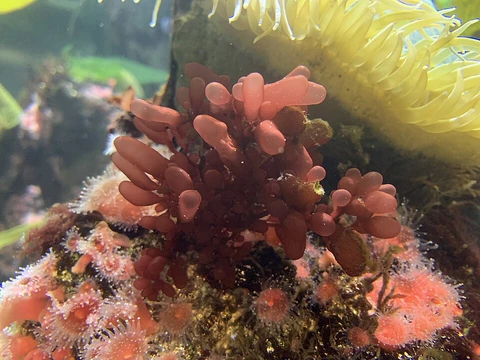
Lithophyllum orbiculatum
A pioneer coralline algae of Atlantic and Mediterranean shores.

Lithophyllum orbiculatum is a type of thalloid coralline algae, a red algae with calcium carbonate deposits in its cell walls. It is often mistaken for the very similar species *Lithophyllum crouanii*.
This algae is commonly found in the northern Atlantic Ocean and the Mediterranean Sea, with more recent collections in the Indian Ocean. It lives in mid-tide and higher level pools, sometimes exposed to air. It grows mainly on hard rock surfaces, but not on limestone or slate, and can also be found on mollusk shells in the same area, though it is physically reduced there. Over time, individuals merge to form large colonies that cover most of a surface.
Ecologically, *L. orbiculatum* acts as a pioneer species, colonizing new surfaces and preparing them for other organisms. It periodically sheds its epithallus to prevent overgrowth, though it is often overtaken by *Lithophyllum incrustans* in ecological succession.
The algae has a rough, chalky texture and ranges in color from grey to brown to pink. It is thin and attaches strongly to surfaces. Young specimens are up to 8 mm in diameter and 1 mm thick, with crimped, attenuated margins. Mature individuals reach about 25 mm in diameter, are thicker, and have irregular shapes. In areas prone to exposure, the thalli form protuberances up to 5 mm tall.
Reproduction occurs from October to February via uniporate conceptacles—cavities housing reproductive organs. The algae can be tetrasporangial, spermatangial, or carposporangial, with conceptacle size varying by type.
Quick Facts
- Genus
- Lithophyllum
- Species
- orbiculatum
Facts from the source article.
Lore & Background
Lithophyllum orbiculatum has a history of taxonomic confusion due to its close resemblance to Lithophyllum crouanii, which was often misidentified as this species. It is distributed in the north Atlantic Ocean, the Mediterranean Sea, and has more recently been collected in the Indian Ocean. The algae lives in mid-tide and higher level pools, occasionally exposed to air, and grows mostly on hard rock surfaces—not on limestone or slate—as well as on mollusk shells, though it is physically reduced on shells. Over time, individuals coalesce into large colonies that cover most of a surface.
Reader's Guide
Lithophyllum orbiculatum holds ecological significance as a pioneer species that first colonizes new surfaces, preparing them for other organisms. It sheds its epithallus periodically to prevent overgrowth, yet it is often overgrown by Lithophyllum incrustans in a process of ecological succession. Morphologically, it has a rough, chalky texture and ranges in color from grey, brown, and pink. Young specimens are thin (up to 1 mm thick) with attenuated, crimped margins and a diameter up to 8 mm; mature individuals reach about 25 mm in diameter and become thicker with irregular shapes. In areas prone to air exposure, the thalli form protuberances up to 5 mm tall. Reproduction occurs during winter (October to February) via uniporate conceptacles, which vary in size depending on whether the algae is tetrasporangial, spermatangial, or carposporangial. Its strong attachment to surfaces and calcareous cell walls contribute to its persistence in intertidal zones.
Did You Know?
- Lithophyllum orbiculatum was often misidentified as Lithophyllum crouanii due to their similarity.
- It has been collected in the Indian Ocean in addition to the Atlantic and Mediterranean.
- The algae sheds its epithallus to prevent other organisms from growing over it.
- Specimens in exposed areas can develop protuberances up to 5 mm tall.
More in Red Macroalgae and Coralline Algae 1-24
Spotted an error? Know more?
Reader corrections go straight into our review queue. Suggest an edit · How this site is sourced