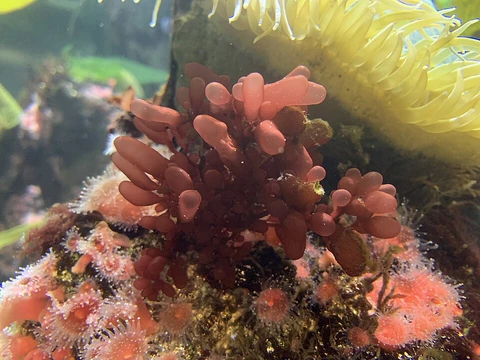
Jania (alga)
Articulated coralline alga with calcified and uncalcified segments.

Jania is a genus of red macroalgae, or seaweeds, that have hard, branching, calcareous skeletons. It belongs to the family Corallinaceae. The genus name comes from the Greek water nymph Ianeira (or Janeria), and it was first described by Jean Vincent Félix Lamouroux in 1812. Following a recent integrated taxonomic study of the genus and its tribe Janieae, all species formerly classified under *Cheilosporum* and *Haliptilon* have been moved into *Jania*. As a result, the genus now contains about 55 confirmed species.
Morphologically, *Jania* is an articulated coralline alga. It has erect thalli with branches arranged in a dichotomous pattern. These branches consist of alternating segments: red or pink, calcified, cylindrical sections (intergenicula) and white, uncalcified sections (genicula). The alga attaches to the substrate using small, stolon-like holdfasts. The intergenicula can be cylindrical, subcylindrical, or compressed, and may be smooth, winged, or lobed.
Species of *Jania* are widely distributed around the world. Ecologically, they are found in sheltered reef habitats, often in crevices or shaded areas. They can grow on rock (epilithic) or on other plants (epiphytic), and may also form free-living clumps known as articuliths.
Like most red seaweeds, *Jania* has a triphasic life cycle. In addition to the free-living haploid (gametophyte) and diploid (tetrasporophyte) generations, there is a parasitic diploid generation called the carposporophyte. The tetrasporophyte releases four haploid spores (tetraspores), which develop into male or female gametophytes. A spermatium from the male gametophyte is trapped by the trichogyne of the female gametophyte’s carpogonium; they fuse to form a zygote, which develops into the carposporophyte. The carposporophyte then produces diploid carpospores, which grow into the tetrasporophyte. A key reproductive structure in coralline algae is the conceptacle, a calcified depression where tetrasporangia, spermatangia, and carposporangia form.
There is no known cultivation technology for this genus. In terms of chemical composition, priming tomato seeds with polysaccharides from *Jania* has been shown to greatly improve seedling resistance to soil-borne pathogens and promote plant growth. Despite this potential agricultural use, *Jania* is not currently commercially utilized due to a lack of interest in the genus.
Quick Facts
- Taxon
- Jania
Facts from the source article.
Lore & Background
The genus name Jania is derived from the Greek water nymph Ianeira (or Janeria). It was first circumscribed by Jean Vincent Félix Lamouroux in 1812. Based on a recent integrated taxonomic examination of the genus and its tribe Janieae, members of Cheilosporum and Haliptilon have all been transferred under Jania, resulting in around 55 confirmed species. Morphologically, Jania is an articulated coralline alga with erect thalli bearing dichotomously arranged branches. These branches consist of alternating segments: red or pink, calcified, cylindrical sections (intergenicula) and white uncalcified sections (genicula). The alga attaches to substrates via small, stolon-like holdfasts. Intergenicula can be cylindrical, subcylindrical, or compressed, and may be smooth, winged, or lobed. Jania species are well-distributed throughout the world. Ecologically, they are found in sheltered reef habitats, often in crevices or shaded areas, and can be epilithic, epiphytic, or form free-living clumps called articuliths.
Reader's Guide
Jania's significance lies in its unique morphology as an articulated coralline alga, with alternating calcified and uncalcified segments that distinguish it from other red macroalgae. Its recent taxonomic revision, which absorbed Cheilosporum and Haliptilon, has expanded the genus to about 55 species, reflecting ongoing refinement in coralline systematics. The genus exhibits a triphasic life cycle typical of red seaweeds, involving haploid gametophytes, diploid tetrasporophytes, and a parasitic carposporophyte generation. Reproduction occurs within conceptacles, calcified depressions that house tetrasporangia, spermatangia, and carposporangia. While no cultivation technology exists for Jania, its polysaccharides have shown potential in priming tomato seeds to improve resistance to soil-borne pathogens and promote plant growth. Despite this agricultural promise, the genus is not currently commercially utilized due to a lack of interest. Its global distribution and ability to form free-living articuliths further highlight its ecological versatility.
Did You Know?
- Jania is named after the Greek water nymph Ianeira (or Janeria).
- Members of Cheilosporum and Haliptilon have been transferred into Jania, bringing the confirmed species count to about 55.
- Jania polysaccharides have been shown to improve tomato seedling resistance to soil-borne pathogens.
More in Red Macroalgae and Coralline Algae 1-24
Spotted an error? Know more?
Reader corrections go straight into our review queue. Suggest an edit · How this site is sourced