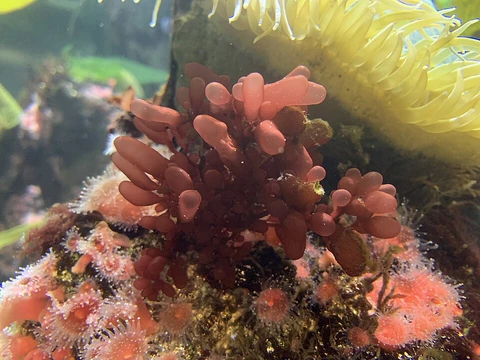
Corallinaceae
One of two extant coralline red algae families.

The Corallinaceae constitute one of the two living families of coralline red algae. They differ from the similar-looking Sporolithaceae because they produce sporangial chambers that are grouped together into clusters called sori. Within the family, the subfamily Corallinoideae is monophyletic, while all the other subfamilies together form a separate monophyletic group. The genera recognized by the World Register of Marine Species are listed below by subfamily.
Quick Facts
- Taxon
- Corallinaceae
Facts from the source article.
Lore & Background
The Corallinaceae are defined by their grouped sporangial chambers, which are clustered into sori, a feature that separates them from the Sporolithaceae. The family is divided into several subfamilies, including Amphiroideae, Corallinoideae, Lithophylloideae, Mastophoroideae, and Metagoniolithoideae, as well as a number of unassigned genera. The Corallinoideae is noted as monophyletic, while the other subfamilies together form another monophyletic group, indicating a clear evolutionary split within the family.
Reader's Guide
The Corallinaceae are significant as one of only two extant families of coralline red algae, a group important for their role in marine ecosystems, particularly in reef building and as habitat formers. Their classification hinges on the reproductive structure of grouped sporangial chambers in sori, a key diagnostic trait. The family's internal phylogeny shows a clear monophyletic split between the Corallinoideae and the other subfamilies, which together form another monophyletic lineage. The World Register of Marine Species lists numerous genera across five subfamilies and several unassigned genera, reflecting the diversity within the family. This taxonomic framework provides a basis for understanding coralline algal evolution and biodiversity.
Did You Know?
- The Corallinaceae are one of the two extant coralline families of red algae.
- They are differentiated from Sporolithaceae by grouped sporangial chambers clustered into sori.
- The subfamily Corallinoideae is monophyletic.
- The other subfamilies of Corallinaceae form another monophyletic group.
More in Red Macroalgae and Coralline Algae 1-24
Spotted an error? Know more?
Reader corrections go straight into our review queue. Suggest an edit · How this site is sourced