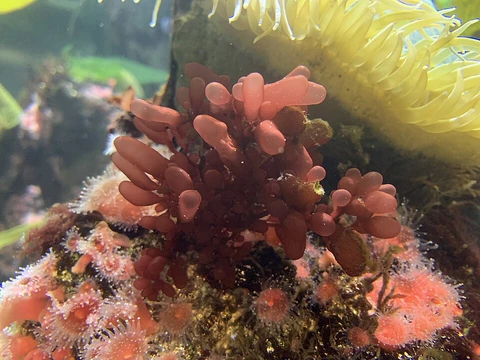
Corallina officinalis
A calcified red seaweed that strengthens its thallus with calcium carbonate.

Corallina officinalis is a type of red seaweed that builds calcium carbonate inside its cells, making its body stronger. This calcification gives the seaweed a pink colour, with white patches where the deposits are thickest, such as at the growing tips. Because it is so chalky, most grazers on the rocky shore find it unappetising.
This seaweed grows firmly attached to rock, forming tufts up to 120 millimetres long. Its fronds are made of jointed, cylindrical stalks that look like a string of beads, with segments that are slightly longer than wide near the base and become larger and more wedge-shaped higher up. The fronds branch in opposite pairs and have a pinkish hue, though they can bleach white in sunlight.
Male and female reproductive structures appear on separate plants as small, chalky nodules.
Corallina officinalis is found in the lower and middle parts of the shore, especially around the rims of tide pools and in shallow crevices that are regularly washed by seawater. It grows best on the lower shore where fucoid algae are absent, but also occurs higher up on exposed coasts. It can live from the mid-littoral zone down to a depth of 33 metres, and it often grows on rocks, sometimes on shells or other algae. Its dense tufts provide a home for many small animals that feed on microorganisms living there.
This species is common on solid rock around Great Britain, Ireland, and the Isle of Man. It is also recorded along the North Atlantic coast from northern Norway to Morocco, and intermittently from Greenland to Argentina. Additionally, it appears in the USA, Argentina, and parts of Japan, China, Australia, and New Zealand. In New Zealand, it is found in the intertidal zone of the Kermadec Islands, the North, South, Chatham, and Stewart Islands, as well as the Antipodes and Auckland Islands.
Quick Facts
- Genus
- Corallina
- Species
- officinalis
Facts from the source article.
Lore & Background
The thallus of Corallina officinalis is firmly attached to rock and grows in tufts up to 120 mm long. It has articulated pinnate branching with successive opposite lateral branches. Each frond consists of cylindrical calcified stipes showing segments a little longer than broad, rising from a crustose base like a string of beads, becoming larger and more wedge-shaped higher up the stipe. The fronds are pinkish in colour and may bleach to white when exposed to sunlight. The sexes exist on separate plants and appear as small chalky nodules.
Reader's Guide
Corallina officinalis is primarily found growing around the rims of tide pools and in shallow crevices on rocky shores that are regularly refreshed with sea water. It predominantly grows on the lower shore, especially where fucoid algae are absent, but is also found further up shore on exposed coasts. It provides a habitat for many small animals that feed on microorganisms dwelling in its dense tufts. The calcium carbonate deposits within its cells make it unpalatable to most rocky shore grazers, contributing to its persistence in intertidal communities. Its distribution is broad, recorded from the North Atlantic coast, Greenland to Argentina, and parts of the Pacific including Japan, China, Australia, and New Zealand. In New Zealand, it occurs on the intertidal zone of the Kermadec Islands, the North, South, Chatham, Stewart, Antipodes, and Auckland Islands.
Did You Know?
- Corallina officinalis forms calcium carbonate deposits within its cells, making it unpalatable to most rocky shore grazers.
- The thallus can grow to a length of 120 mm and has articulated pinnate branching.
- It is found from mid-littoral zones to depths of 33 m.
More in Red Macroalgae and Coralline Algae 1-24
Spotted an error? Know more?
Reader corrections go straight into our review queue. Suggest an edit · How this site is sourced