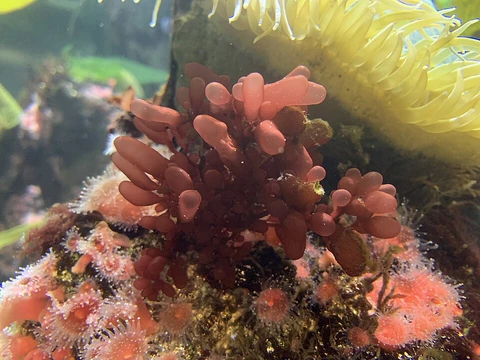
Amphiroa beauvoisii
A widely distributed coralline alga with fan-like branching planes.

Amphiroa beauvoisii is a red alga belonging to the Corallinaceae family, with a thallus structure. It has a global distribution and typically grows on rocks in the intertidal zone. The organism starts from a calcified, crust-like base that anchors it to the rock surface. From this base, erect branches emerge that can reach up to 85 mm in length. These branches are composed of alternating calcified segments (intergenicula) and non-calcified segments (genicula), and they spread out in a fan-like plane roughly 30 mm tall. Branching usually occurs in two directions, though three or four branches are possible but rare.
The intergenicula are generally flat, though they may be more rounded near the base. Their width stays fairly consistent along the branch, measuring 3–6.5 mm long, 1–3.5 mm wide, and 300–400 mm thick. In some cases, they widen toward the tips. Inside the core of the alga, filaments contain one to four arched rows of larger cells (45–85 μm long) alternating with a single row of shorter cells (6–40 μm long). In the outer periphery, these filaments lack any regular row arrangement. Genicula typically appear at branch splits or within 2 mm of a split. Although the genicula themselves are not calcified, the filaments around them remain calcified, which eventually causes these filaments to crack and fall off, sometimes leaving calcified spurs. Mature genicula consist of at least five rows of thick-walled cells, and the transition from genicula to intergenicula happens between these cell layers.
Reproductive structures called conceptacles are scattered across the surface of the intergenicula’s periphery. Each conceptacle has a single pore, is 220–330 μm wide, and protrudes 85–140 μm above the surface. They are surrounded by block-like cells that may shrink over time, creating a moat-like depression around the raised conceptacle. Inside the conceptacles, several types of sporangia occur. Tetrasporangia form around a central column of long sterile cells and are found in conceptacles with flat floors, arranged in groups of four per conceptacle. Carposporangial conceptacles have a warty, oblong shape, and their carposporangia feature superficial gonimoblast filaments.
Under a scanning electron microscope, the cell outlines on the intergenicula surface are clearly visible. Calcified ridges 3–9 μm wide split into two narrower ridges at the middle lamella.
Quick Facts
- Genus
- Amphiroa
- Species
- beauvoisii
Facts from the source article.
Lore & Background
Jean Vincent Lamouroux provided the original description for Amphiroa beauvoisii in 1816, naming it after the entomologist Palisot de Beauvois. The holotype was collected from the coast of Portugal and donated to the Lamouroux herbarium. The species has several illegitimate names, including Amphiroa belvisii introduced by Lamouroux himself in 1824, and many heterotypic synonyms such as A. algeriensis, A. brasiliana, and A. zonata. Later studies revealed that A. exilis, once considered a synonym, is a distinct but closely related species.
The organism grows on rock surfaces, attached by a calcified crustose base. Erect axes branch in a fan-like plane, composed of alternating calcified intergenicula and non-calcified genicula. Intergenicula are usually flat and measure 3–6.5 mm long. Genicula typically occur where branches split. Conceptacles containing reproductive sporangia are scattered on the surface of intergenicula, each with a single pore. The species is very similar to A. anceps, A. gracilis, and A. klochkovana, but can be differentiated by its compressed intergenicula and the absence of decalcified peripheral cells in its genicula.
Reader's Guide
Amphiroa beauvoisii is notable for its extremely wide distribution across tropical and subtropical regions, including the Mediterranean, Indian Ocean, Gulf of California, Caribbean, and South African coast, with more recent records from temperate Australian waters. Its life cycle varies geographically: in subtropical climates, tetrasporangial, bisporangial, and gametangial specimens have been found; in tropical regions, proportions differ by location, with some populations showing only tetrasporangial and bisporangial forms. In Australian populations, tetrasporangial forms are common, while gametangial and carposporangial forms have not been recorded. The species reproduces both through germinating spores and by regrowing the holdfast. Its morphology and reproductive behavior change seasonally, influenced by factors beyond just temperature. The species has been tested for bioactive properties, though details are not provided in the source. Its taxonomic history includes numerous misidentifications and illegitimate names, reflecting the challenges of distinguishing it from similar Amphiroa species.
Did You Know?
- The species was named after Palisot de Beauvois, an 18th-century French entomologist and biologist.
- Its holotype was collected from the coast of Portugal by an unknown collector.
- In Australian populations, only tetrasporangial forms have been recorded; gametangial and carposporangial forms have not been found.
- The genicula are non-calcified, but the filaments associated with them remain calcified and eventually crack off.
More in Red Macroalgae and Coralline Algae 1-24
Spotted an error? Know more?
Reader corrections go straight into our review queue. Suggest an edit · How this site is sourced