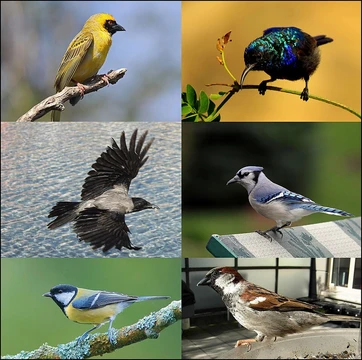
Yellow-breasted chat
A large, skulking songbird with a variable, mimicking song.

The yellow-breasted chat (Icteria virens) is a sizable songbird that lives in North and Central America. It stands alone in its own family, Icteriidae, after being reclassified from the New World warbler family Parulidae in 2017. Sometimes it is still grouped with the New World blackbird family, Icteridae, which has a confusingly similar name.
Carl Linnaeus first described this bird in 1758, placing it with thrushes under the name *Turdus virens*. He based his description on Mark Catesby’s earlier account of the "yellow brested chat." The species now belongs to the genus *Icteria*, introduced in 1808 by Louis Pierre Vieillot, and to the family Icteriidae, coined by Spencer Baird in 1865. Though once considered the largest warbler, genetic studies moved it to its own family. Research shows Icteriidae and Icteridae are each other’s closest relatives, and a 2019 study placed the chat as sister to Icteridae, not within it. Phylogenomic studies reveal that Parulidae warblers are sister to Icteridae, while Icteriidae is sister to that combined clade.
Measuring 17 to 19.1 cm long with a wingspan of 23 to 27 cm, the chat weighs 20.2 to 33.8 g. It has olive upperparts, a white belly, and a bright yellow throat and breast. Large white eye rings and blackish legs are distinctive. Its song is a strange mix of cackles, clucks, whistles, and hoots, and it sometimes mimics other birds. Its call is a harsh *chak*. During breeding season, it sings from exposed spots and flies in the open while gurgling.
This shy, skulking bird is more often heard than seen. It breeds from southern Canada to central Mexico, wintering mainly in Mexico and Central America, though some stay farther north along coasts. It favors dense shrubbery, often in abandoned farmland or overgrown rural areas.
The nest is a bulky cup of grasses, leaves, bark, and weed stems, lined with finer materials, placed about 2.5 m up in thick shrubs. Females lay three to five creamy-white eggs with reddish-brown speckles, incubating them for 11 to 12 days. Both parents feed the young, which fledge in 8 to 11 days. Chats guard their nests well, so brown-headed cowbird parasitism is less common than in other cup-nesters. They are not very monogamous; a Kentucky study found 17% of nestlings came from outside the social pair.
Chats are omnivorous, foraging in dense cover for insects and berries.
Quick Facts
- Genus
- Icteria
- Species
- virens
Facts from the source article.
Lore & Background
The yellow-breasted chat was formally described by Carl Linnaeus in 1758, who placed it in the genus Turdus. It was later moved to the genus Icteria by Louis Pierre Vieillot in 1808. Its taxonomic history is complex: formerly considered the largest member of the Parulidae, it was reclassified into its own family Icteriidae in 2017. However, a 2019 analysis placed the chat as sister to Icteridae, not within it, and phylogenomic work shows Parulidae as sister to Icteridae, with Icteriidae sister to that combined clade.
The species is shy and skulking, often heard but not seen. Its song is an odd mix of cackles, clucks, whistles, and hoots, and it mimics other birds, sometimes confusing birdwatchers.
Reader's Guide
The yellow-breasted chat holds significance as a taxonomic puzzle, illustrating the fluid nature of avian classification. Its reclassification from the Parulidae to the monotypic Icteriidae in 2017, and its occasional placement in the Icteridae, highlights how molecular phylogenetics can overturn traditional groupings. The species also serves as an example of a bird that, despite being a cup-nest builder, experiences less brood parasitism by brown-headed cowbirds than similar species, possibly due to vigilant nest guarding. Its declining population in eastern North America due to habitat loss underscores the impact of deforestation and urban development. The chat's ability to mimic other birds and its unusually large size for a former warbler make it a distinctive subject for ornithological study. Its wide range and least-concern status globally suggest resilience, but regional declines warrant continued monitoring.
Did You Know?
- The yellow-breasted chat was originally described by Carl Linnaeus in 1758 as Turdus virens.
- It is the only species in the family Icteriidae, which was introduced by Spencer Baird in 1858.
- The species can weigh more than twice as much as other New World warblers.
- In a study in central Kentucky, 17% of nestlings were not sired by the social male.
Frequently Asked Questions
Who is Yellow-breasted chat?
Yellow-breasted chat (Icteria virens) is a medium-sized songbird native to North and Central America, first formally described by Carl Linnaeus in 1758. It measures roughly 17 to 19 centimeters in length and weighs between 20 and 34 grams.
What is Yellow-breasted chat's role in the ecosystem?
As a skulking, ground-foraging insectivore, the yellow-breasted chat helps regulate invertebrate populations in dense undergrowth and wetland thickets. Its loud, variable, and imitative song also serves as a territorial signal, often echoing the calls of other species.
Why is Yellow-breasted chat important to bird taxonomy?
The yellow-breasted chat is the sole member of its own family, Icteriidae, making it a monotypic lineage that was reclassified out of the New World warbler family (Parulidae) in 2017. This solitary status makes it a key reference point for understanding passerine evolutionary relationships.
What are Yellow-breasted chat's signature 'powers'?
Its most celebrated trait is a complex, variable song that incorporates imitations of other birds' calls, giving the impression of a small chorus. Combined with its secretive, skulking behavior in dense vegetation, it earned the common name 'chat' for its restless, chattering demeanor.
More in Passeriformes 1-20
Spotted an error? Know more?
Reader corrections go straight into our review queue. Suggest an edit · How this site is sourced