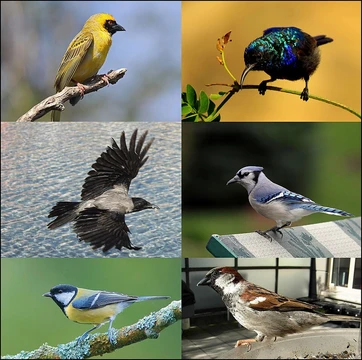
Eupasserine
True passerines, comprising all passerines except New Zealand wrens.

Eupasserines are passerines belonging to the clade Eupasseres, which includes all passerine birds except the New Zealand wrens (Acanthisitti). The term derives from the prefix 'eu-', meaning 'true' or 'genuine', and 'passeres', referring to passerines, thus meaning 'true passerines' as an exception to the ancient lineage of Acanthisitti. They contain all families of passerine but one, Acanthisittidae, and all species except the six recognized New Zealand wrens.
Quick Facts
- Taxon
- Eupasseres
Facts from the source article.
Lore & Background
Eupasserines are divided into two major groups: the suboscines (Tyranni) and the songbirds (Oscines or Passeri). Suboscines have different syrinx structures than songbirds and include the Old World suboscines and the American Sapayoa in infraorder Eurylamides, while all other suboscines, exclusively in the New World, are in infraorder Tyrannides. The suboscines consist of around 1,100–1,200 species and 16 families, with the largest bird family being the tyrant flycatchers (Tyrannidae), containing around 400 species.
Songbirds, or Oscines, are defined by their complex syrinx and ability to produce elaborate song; all oscines are true songbirds. The number of families and their arrangement varies among taxonomic checklists (e.g., IOC or Clements).
Reader's Guide
Eupasserines represent the vast majority of passerine birds, encompassing all passerine families except the ancient New Zealand wrens. Their significance lies in their immense diversity and ecological dominance across nearly all terrestrial habitats. The clade is split into suboscines and songbirds, each with distinct anatomical and behavioral traits. Suboscines, with their simpler syrinx, include the tyrant flycatchers, the largest bird family. Songbirds, many capable of complex vocalizations, have radiated into hundreds of families, particularly in Australasia and the Americas. The classification of songbirds remains partially unresolved, with several families uncategorized and alternative taxonomic schemes proposed. Understanding eupasserines is crucial for studying avian evolution, biogeography, and the development of vocal communication. Their fossil record and phylogenetic relationships continue to be refined, but the core division between suboscines and oscines is well established.
Did You Know?
- Eupasserines contain all passerine families except Acanthisittidae.
- The word Eupasseres means 'true passerines', derived from Greek 'eu-' and Latin 'passeres'.
- The largest bird family, Tyrannidae (tyrant flycatchers), is within the suboscines and contains around 400 species.
Nomenclature and Taxonomic Identity
Eupasserines represent the vast majority of the perching bird order, defined as all passerines belonging to the clade Eupasseres. The name itself carries a deliberate taxonomic statement: the Greek prefix eu-, meaning true or genuine, is paired with passeres, the Latin root for passerines. Together they translate to true passerines, a label that positions this group as the standard-bearer of the order while setting aside one ancient outlier. That outlier is the New Zealand wren family, Acanthisitti, which sits as the sister lineage to Eupasseres rather than within it. In practical terms, this means Eupasserines encompass every passerine family and species except the six recognized New Zealand wrens and their family Acanthisittidae. The clade is thus not a small or narrowly defined group but rather the default, broad-strokes assembly of passerine diversity, with the wrens serving as the single exception carved out by their distinct evolutionary history.
The Suboscine Branch (Tyranni)
The suboscine portion of Eupasseres, classified under the infraorder Tyranni, is distinguished by syrinx structures that differ fundamentally from those of songbirds. This branch splits into two major geographic and phylogenetic streams. The infraorder Eurylamides gathers the Old World suboscines together with the American Sapayoa, a relatively compact grouping. By contrast, the infraorder Tyrannides contains every other suboscine lineage, all of which are restricted to the New World. Altogether, the suboscine assemblage accounts for roughly one thousand species distributed across sixteen families. Within that framework, the tyrant flycatchers of the family Tyrannidae stand out as the single largest bird family on Earth, numbering around four hundred species. Phylogenetic relationships within both Eurylamides and Tyrannides have been mapped using the framework established by Oliveros and colleagues in 2019, providing the current reference for how these lineages nest within one another.
The Songbird Branch (Passeri)
The oscine half of Eupasseres, organized under the infraorder Passeri, encompasses the birds most famous for elaborate song. Not all members, however, are true songbirds. True songbirds possess a double larynx, a vocal apparatus that enables complex, melodious output. Other oscines either produce only simple calls or manage to sing without that dual-larynx structure, highlighting a spectrum of vocal capability within the group. The oscine assemblage is extraordinarily large in taxonomic breadth. At its base sit ten families that remain uncategorized, all of them endemic to Australia, New Guinea, or both regions. Above them, the infraorder Corvides holds four additional uncategorized families, three superfamilies, and twenty-nine families in total. The infraorder Passerides is even more expansive, comprising seventy-eight families overall, including eight that are still unassigned, three parvorders, six superfamilies, and twenty-five families within the parvorder Passerida that have not yet been sorted into superfamilies. An alternative taxonomic scheme elevates the two infraorders to parvorder rank and reclassifies the standard parvorders as superfamilies.
Phylogenetic Breadth and Systematic Scope
What makes Eupasserines remarkable as a taxonomic unit is not any single trait but sheer inclusiveness. The clade sweeps in every passerine family except Acanthisittidae and every passerine species except the six recognized New Zealand wrens, making it effectively the default container for perching bird diversity. This breadth spans two fundamentally different vocal mechanisms, two geographic spheres of dominance, and hundreds of families across multiple hierarchical ranks. The phylogenetic architecture that organizes this diversity has been refined through molecular and morphological work, with the 2019 analysis by Oliveros and colleagues serving as the current reference point for relationships within both the Eurylamides and Tyrannides on the suboscine side, and for the nested structure of Corvides and Passerides on the oscine side. The result is a clade so vast and heterogeneous that its internal taxonomy still contains numerous uncategorized families and unresolved superfamily assignments, a reminder that even within the best-studied bird order, the full branching pattern remains an active area of research.
Frequently Asked Questions
What are Eupasserines?
Eupasserines (clade Eupasseres) encompass virtually every passerine bird except the six New Zealand wrens. They are essentially the 'true passerines,' representing the core radiation of the order Passeriformes.
How many species belong to Eupasserines?
The clade includes roughly 1,100 to 1,200 suboscine species across 16 families, in addition to all oscine songbird families. The precise family count can vary slightly depending on whether you follow the IOC or Clements checklist.
What is excluded from Eupasserines?
Only the New Zealand wrens (Acanthisittidae) fall outside this clade. These six species represent an ancient lineage that diverged before the rest of the passerine radiation took off.
Why is the Eupasserine clade important?
It unites nearly all songbirds and suboscines under a single evolutionary node, making it the backbone of passerine diversity. Recognizing this grouping underscores how uniquely the Acanthisitti branched off early, preserving a distinct ancient lineage.
Where does the name 'Eupasserine' come from?
The term pairs the Greek prefix 'eu-' (meaning true or genuine) with 'passeres' (passerines), effectively translating to 'true passerines.' This naming convention highlights that the group is the core, expected radiation, with the New Zealand wrens treated as the notable exception.
More in Passeriformes 1-20
Spotted an error? Know more?
Reader corrections go straight into our review queue. Suggest an edit · How this site is sourced