Wrenthrush
A unique oscine endemic to high-altitude forests of Costa Rica and Panama.

Francesco Veronesi from Italy · CC BY-SA 2.0
The wrenthrush (Zeledonia coronata), or zeledonia, is a distinctive nine-primaried oscine found only in the Talamancan montane forests. It belongs to its own genus and family, and despite its name, it has no close relation to either wrens or thrushes.
Its classification has shifted over time. It was once grouped with thrushes and Old World flycatchers, and later placed among the New World warblers. After genetic studies of nuclear and mitochondrial DNA, it was moved to its own family in 2017. The exact relationships of this family remain uncertain, but most taxonomies place it near the spindalises, Cuban warblers, and several small Caribbean families, with more distant ties to New World sparrows and blackbirds. BirdLife International’s Handbook of the Birds of the World, however, considers it much closer to sparrows and blackbirds than other systems do. The genus name honors Costa Rican ornithologist José Castulo Zeledón. The species is monotypic.
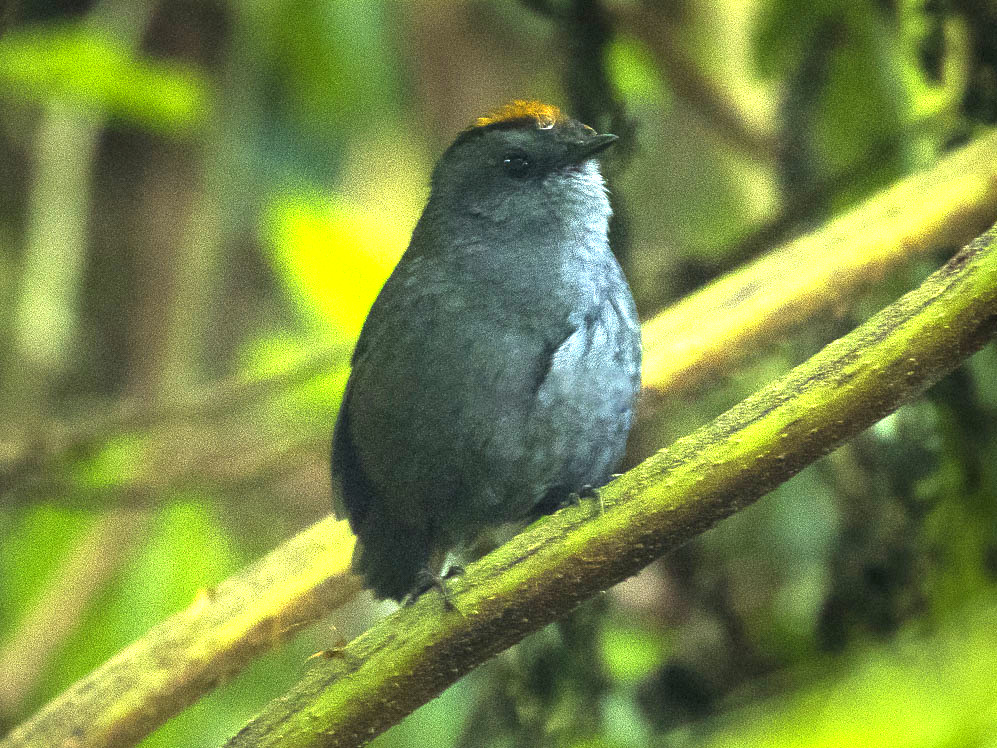
Measuring 10 to 11.5 cm (3.9 to 4.5 in) long and weighing about 21 g (0.74 oz), the wrenthrush is short-tailed and plump, with a thin bill similar to that of a New World warbler. Males and females look alike. Adults have a large yellow-orange patch bordered in black on the crown, a leaden gray face and neck sides, dull olive bronze upperparts, tail, and flanks, and leaden gray underparts with an olive tinge on the undertail coverts. Juveniles lack the orange crown and have browner upperparts.
The wrenthrush ranges from the Cordillera de Guanacaste in northern Costa Rica, discontinuously through that country, into western Panama’s Chiriquí and Veraguas provinces. It lives in montane evergreen and elfin forests, environments that are constantly wet and foggy. It favors dense vegetation near streams, including stands of *Chusquea* bamboo. Its elevation range runs from about 1,500 m (4,900 ft) up to treeline; in Costa Rica it is most common around 2,500 m (8,200 ft).
The species is mostly sedentary, with little elevational movement. It is a weak flier, rarely taking wing and then only for short distances. Its short rounded wings and small keel for flight muscles led to early speculation that it may be evolving toward flightlessness.
It forages by hopping among branches and along the ground, searching for arthropods, especially spiders and Lepidoptera larvae.
Quick Facts
- Grandparent Authority
- Ridgway, 1907
- Genus
- Zeledonia
- Species
- coronata
Facts from the source article.
Lore & Background
The wrenthrush was historically classified with thrushes and Old World flycatchers, then placed among New World warblers (Parulidae) by the late 20th century. Phylogenetic studies of nuclear and mitochondrial DNA led to its reassignment in 2017 to its own family, though its exact placement remains debated. Most taxonomic systems consider it closely related to spindalises, Cuban warblers, and other small Caribbean families, while BirdLife International places it nearer to New World sparrows and blackbirds.
The species is named after Costa Rican ornithologist José Castulo Zeledón. It is monotypic, with no subspecies recognized. Adults have a distinctive yellow-orange crown patch bordered in black, leaden gray face and underparts, and dull olive bronze upperparts. Juveniles lack the orange crown and are more brownish above.
The wrenthrush is a weak flier with short rounded wings and a small keel, leading to early speculation that it is evolving toward flightlessness. It forages by hopping among branches and along the ground for arthropods, especially spiders and Lepidoptera larvae. Its breeding season spans March to early July; nests are domes of moss, twigs, and leaves placed in earthen bank cavities, with clutches of three eggs.
Reader's Guide
The wrenthrush is significant as the sole representative of its genus and family, illustrating the taxonomic complexity of Neotropical birds. Its placement has shifted over decades, reflecting advances in molecular phylogenetics, and it remains a subject of taxonomic uncertainty. Ecologically, it is a specialized inhabitant of high-altitude, constantly wet montane and elfin forests, favoring dense vegetation near streams and Chusquea bamboo. Its weak flight and sedentary nature make it vulnerable to habitat degradation, though no immediate threats are identified. The species is considered Least Concern by the IUCN, with a stable but unknown population. Its vocal duets and cryptic behavior add to its interest for ornithologists. The wrenthrush's restricted range and unique evolutionary history underscore the importance of conserving Talamancan montane ecosystems.
Did You Know?
- The wrenthrush is neither a wren nor a thrush, despite its common name.
- Its genus name commemorates Costa Rican ornithologist José Castulo Zeledón.
- It is a weak flier with short rounded wings and a small keel, and early speculation suggested it is evolving toward flightlessness.
Gallery
Frequently Asked Questions
Who is Wrenthrush?
The Wrenthrush (Zeledonia coronata) is a small, roughly 21-gram oscine that lives exclusively in the montane cloud forests of Costa Rica and western Panama. It is the sole representative of its own genus and its own family, making it a one-of-a-kind branch on the songbird tree.
What makes Wrenthrush unique among passerines?
Despite its name implying kinship with both wrens and thrushes, genetic work shows it is closely related to neither. It also sports nine primaries per wing—a rare trait in passerines—and since 2017 it has been assigned to a monotypic family of its own.
Why is Wrenthrush important to scientists?
Its exact position on the passerine phylogeny is still unresolved, with most recent taxonomies placing it near the spindalids. Pinning down those relationships could reshape how we interpret the radiation of Neotropical songbirds, making this tiny bird a high-value target for evolutionary research.
Where can I actually see a Wrenthrush in the wild?
The bird is restricted to the Talamancan montane forests that stretch across southern Costa Rica and into western Panama. Outside that high-altitude cloud-forest corridor, you will not encounter it.
More in Passeriformes 1-20
Spotted an error? Know more?
Reader corrections go straight into our review queue. Suggest an edit · How this site is sourced