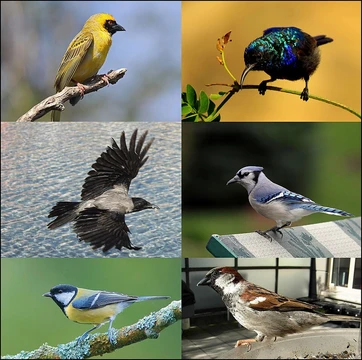
Passerine
Largest order of birds, known for perching and diverse vocalizations.

Passerines, also known as perching birds, are any birds of the order Passeriformes. They are the largest order of birds, with around 140 families and approximately 6,000 to 6,400 identified species, representing 60% of all birds. Passerines are divided into three suborders: New Zealand wrens, Suboscines (primarily found in the Americas), and songbirds (oscines). The earliest known passeriform fossils come from the early Eocene of Europe and North America, not the Southern Hemisphere, and they are one of the most diverse clades of terrestrial vertebrates.
Quick Facts
- Taxon
- Passeriformes
- Diversity Link
- #Taxonomic list of Passeriformes families
- Diversity
- Roughly 140 families, 6,500 species
- Audio
- Male-Songbird-Indicates-Body-Size-with-Low-Pitched-Advertising-Songs-pone.0056717.s005.ogv
- Audio Caption
- Song of a purple-crowned fairywren (Malurus coronatus)
Facts from the source article.
Lore & Background
Passerine chicks are altricial—blind, featherless, and helpless at hatching—requiring extensive parental care. Egg color varies widely across passerines and nonpasserines alike: many passerines lay colored or patterned eggs, but others lay plain white eggs, and many nonpasserines also produce colorful or patterned eggs. Clutch sizes vary greatly: some larger Australian passerines lay a single egg, most smaller passerines in warmer climates lay two to five, while hole-nesting species in higher northern latitudes can lay up to a dozen. The family Viduidae and several other groups are brood parasites, laying eggs in other birds' nests.
Reader's Guide
Passerines are significant as the largest and most diverse order of birds, comprising 60% of all bird species. Their evolutionary history, long mysterious, is now being clarified by molecular biology and improved paleobiogeographical data. The first passerines evolved in the Southern Hemisphere in the late Paleocene or early Eocene, around 50 million years ago. Their initial diversification coincided with the separation of southern continents in the early Eocene. New Zealand wrens were the first to become isolated in Zealandia, followed by the split between Tyranni in South America and Passeri in Australia. The Passeri experienced a great radiation in Australia, and a major branch, the parvorder Passerida, dispersed into Eurasia and Africa about 40 million years ago, leading to three major lineages comprising about 4,000 species. The fossil record is poor due to their small size and delicate bones, but early European fossils from the Oligocene include Wieslochia, Jamna, Resoviaornis, and Crosnoornis. Passerines' perching adaptation, diverse vocalizations, and complex nest construction highlight their cognitive and ecological importance.
Did You Know?
- Passerines have an anisodactyl toe arrangement: three toes forward and one back, facilitating perching.
- The heaviest passerines are the thick-billed raven and larger races of the common raven, exceeding 1.5 kg and 70 cm.
- The smallest passerine is the short-tailed pygmy tyrant, at 6.5 cm and 4.2 g.
- Some passerines, such as the viduas and cowbirds, are brood parasites that lay eggs in other birds' nests.
Deep Roots in the Southern Hemisphere
The evolutionary story of passerines stretches back roughly sixty million years, to the late Paleocene or early Eocene, when the first members of this lineage emerged in the Southern Hemisphere. For much of the twentieth century, scientists struggled to untangle relationships among passerine families, often lumping groups together based on superficial morphological resemblances that later proved to be products of convergent evolution rather than true kinship. The wrens of the Americas, Eurasia, Australia, and New Zealand, for instance, share a similar look and behavior yet occupy three entirely separate branches of the passerine tree. Modern molecular biology and improved paleobiogeographical evidence have begun to clarify the picture. The earliest diversification tracks the breakup of the southern continents during the early Eocene: the New Zealand wrens became the first group isolated on Zealandia, followed by a split giving rise to the Tyranni in South America and the Passeri on the Australian continent, where the latter underwent a spectacular radiation of forms. Today, with more than 140 families and roughly 6,500 identified species, Passeriformes stands as the largest order of birds, accounting for about 60 percent of all avian species and representing one of the most diverse clades of terrestrial vertebrates.
The Engineering of Perching
What sets passerines apart from nearly every other bird order is their foot architecture. Each foot carries three forward-pointing toes and a single rear-facing hallux, a configuration known as anisodactyl. Because the hind toe is unusually long and attaches to the leg at approximately the same height as the front three, the bird can wrap its digits around a branch and hold a stable upright posture. The toes remain separate and unwebbed in most species, although a few cotingas show a partial fusion between the second and third toes near their base. A second, often overlooked adaptation lives in the leg itself: a specialized tendon stretches from the underside of the toes up to the muscle behind the tibiotarsus. Bending the leg pulls this tendon taut, which in turn snaps the toes into a rigid curl around the perch. This passive locking mechanism is what lets a passerine doze on a twig without tumbling to the ground. Tail feather counts also show striking variation. Twelve is the norm, yet the superb lyrebird carries sixteen, while several Furnariidae spinetails drop to ten, eight, or even six, as in Des Murs's wiretail. Species that climb tree trunks, like treecreepers and woodcreepers, stiffen their tail feathers to use as a prop, and some families grow extremely long tails as courtship displays, as the long-tailed widowbird does.
Voices and the Three Great Clades
Passeriformes divides into three primary clades, each with a distinct vocal and geographic identity. The New Zealand wrens (Acanthisittidae) are tiny birds restricted to New Zealand in modern times; molecular evidence places them as the sister group to the other two clades. The suborder Tyranni, sometimes called suboscines, comprises non-singing birds primarily found across the Americas. The third and most vocalized group is the Passeri, the songbirds or oscines, which possess the finest control of syrinx muscles of any bird. This muscular precision produces an extraordinary range of songs and vocalizations, though not all oscine sounds register as musical to human ears—crows, for example, fall into that category. At the other extreme, the superb lyrebird is a remarkably accomplished mimic, capable of reproducing a wide array of sounds. The sheer scale of this order is staggering: more than 140 families and approximately 6,500 identified species make Passeriformes the largest order of birds and one of the most diverse clades of terrestrial vertebrates, representing roughly 60 percent of all bird species. Most passerines are insectivorous or omnivorous, supplementing their diets with fruit and seeds.
Nests, Eggs, and the Burden of Care
Passerine chicks are altricial—blind, featherless, and entirely helpless at hatching—demanding extensive parental investment from both adults. In contrast to most nonpasserine birds, whose eggs tend to be plain white, the majority of passerines lay colored eggs. One remarkable exception is the vinous-throated parrotbill, which produces eggs in two distinct colors, white and blue, apparently as a defense against the brood-parasitic common cuckoo. Clutch sizes vary enormously across the order: large Australian species such as lyrebirds and scrub-robins lay a single egg, smaller passerines in warmer climates typically produce two to five, while high-latitude hole-nesters like tits can lay up to a dozen. Several passerine groups, including the viduas, cuckoo-finches, and cowbirds, are brood parasites that deposit their eggs in other species' nests; the family Viduidae does not build its own nest at all. Nest construction itself is a cognitively demanding task, and a study linking brain size to building complexity across many passerine species found that different nest attachment modes require different levels of cognitive ability, underscoring the extraordinary behavioral diversity within this single order.
Frequently Asked Questions
Who is Passerine?
Passerines, commonly called perching birds, make up the single largest order in the bird world, encompassing roughly 6,000 to 6,400 identified species across about 140 families. They account for approximately 60% of all known bird species.
What are Passerine's signature abilities?
Their defining trait is a specialized foot structure built for gripping and perching on branches. They are also renowned for an extraordinary range of vocalizations, from simple calls to highly complex songs.
Where does Passerine's origin story begin?
The lineage traces back to the Southern Hemisphere roughly 60 million years ago. From that starting point, the group diversified into one of the most species-rich clades of land-dwelling vertebrates on Earth.
What are Passerine's three main suborders?
The order splits into New Zealand wrens, Suboscines (mostly distributed across the Americas), and the oscines, or true songbirds. Together these three groups cover the full breadth of passerine diversity.
Why is Passerine considered so important in the bird world?
With roughly 60% of all bird species falling under this order, passerines dominate terrestrial avian diversity. Their sheer number of families and identified species makes them the most biodiverse group among land vertebrates.
More in Passeriformes 1-20
Spotted an error? Know more?
Reader corrections go straight into our review queue. Suggest an edit · How this site is sourced