Piping shrike
State bird emblem of South Australia, a white-backed magpie.

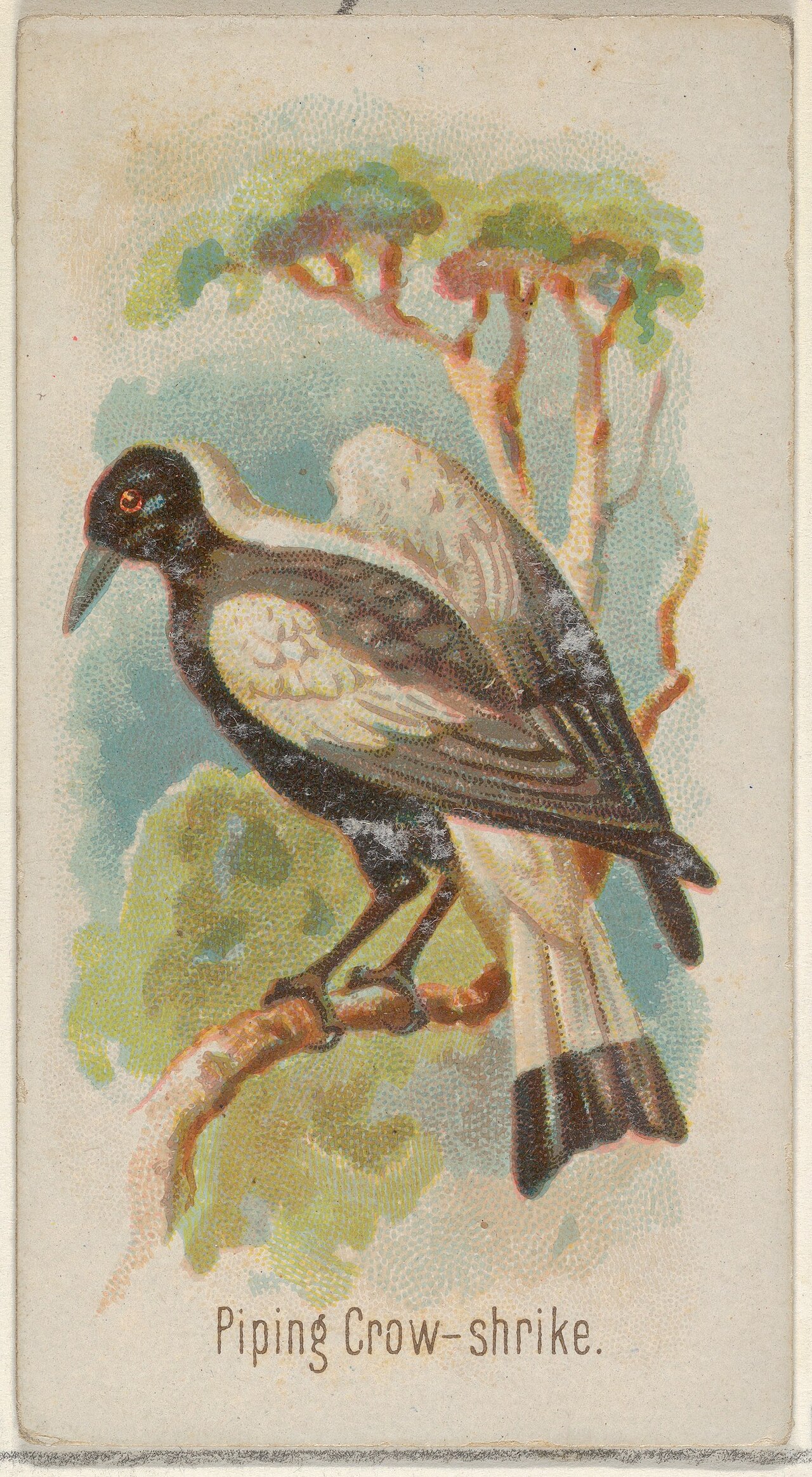
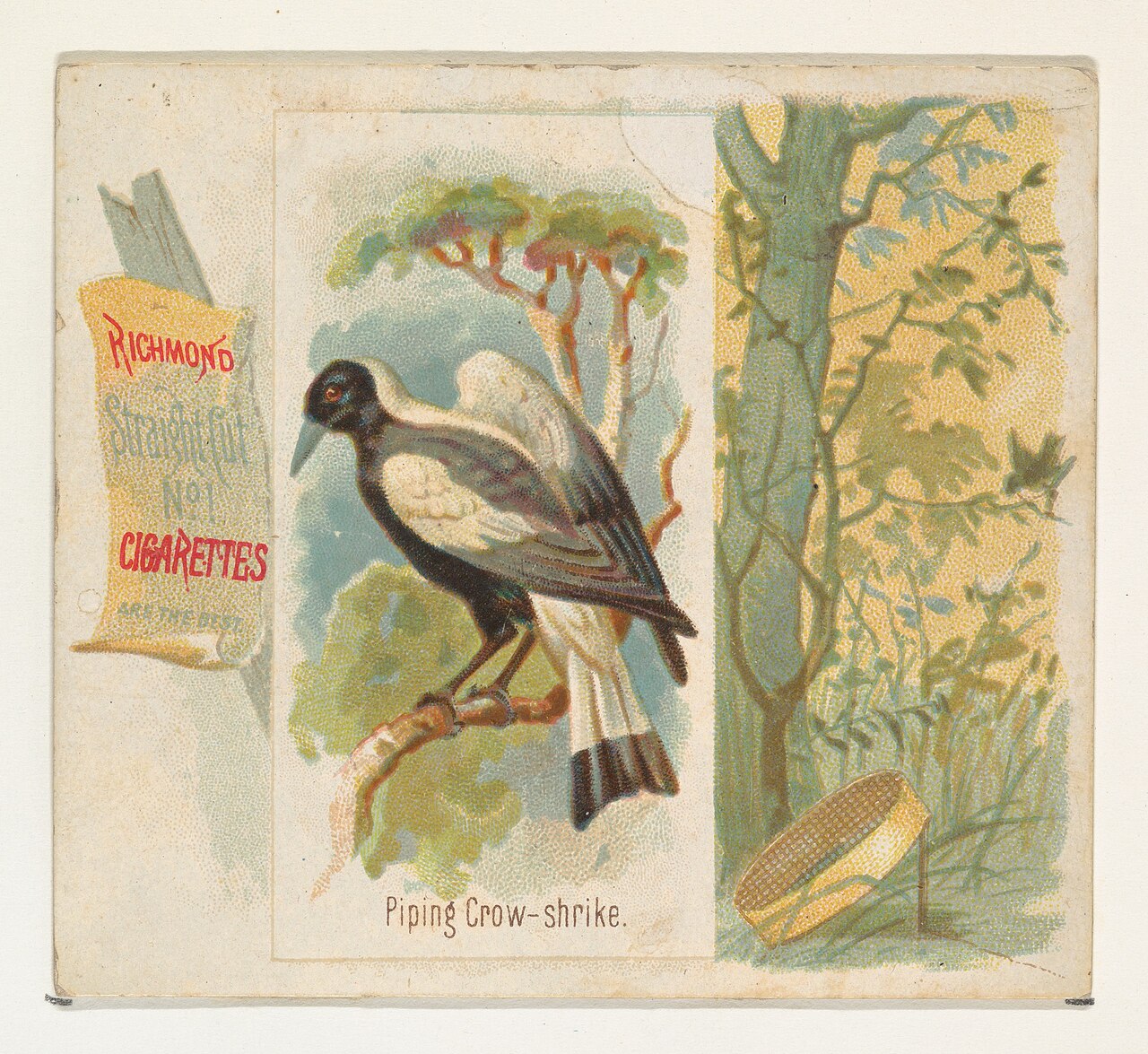
Geo. S. Harris and Sons / Allen & Ginter · CC0
The piping shrike is the bird depicted on the state badge and flag of South Australia. It is a white-backed magpie (Gymnorhina tibicen telonocua), a subspecies of the Australian magpie. The name 'piping shrike' was used officially by the South Australian governor in the early 1900s and remains a local name for the bird due to its continuous use on the state flag.
- Region
- South Australia, Victoria, New South Wales, Queensland
- First official use
- 1904 in State Badge
Lore & Background
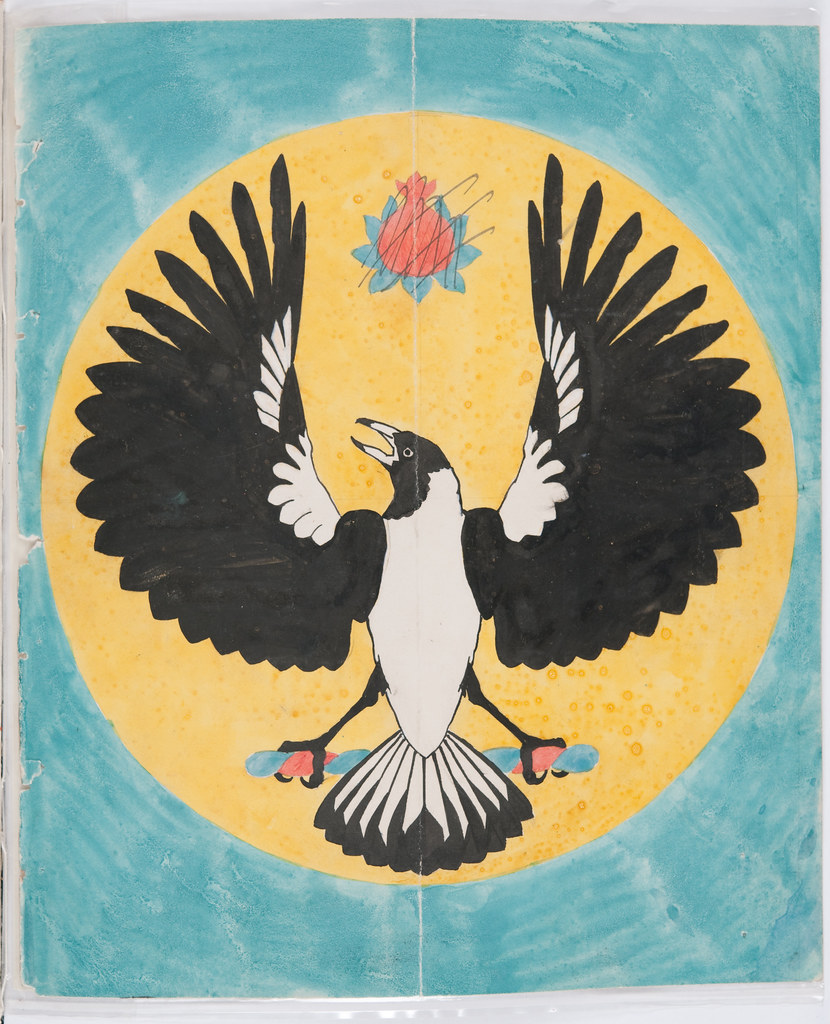
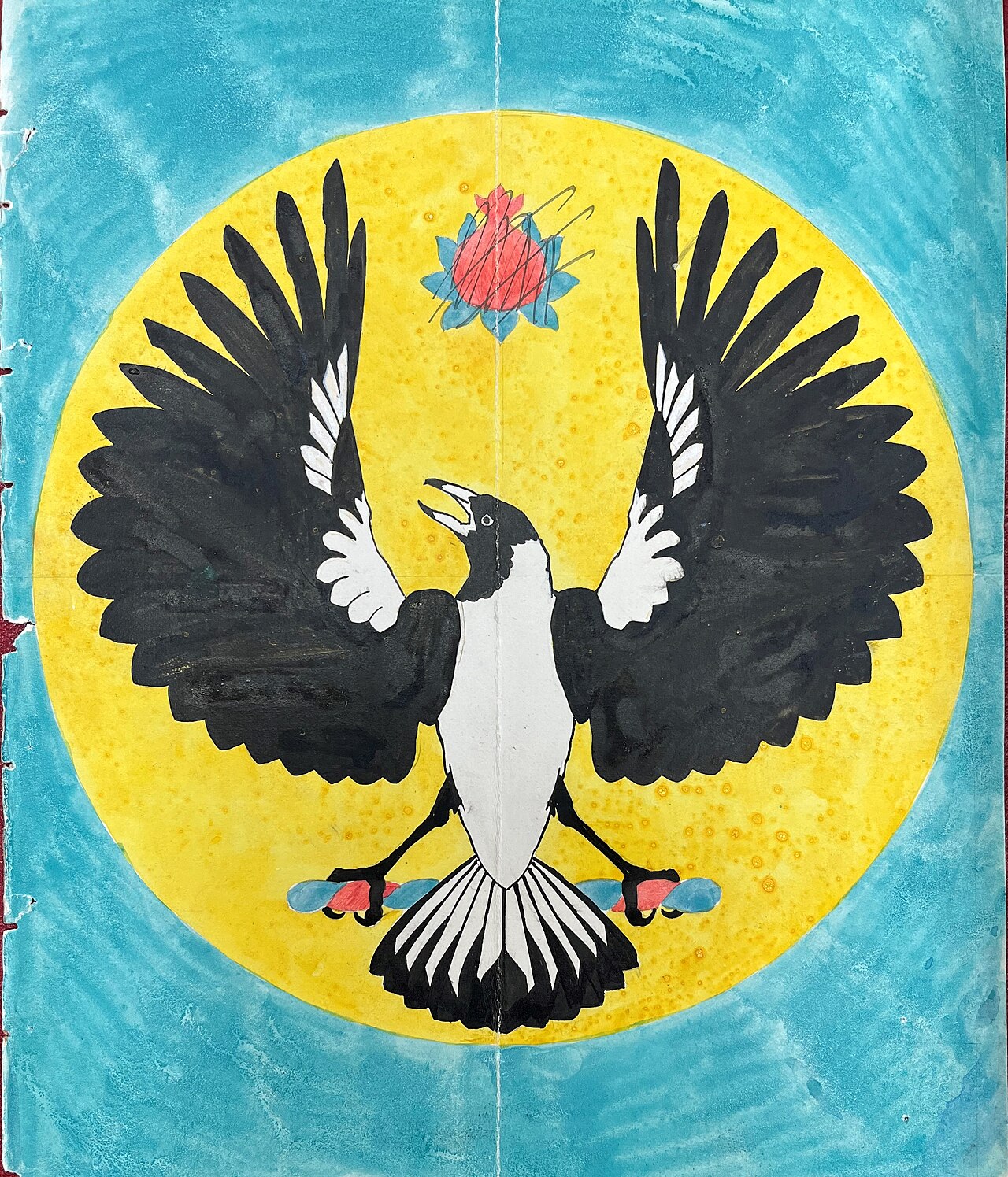
The piping shrike was included in the State Badge proclaimed in 1904, not on the Governor's ensign in 1903 (the ensign itself was adopted that year, but the shrike design came later). The original design is credited to H. P. Gill, director of the School of Arts, with input from Governor General Hallam Tennyson. However, relatives of Robert Craig and of artist Frances Jane Warhurst have each claimed sole responsibility for the design. The badge shows the bird against a yellow rising sun, representing Australian Federation, and was incorporated into the state flag in 1904 and the coat of arms in 1984.
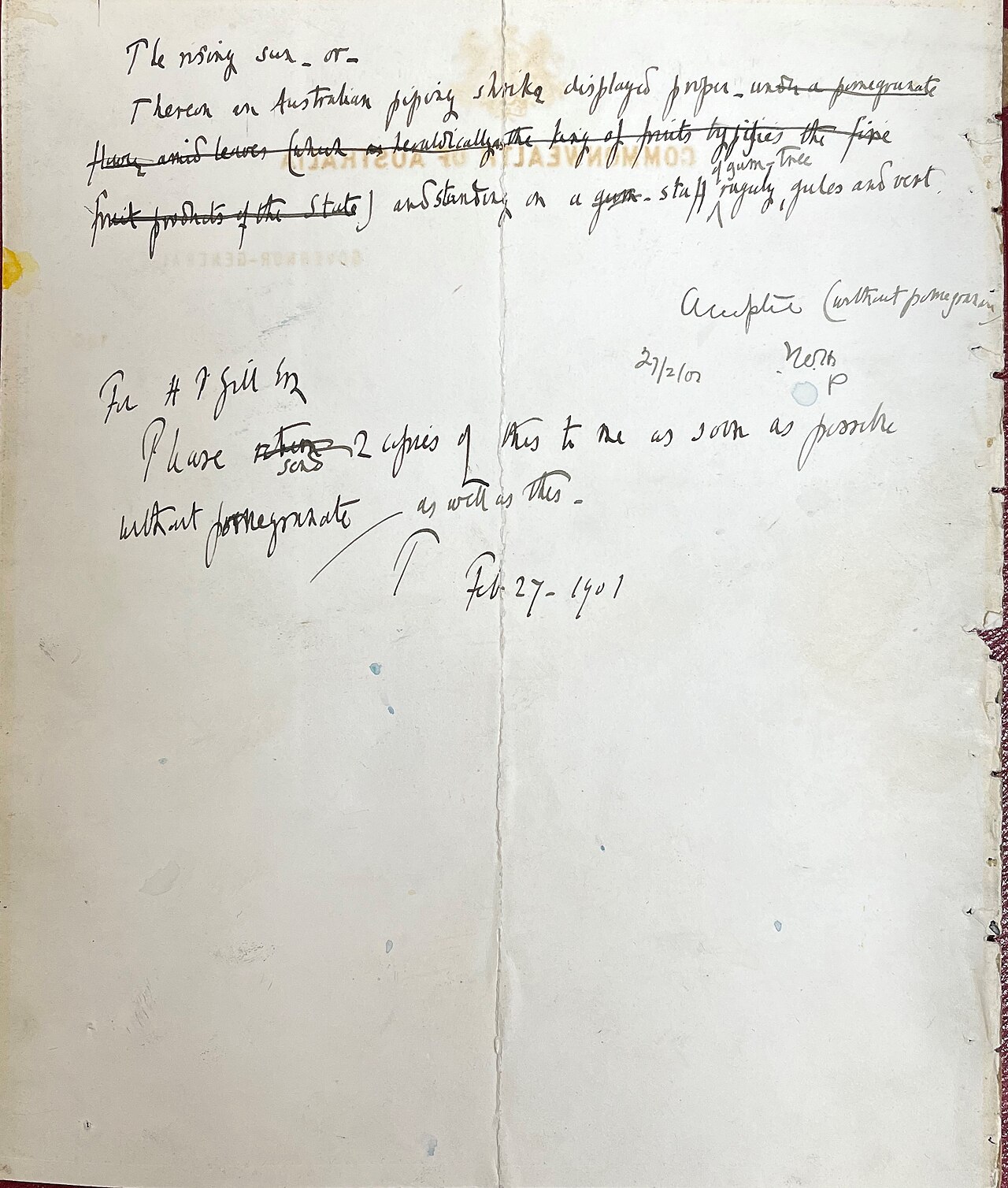
The bird is depicted from behind, with its tail over a gum-tree branch and head turned left. Governor Tennyson wrote 'Australian piping shrike' on the back of the original painting. The common name 'piping shrike' derives from the bird's piping call and predates the scientific name; it was already in colloquial use for the Australian magpie before the governor adopted it. Explorer Charles Sturt in the 1840s described the white-backed crow shrike (an earlier name) as having a clear fine note and being easily domesticated.
Confusion sometimes arises with the magpie-lark, but the piping shrike is specifically the white-backed magpie. The name 'piping shrike' is rarely found in current bird books but persists as a local name because of its heraldic history.
Reader's Guide
The piping shrike holds significance as the enduring emblem of South Australia, appearing on the state flag, badge, and coat of arms. Its official use began in the early 1900s, and the name reflects a blend of colonial naming practices and natural history. The bird's depiction—showing its back—has caused occasional misidentification with the magpie-lark, but government sources confirm it as the white-backed magpie, a subspecies largely confined to South Australia. The scientific name Gymnorhina tibicen retains the Latin root for piping, linking to the bird's clear call noted by early explorers like Charles Sturt. Over time, common names shifted from 'piping crow-shrike' to 'white-backed magpie', but the heraldic term 'piping shrike' has persisted. The design's origins involve disputed credit among H. P. Gill, Robert Craig, and Frances Jane Warhurst, reflecting the collaborative and sometimes contested nature of state symbolism. Today, the piping shrike remains a recognized local name, and the bird is listed in ornithological references as an alternative English name for the Australian magpie.
Did You Know?
- The piping shrike is depicted from behind, with its tail over the gum-tree branch and head turned left.
- The common name 'piping shrike' comes from the bird's piping call, not from the Latin tibicen, and was used by Governor Tennyson on the original painting.
- The white-backed magpie (Gymnorhina tibicen telonocua) is the subspecies shown on the badge, and its range extends beyond South Australia into parts of Victoria, New South Wales, and Queensland.
- The design of the piping shrike badge is disputed, with claims of credit by H. P. Gill, Robert Craig, and Frances Jane Warhurst.
A Name Built on Misunderstanding
The label attached to South Australia's state emblem traces back to a period when European settlers tried to slot unfamiliar Australian birds into categories they already recognised. In the early 1800s the black-backed magpie was called the piping crow shrike, while its white-backed counterpart earned the name white backed crow shrike. Both designations reflected a perceived resemblance to European crows, shrikes, and magpies—birds the colonists knew from home. The Latin binomial Gymnorhina tibicen telonocua preserves the piping element through the root tibicen, meaning piper. Over time the older compound names lost favour, a shift partly influenced by Robert Hall, a fellow of the Linnean Society, who in his 1907 volume Useful Birds of Southern Australia argued that even the word magpie was a misnomer for these birds. Modern taxonomy places the Australian magpie closest to the Australian butcherbirds, confirming it is neither a true magpie, crow, nor shrike in the European sense. Yet the colonial-era shorthand endures, frozen onto a state flag.
The Badge's Contested Birth
The piping shrike first appeared on the Governor's ensign in 1903 and was formally proclaimed as the State Badge in 1904. Original reports credit H. P. Gill, director of the School of Arts, with the design, noting some input and critique from Governor General Hallam Tennyson, 2nd Baron Tennyson. The attribution has never been uncontested, however. The nephew of Robert Craig, also connected to the School of Arts, has claimed his uncle was solely responsible for the original design. Separately, relatives of Adelaide artist Frances Jane Warhurst assert that she based the image on the eagle depicted on the seal of the Prussian consul, a close friend of hers. A later version was also credited to Gill in 1910. On 27 February 1901 the painting was approved by both the governor and the premier as the new state badge. The premier inscribed Accepted (without pomegranate) on the reverse, while the governor penned a full heraldic description, ultimately striking the pomegranate reference and refining the wording around the gum-tree branch.
What the Bird Actually Shows
One of the most persistent sources of confusion surrounding South Australia's emblem is that the viewer is looking at the back of the bird rather than its front. This is confirmed by the position of the tail, which drapes over the rear of the gum-tree branch, and by the head being turned to the bird's left. Because the image does not make it immediately obvious that the bird's back is what is depicted, the piping shrike has been mistakenly associated with the magpie-lark (Grallina cyanoleuca), also known locally as the Murray magpie, pee wee, or mudlark. The governor's own heraldic description on the reverse of the original painting reads: The rising sun – or – Thereon an Australian piping shrike displayed proper – under a pomegranate flower amid leaves and standing on a gum-staff, raguly, gules and vert. He later removed the pomegranate reference and changed gum-staff to staff of gum tree. The bird is set against the yellow risen sun of Australian Federation, a backdrop that carried the badge into the state flag of 1904 and the coat of arms of 1984.
A Name That Outlived Its Taxonomy
The name piping shrike is rarely encountered in modern ornithological literature, yet it persists as an occasional local designation for the white-backed magpie (Gymnorhina tibicen telonocua) because of its unbroken association with the South Australian state flag. Newspaper articles from the early 1900s and the South Australian Bird Protection Act of 1900 both grouped black-backed and white-backed magpies under the umbrella term Piping Crow Shrikes. The term was already in colloquial use before the governor adopted it officially; a newspaper from 1891 provides an early example. Explorer Charles Sturt, writing in the 1840s, described the White-backed Crow Shrike as a winter bird in South Australia whose clear fine note was most heard on the coldest mornings, and noted that birds of the genus were easily domesticated and learned to pipe tunes. The subspecies' range is almost entirely confined to South Australia, cementing the bird's identity with the state. The name's survival is a testament to how a single heraldic decision can freeze a colonial-era label into permanent public consciousness.
Gallery
Frequently Asked Questions
Why is it called a 'piping shrike' if it's actually a magpie?
The South Australian governor adopted that name officially around 1904, and it has stuck ever since because it is printed on the state flag and badge.
Where does the Piping shrike live?
Its range spans South Australia, Victoria, New South Wales, and Queensland.
What is the Piping shrike's role in South Australian identity?
It serves as the state bird emblem, featured on both the official state badge and the state flag, a designation dating back to 1904.
How is the Piping shrike different from other Australian magpies?
It is specifically the white-backed subspecies (telonocua) of Gymnorhina tibicen, set apart from other magpie subspecies by its distinctive white back plumage.
More in Passeriformes 1-20
Spotted an error? Know more?
Reader corrections go straight into our review queue. Suggest an edit · How this site is sourced