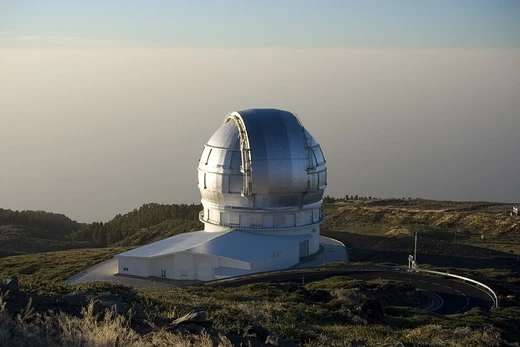
Yerkes 41-inch reflector
40-inch Ritchey–Chrétien reflector completed in 1968 at Yerkes Observatory.

The Yerkes 41-inch reflector is a reflecting telescope with a 40-inch (101.6 cm) clear aperture located at Yerkes Observatory. It was finished in 1968. The telescope is called the "41 inch" to distinguish it from the observatory's 40-inch refractor; the mirror itself has a physical diameter of 41 inches (104 cm). Optically, it uses a Ritchey–Chrétien design, and its primary mirror is made from Cer-Vit low-expansion glass. The mirror was figured by Tinsley Laboratories after a graduate student working on it died unexpectedly. The telescope was installed in the southern dome, replacing an older 24-inch reflector. In the 21st century, it was added to the robotic Skynet telescope network alongside a 24-inch telescope at Yerkes.
Initial instruments for the 41-inch included an image tube spectrograph, a photoelectric photometer, a photoelectric spectrophotometer, and a photographic plate camera. During the 1990s, the telescope served as a testbed for the Wavefront Control Experiment, an adaptive optics system that used a deformable mirror to counteract atmospheric blurring. This system was applied to research combining adaptive optics with fiber optics for high-accuracy spectrographs, data from which can be used to detect exoplanets via Doppler shift.
- Aperture
- 40 inches (101.6 cm)
- Physical mirror diameter
- 41 inches (104 cm)
- Optical design
- Ritchey–Chrétien
- Mirror material
- Cer-Vit low-expansion glass
- Completion year
- 1968
- Location
- Yerkes Observatory, southern dome
Lore & Background
The telescope was added in the late 1960s and is often called the '41 inch' to avoid confusion with the Yerkes 40-inch refractor. Its mirror has a physical diameter of 41 inches, though the clear aperture is 40 inches. The mirror was made from Cer-Vit low-expansion glass; figuring was mostly done at Yerkes Observatory's optical workshop, but the mirror was completed by Tinsley Laboratories after a graduate student working on it died unexpectedly. The telescope was installed in the southern dome, replacing a 24-inch reflector from the turn of the century. In the 21st century, it was placed on the robotic Skynet telescope network alongside a 24-inch telescope at Yerkes.
Reader's Guide
The Yerkes 41-inch reflector served as a testbed for the Wavefront Control Experiment in the 1990s, an adaptive optics system using a deformable mirror to reduce atmospheric blurring. This work included studying the combination of adaptive optics with fiber optics for high-accuracy spectrographs, which can be used to detect exoplanets via Doppler shift. The telescope is one of three major instruments at Yerkes Observatory in the late 20th and 21st centuries, alongside the 40-inch refractor and a 24-inch reflector. Its launch instruments included an image tube spectrograph, photoelectric photometer, photoelectric spectrophotometer, and photographic plate camera. In 2002, it received a new dome.
Did You Know?
- The telescope's mirror has a physical diameter of 41 inches but a clear aperture of 40 inches.
- It was used as a testbed for the Wavefront Control Experiment adaptive optics system in the 1990s.
Optical Design and the Cer-Vit Mirror
The Yerkes 41-inch reflector employs a Ritchey-Chretien optical configuration, a design that sets it apart from the refracting tradition that defined the observatory's founding instrument. At its heart sits a primary mirror fabricated from Cer-Vit, a low-expansion glass material chosen for its resistance to thermal distortion—a property essential for holding a precise optical figure across varying night-sky temperatures. The mirror's physical diameter measures 41 inches (104 cm), yet its clear, usable aperture is 40 inches. That one-inch margin of edge thickness is precisely why the instrument is conventionally called the "41-inch" rather than the "40-inch," a deliberate naming choice that avoids confusion with the observatory's celebrated 40-inch refracting telescope. The reflector is housed in one of two smaller domes at the Williams Bay, Wisconsin site, where it has stood alongside the great Alvan Clark lens and Warner & Swasey mount since the late 1960s. Together, the two instruments embody two fundamentally different approaches to collecting and focusing starlight: ground glass lenses versus a polished reflective surface.
The Launch Instrument Suite
When the 41-inch reflector became operational in the late 1960s, it arrived equipped with a suite of instruments designed to exploit the advantages of a reflective optical path. The launch package included an image tube spectrograph, a photoelectric photometer, a photoelectric spectrophotometer, and a photographic plate camera. This combination reflected the transitional era in which the instrument was deployed: photoelectric detectors were beginning to supplant purely photographic methods, yet the plate camera remained part of the standard toolkit. The spectrophotometer and spectrograph together allowed observers to break starlight into its constituent wavelengths and measure intensity distributions, while the photometer offered quantitative brightness measurements. The presence of both photoelectric and photographic instruments on the same telescope underscored the practical reality of 1960s astronomy, where new electronic detection technology was being integrated alongside time-tested photographic techniques that had served the field for generations. The observatory's own collection of over 170,000 photographic plates testified to how central that older method had been to a century of research at Williams Bay.
Pioneering Adaptive Optics
Among the 41-inch reflector's most significant contributions to the broader field of astronomy was its role in helping to pioneer adaptive optics. This technology, which compensates for the distorting effects of atmospheric turbulence to produce sharper images than a passive optical system alone can achieve, represented a major leap forward in ground-based observing. The 41-inch's Ritchey-Chretien optical design and its stable Cer-Vit mirror provided a well-corrected baseline against which adaptive corrections could be applied and evaluated. By the time the instrument was brought online—overall installation completed by December 1967 and the optical system finished in 1968—adaptive optics was still in its infancy, and the Yerkes reflector became one of the early platforms on which the technique was demonstrated and refined. This work helped lay the conceptual and practical groundwork that would later make high-resolution ground-based astronomy possible at scales far beyond what a fixed, uncorrected optical system could deliver. The 41-inch thus occupies a distinctive place in the history of observational technique, bridging the photoelectric and photographic methods of its launch era and the electronically corrected imaging that would follow.
A New Instrument for a Historic Site
The 41-inch reflector was added to the Yerkes Observatory complex in the late 1960s, a period when the site was already more than seventy years old. The observatory itself had been founded in 1892 by George Ellery Hale and financed by Charles T. Yerkes, representing a philosophical shift from simple telescope housings to integrated research facilities combining observation equipment with laboratory space for physics and chemistry analysis. By the time the reflector's overall installation was completed in December 1967 and its optics were finished in 1968, the famous 40-inch refractor had long since been surpassed in aperture by larger instruments elsewhere, yet Yerkes remained a center for serious astronomical research. The 41-inch gave the observatory a modern reflecting instrument to complement its historic refracting telescope, housed in one of two smaller domes on the Williams Bay grounds. The observatory continued under University of Chicago management until October 2018, when it was closed; ownership then passed to the non-profit Yerkes Future Foundation in May 2020, which has since undertaken millions of dollars in restoration and reopened the site for public tours in May 2022.
Frequently Asked Questions
What is the Yerkes 41-inch reflector?
It is a reflecting telescope at Yerkes Observatory with a 40-inch (101.6 cm) clear aperture, completed in 1968. It sits in the observatory's southern dome, where it replaced an older 40-inch Ritchey–Chrétien instrument.
Why is it called the "41-inch" if its aperture is 40 inches?
The nickname exists to keep it distinct from Yerkes' famous 40-inch refractor. The primary mirror's physical diameter actually measures 41 inches (104 cm), which is the source of the name.
What optical design and mirror material does the Yerkes 41-inch reflector use?
It is built on a Ritchey–Chrétien configuration, and its primary mirror is cast from Cer-Vit low-expansion glass. That pairing gives a flat image field while keeping thermal distortion to a minimum.
What happened during the figuring of the Yerkes 41-inch reflector's mirror?
A graduate student working on the project died unexpectedly, and Tinsley Laboratories took over to finish the figuring. The telescope was nonetheless completed and installed in 1968.
Where exactly is the Yerkes 41-inch reflector housed?
It occupies the southern dome at Yerkes Observatory. It was installed there in place of a previous, older 40-inch Ritchey–Chrétien reflector.
More in Optical Telescopes, Part 3 1-21
Spotted an error? Know more?
Reader corrections go straight into our review queue. Suggest an edit · How this site is sourced