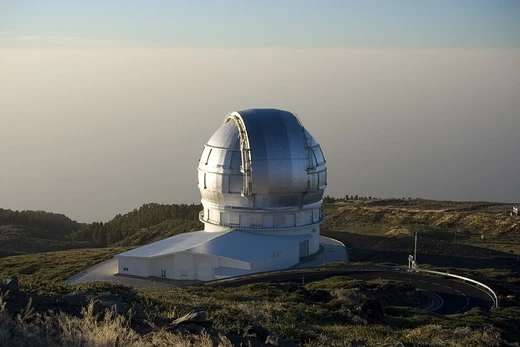
Yapp telescope
36-inch Cassegrain reflector, largest at Greenwich until the late 1950s.

The Yapp telescope is a 36-inch (91 cm) reflecting telescope from the United Kingdom, currently housed at the Observatory Science Centre in Herstmonceux. Ordered from Grubb Parsons in 1931 by the Royal Observatory, Greenwich, it was installed in a new dome building there. With a 36-inch (91 cm) mirror and a 4.57-meter (15 ft) focal length, it remained the largest telescope at the Greenwich Observatory until the late 1950s. The instrument was a Cassegrain reflector on an equatorial mount, equipped with two spectrographs (one from Adam Hilger, Ltd, delivered in 1937) and an optional eyepiece, plus a 6-inch guide telescope. It was inaugurated on 2 June 1934 by the First Lord of the Admiralty, with the Astronomer Royal noting it had been 40 years since a large telescope was added. The dome building, completed in 1932, was made of red brick with an iron lattice dome covered in papier-mâché and copper, located about 350 yards (320 meters) east of the main observatory buildings in Greenwich Park’s Christie Enclosure. Electric motors powered both the equatorial drive and dome rotation. In the late 1950s, the telescope was dismantled and moved to Herstmonceux as part of the institution’s relocation, where it was placed in Dome B. The Yapp dome building in Greenwich was taken down and sent to the Royal Observatory, Cape of Good Hope to house the planned Elizabeth telescope. The Herstmonceux site operated as an observatory into the 1980s, then transitioned into a popular science museum; the Yapp telescope remains there. The site closed for astronomy in the 1990s and is now a tourist and education attraction, with the Yapp serving as an example of a reflecting telescope. It was one of the largest telescopes at Herstmonceux until the 98-inch Isaac Newton Telescope began operations in 1967 (later moved to La Palma by the 1980s). A 38-inch Hargreaves telescope was also at Herstmonceux but was not actively used. Scientific work with the Yapp included spectroscopic observations of the Be stars η Cen, γ Cas, and Φ Per in the 1970s, using an echelle spectrograph. In 1984, it was tested with an echelle spectrograph from Queen’s University Belfast and a CCD camera, observing Alpha Cygni (Deneb) and Alpha Boo (Arcturus); results were published in a 1985 paper on high-dispersion spectroscopy trials.
- Aperture
- 36 inches (91 cm)
- Focal length
- 4.57 meters (15 ft)
- Design
- Cassegrain reflecting on equatorial mounting
- Location (original)
- Christie Enclosure, Greenwich Park
- Location (current)
- Observatory Science Centre, Herstmonceux (Dome B)
- Year ordered
- 1931
- Year inaugurated
- 2 June 1934
Lore & Background
The telescope was ordered from Grubb Parsons in 1931 by the Royal Observatory, Greenwich, and installed in a new dome building. It had a reflecting mirror 36 inches wide and a focal length of 4.57 meters. Instruments included two spectrographs, one made by Adam Hilger, Ltd and delivered in 1937, and an option for an eyepiece. It also had a 6-inch guide telescope. The drive for the equatorial and dome rotation were powered by electric motors. The original dome building at Greenwich was red brick, with a dome of iron lattice with paper mache covered with copper. The telescope was inaugurated on 2 June 1934 (Visitation day), opened by the First Lord of the Admiralty. The Royal Astronomer noted it had been 40 years since a large telescope was added. The Yapp dome building in Greenwich was taken down and sent to the Royal Observatory, Cape of Good Hope to house the planned Elizabeth telescope.
Reader's Guide
The Yapp telescope was one of the biggest at Herstmonceux until the 98-inch Isaac Newton Telescope was commissioned in 1967, which was later moved to La Palma. There was also a 38-inch Hargreaves telescope at Herstmonceux, but it was not put into action particularly. The Yapp telescope, along with the 98-inch Isaac Newton Telescope, collected observations on stellar radial velocities between 1964 and 1971. An example of astronomical studies done with the Yapp reflector is Spectroscopic Observations of the Be Stars η Cen, γ Cas and Φ Per, a study in the 1970s using an echelle spectrograph. In 1984, the Yapp telescope was tested with an echelle spectrograph from Queen's University Belfast and a CCD camera, observing Alpha Cygni (Deneb) and Alpha Boo (Arcturus); results were published in the 1985 research paper 'High dispersion spectroscopy trials using an echelle spectrograph with CCD camera.' The telescope remains at the Observatory Science Centre as a preserved example of a reflecting telescope and a noted tourist and education attraction.
Did You Know?
- The Yapp telescope was the largest telescope in use at the Royal Observatory, Greenwich until the late 1950s.
- The telescope was moved to Herstmonceux in the late 1950s and placed in Dome B.
- In 1984, it was tested with an echelle spectrograph and CCD camera, observing Deneb and Arcturus.
A Place in the Instrumental Timeline
The Yapp telescope, ordered in 1931, represents one link in a long chain of major instrument acquisitions that defined the Royal Observatory, Greenwich, across three and a half centuries. When the institution first opened its doors in the summer of 1676, it already housed clocks and instruments donated by Sir Jonas Moore. Over the following decades, the hilltop site saw the installation of the Sheepshanks equatorial refractor in 1838, a 6.7-inch aperture instrument, followed by the 28-inch Great refractor in 1893. The 1931 order for the Yapp telescope continued this tradition of equipping the observatory with increasingly capable optical tools. More than a century later, in 2018, the Annie Maunder Astrographic Telescope returned the Greenwich site to active astronomical research. Viewed in this sequence, the Yapp telescope occupies a distinctive middle position: it was commissioned during the final decades of the observatory's primary scientific presence on the Greenwich hilltop, before the working institution began its gradual relocation elsewhere.
The Institution Behind the Commission
The body that placed the order for the Yapp telescope in 1931 was an institution with roots stretching back to 1675, when King Charles II commissioned a new observatory to solve the pressing problem of determining longitude at sea. The site on the old Greenwich Castle hilltop was selected by Sir Christopher Wren, who had previously held the Savilian Professorship of Astronomy, and the resulting building—often called Flamsteed House after its first occupant, John Flamsteed—stands as Britain's first purpose-built scientific research facility. Constructed for 520 pounds from largely recycled materials on the foundations of Duke Humphrey's Tower, the structure was deliberately sited on royal park land to avoid the expense of purchasing new ground. The founding charter charged the Astronomer Royal with rectifying the tables of celestial motions and the positions of fixed stars, ultimately to perfect the art of navigation. By the time the Yapp telescope was ordered, this mission had evolved through the Board of Longitude, the Nautical Almanac, and daily time-ball signals, but the underlying purpose—precision measurement of the heavens—remained the institution's defining character.
An Era of Transition
The 1931 order for the Yapp telescope arrived at a moment when the Royal Observatory, Greenwich, was still fully operational on its hilltop site, yet the winds of change were already gathering. Over the following two decades, the scientific work that had anchored the institution for two and a half centuries began to be relocated in stages. In 1948, the Office of the Astronomer Royal departed for Herstmonceux in East Sussex, and by 1957 the entire working observatory had completed its move, leaving the Greenwich site to be renamed the Old Royal Observatory. This transition meant that the Yapp telescope was commissioned during what would become the final chapter of active, on-site astronomical research at the original location. The building that had housed Flamsteed, that had dropped its time ball since 1833, and that had broadcast hourly time signals on radio from 1924, was gradually transformed into a museum. The telescope thus stands as a tangible artifact of the observatory's last working era on the Greenwich hill, a reminder of the period when the site was still a living center of scientific inquiry rather than a preserved heritage landmark.
Enduring Legacy and Institutional Identity
The Royal Observatory, Greenwich, carries distinctions that few other institutions can claim. It holds the International Astronomical Union observatory code of 000, the very first entry in the global registry. The Prime Meridian that passed through its grounds gave its name to Greenwich Mean Time, the forerunner of today's Coordinated Universal Time, and the 1884 International Meridian Conference in Washington confirmed Greenwich as the world's reference meridian for a full century. Today, the observatory shares the collective designation of Royal Museums Greenwich alongside the National Maritime Museum, the Queen's House, and the clipper ship Cutty Sark. Within this broader heritage landscape, the Yapp telescope—ordered in 1931 and part of the site's scientific equipment—serves as a physical connection to the institution's working past. Although the Greenwich site is now maintained almost exclusively as a museum, the presence of instruments like the Yapp telescope, alongside the 2018 return of the Annie Maunder Astrographic Telescope to research use, underscores that the hilltop's identity as a place of astronomical observation has never been entirely abandoned, even as its primary role shifted from active discovery to public education and preservation.
Frequently Asked Questions
What is the Yapp telescope?
It is a 36-inch (91 cm) Cassegrain reflecting telescope that held the title of largest instrument at the Royal Observatory, Greenwich, from its early-1930s installation until the late 1950s.
Who built the Yapp telescope and when was it commissioned?
The Royal Observatory, Greenwich, placed the order with the firm Grubb Parsons in 1931. A spectrograph from Adam Hilger, Ltd, was added later, arriving in 1937.
What are the main optical and mechanical specs of the Yapp telescope?
The instrument pairs a 91 cm primary mirror with a 4.57-metre (15 ft) focal length in a Cassegrain layout on an equatorial mount. It was supplied with two spectrographs and an optional visual eyepiece for direct observation.
Where can you visit the Yapp telescope today?
After leaving its original Christie Enclosure in Greenwich Park, the telescope was relocated to the Observatory Science Centre at Herstmonceux, where it is displayed inside Dome B.
Why is the Yapp telescope considered significant in British astronomical history?
For roughly two and a half decades it was the flagship research instrument at one of the world's most renowned observatories, anchoring Greenwich's observational programme until larger telescopes took over in the late 1950s.
More in Optical Telescopes, Part 3 1-21
Spotted an error? Know more?
Reader corrections go straight into our review queue. Suggest an edit · How this site is sourced