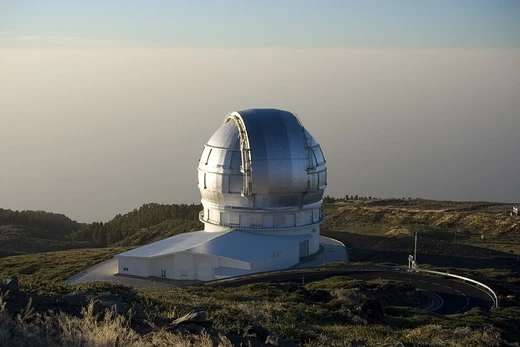
Wide Field Survey Telescope
Chinese time-domain survey telescope with a 2.5-metre mirror.

The Wide Field Survey Telescope (WFST) is a Chinese observatory with a 2.5-meter primary mirror, built to monitor astronomical objects that change over time, like supernovae. It achieved first light on September 17, 2023, by capturing an image of the Andromeda Galaxy. The telescope covers six wavelength bands from 320 to 1028 nanometers, has a 3-degree field of view, and can detect objects down to 23rd magnitude. Nicknamed Mozi after an ancient Chinese philosopher and optics pioneer, it sits at an altitude of 4,200 meters on the Tibetan Plateau near Lenghu Town in Qinghai Province. Construction began in 2017, led by the University of Science and Technology of China in Hefei and the Purple Mountain Observatory of the Chinese Academy of Sciences in Nanjing. Following a three-month pilot survey, the WFST is expected to start a six-year mission in 2024. Its location helps fill a gap in the global network of high-altitude observatories, which are mostly concentrated in the Western Hemisphere—such as Maunakea in Hawaii, Cerro Paranal in Chile, and La Palma in the Canary Islands—enabling more consistent tracking of fast-changing celestial events.
- Primary mirror diameter
- 2.5 metres
- First light date
- 17 September 2023
- First light target
- Andromeda Galaxy
- Wavelength bands
- six bands spanning 320 to 1028 nm
- Field of view
- 3°
- Limiting magnitude
- 23rd magnitude
- Location
- Tibetan Plateau, near Lenghu Town, Qinghai Province, at 4200 metres altitude
- Nickname
- Mozi
- Project start year
- 2017
- Institutions
- University of Science and Technology of China (Hefei) and Purple Mountain Observatory of the Chinese Academy of Sciences (Nanjing)
Lore & Background
The Wide Field Survey Telescope saw first light on 17 September 2023, when it imaged the Andromeda Galaxy. The telescope is nicknamed Mozi after an ancient Chinese philosopher and optics pioneer. It is located on the Tibetan Plateau near Lenghu Town in Qinghai Province, at an altitude of 4200 metres. The project to build the telescope was begun in 2017 by the University of Science and Technology of China in Hefei and the Purple Mountain Observatory of the Chinese Academy of Sciences in Nanjing. After a three-month pilot survey, the telescope is anticipated to begin a 6-year mission in 2024.
Reader's Guide
The Wide Field Survey Telescope addresses a notable gap within the current global network of high-altitude, advanced observatory complexes. Many leading observatories are concentrated in the Western Hemisphere, including Maunakea in Hawaii, Cerro Paranal in Chile, and La Palma in the Canary Islands. By utilizing its site on the Tibetan Plateau, the WFST facilitates more consistent monitoring of rapidly evolving astronomical phenomena, such as supernovae. Its wide field of view and sensitivity to faint objects make it particularly suited for time-domain surveys, tracking objects that change during observation. The telescope operates at six wavelength bands spanning 320 to 1028 nm, and can reach objects as faint as 23rd magnitude. Its 2.5-metre primary mirror and 3° field of view enable it to survey large areas of the sky efficiently, contributing to the study of transient events and variable objects.
Did You Know?
- It saw first light on 17 September 2023 by imaging the Andromeda Galaxy.
- The telescope is located at an altitude of 4200 metres on the Tibetan Plateau near Lenghu Town in Qinghai Province.
Three Families of Light-Bending Design
Optical telescopes divide into three fundamental design families based on how they gather and focus incoming light. Refracting instruments use lenses—and in some cases prisms—to bend light toward a focal point. Reflecting telescopes employ curved mirrors as their primary collecting element. Catadioptric designs blend both approaches, combining lenses and mirrors in a single optical train.
Across all three families, one geometric rule dominates performance: the diameter of the objective. Whether that objective is a convex lens or a concave mirror, its aperture governs two key capabilities simultaneously. A wider opening captures more photons, brightening the resulting image, and at the same time sharpens the instrument's angular resolution, allowing finer detail to be distinguished. This dual relationship between aperture and both light-gathering power and resolving ability explains why the pursuit of ever-larger objectives has driven telescope design from the earliest refractors through modern segmented-mirror reflectors.
From Spectacle Makers to Digital Stacking
The telescope grew out of artisanal lens-grinding rather than a single scientific breakthrough. Refraction and reflection had been theorized by ancient Greek philosophers and later expanded in the medieval Islamic world, but the practical leap came from spectacle makers in thirteenth-century Venice and Florence, then in the Netherlands and Germany. In 1608, Dutch artisan Hans Lippershey filed the earliest known patent for a refracting telescope, soon followed by competing claims from Jacob Metius and an unnamed third party.
Galileo built improved versions within a year and became the first to publish telescope-based astronomical results. Johannes Kepler proposed a convex-eyepiece arrangement that defined the Keplerian design. The achromatic lens, attributed to Chester Moor Hall in 1729 and patented by John Dollond, corrected chromatic aberration and enabled shorter, larger refractors. On the reflecting side, Alhazen's earlier mirror theories inspired James Gregory's 1663 design and Isaac Newton's 1668 Newtonian, though reflectors took over a century to gain broad use. Subsequent advances—silver and aluminum mirror coatings, segmented mirrors, active optics, adaptive optics, and space telescopes—culminated in the 2010s with computer-connected instruments that let amateurs stack digital frames to detect objects as dim as magnitude fifteen.
How the Image Forms
At its core, every optical telescope follows a straightforward optical pathway. The primary light-gathering element—the objective, whether a convex lens or a concave mirror—collects incoming photons from a distant object and concentrates them onto a focal plane, where a real image is constructed. An eyepiece, positioned at or near that focal plane, then acts as a magnifying glass, enlarging the real image for the observer's eye. What the eye ultimately perceives is an inverted, magnified virtual image of the original object.
Most telescope architectures are what are called inverting designs: the image at the focal plane is flipped both upside down and left-to-right, producing a net rotation of 180 degrees relative to the object's true orientation. In astronomical instruments this rotated view is entirely unremarkable, since celestial objects lack a fixed "up" direction. The practical consequence is that the eyepiece simply magnifies whatever real image the objective has already produced, and the observer's visual system adapts to the inverted orientation without difficulty.
Telescopes in Everyday Life
Optical telescopes serve far more purposes than stargazing. The same lens-and-mirror principles that let an astronomer resolve a distant nebula also power the monoculars and binoculars used by birdwatchers tracking shorebirds, pilots navigating coastal waters, hunters scanning tree lines, and reconnaissance operators observing terrain from a distance. Indoors and in semi-outdoor settings, compact optical instruments help audiences follow performance arts and spectator sports with greater clarity.
The early twenty-first century brought a particularly democratizing shift. Building on digital astrophotographic techniques that professional astronomers had refined over decades, manufacturers introduced computer-connected telescopes in the 2010s. These instruments link to a smartphone, tablet, or laptop, allowing non-professional skywatchers to observe stars and satellites with relatively low-cost equipment. The digital workflow captures multiple frames, stacks them, and subtracts the noise component of each exposure. The result is imagery of Messier objects and faint stars as dim as an apparent magnitude of fifteen—achievable with consumer-grade hardware that would have been unimaginable a generation earlier.
Frequently Asked Questions
What is the Wide Field Survey Telescope?
The WFST is a Chinese time-domain observatory built to track transient and variable celestial events such as supernovae. It features a 2.5-metre primary mirror and is colloquially called "Mozi," a nod to the ancient Chinese thinker known for early work on optics.
What are the WFST's main observational capabilities?
The instrument surveys a 3-degree patch of sky across six spectral bands spanning 320 to 1028 nanometres. It can resolve sources as faint as 23rd magnitude, making it well suited for catching brief outbursts in distant objects.
When and how did the WFST achieve first light?
On September 17, 2023, the telescope captured its inaugural image of the Andromeda Galaxy, marking the official first-light milestone for the observatory.
Where is the Wide Field Survey Telescope situated?
The facility is perched at roughly 4,200 metres elevation on the Tibetan Plateau, near Lenghu Town in Qinghai Province, China. The high, dry site minimises atmospheric interference for optical observations.
Why does the WFST matter to the astronomy community?
By repeatedly scanning wide swaths of the sky, it lets astronomers catch and study short-lived phenomena—like supernovae and variable stars—that smaller or narrower instruments might miss entirely. Its combination of a large mirror, broad spectral coverage, and high limiting magnitude gives it a unique niche in both Chinese and global time-domain astronomy.
More in Optical Telescopes, Part 3 1-21
Spotted an error? Know more?
Reader corrections go straight into our review queue. Suggest an edit · How this site is sourced