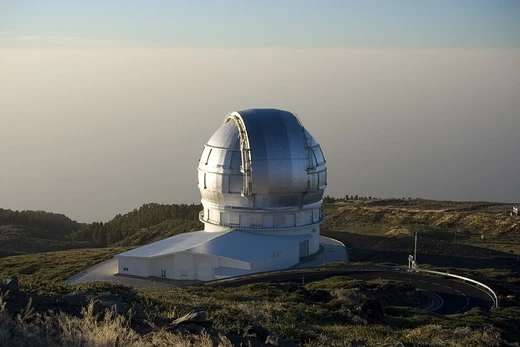
Swiss 1.2-metre Leonhard Euler Telescope
Fully automatic 1.2-metre reflector used for exoplanet detection and characterization.

The Leonhard Euler Telescope, also called the Swiss EULER Telescope, is a fully automatic 1.2-metre (47-inch) reflecting telescope owned and run by the Geneva Observatory. It sits at 2,375 metres (7,792 feet) above sea level on ESO’s La Silla Observatory site in Chile’s Norte Chico region, roughly 460 kilometres north of Santiago. First light occurred on 12 April 1998, and the instrument is named for the Swiss mathematician Leonhard Paul Euler. Its primary tool for exoplanet hunting is the CORALIE spectrograph, an echelle-type instrument copied from the ELODIE spectrograph—the same one Michel Mayor and Didier Queloz used to detect a planet orbiting a star. Installed at the Euler Telescope in April 1998, CORALIE was upgraded in 2007 by Queloz and his team to boost performance for the Wide Angle Search for Planets (SuperWASP) and the Next-Generation Transit Survey. It measures tiny Doppler shifts in a star’s spectrum—the radial-velocity or “wobble” method—to indirectly detect the gravitational pull of an orbiting exoplanet, from which the planet’s mass can be estimated. In 2010, Queloz added the EulerCam (ecam), a high-precision photometry camera designed to detect planets via the transit method, supporting ground-based programs like SuperWASP. The transit method reveals a planet’s size, and combining size with mass from radial-velocity data tells whether the planet is gaseous or rocky. The telescope also carries a smaller, piggyback-mounted instrument called Pisco. Euler’s first discovery was a hot Jupiter around Gliese 86—about four times Jupiter’s mass with a 15.8-day orbit—and many more exoplanets have since been found or followed up. Alongside the Mercator Telescope, it formed part of the Southern Sky extrasolar Planet search Programme, which has uncovered numerous extrasolar planets. Euler is also frequently used to characterize exoplanets discovered by SuperWASP, determining their masses. The CORALIE spectrograph has a fixed resolution of R = 50,000 with three-pixel sampling, and its detector is a 2k × 2k charge-coupled device with 15-micrometre pixels.
- Type
- fully automatic reflecting telescope
- Aperture
- 1.2 metres (47 in)
- Location
- ESO's La Silla Observatory, Chilean Norte Chico region, about 460 km north of Santiago de Chile
- Altitude
- 2,375 m (7,792 ft)
- First light
- 12 April 1998
- Operator
- Geneva Observatory
- Instruments
- CORALIE spectrograph, EulerCam (ecam), piggyback telescope Pisco
Lore & Background
The Euler telescope uses the CORALIE instrument to search for exoplanets. CORALIE is an echelle-type spectrograph, a copy of the ELODIE spectrograph used by Michel Mayor and Didier Queloz to detect the planet orbiting a star. It was built and installed at the Euler Telescope in April 1998, and upgraded in 2007 by Didier Queloz and his team to support the Wide Angle Search for Planets program and the Next-Generation Transit Survey. The instrument is optimized to measure the Doppler effect on a star's electromagnetic spectrum with great precision to detect the gravitational tug of an orbiting exoplanet, an indirect detection method also known as radial velocity or wobble method. The mass of the planet can be estimated from these measurements. The spectrograph participates in the Southern Sky extrasolar Planet search Programme initiated by Michel Mayor.
Reader's Guide
The Euler telescope's significance lies in its contributions to exoplanet discovery and characterization. Its first discovery was a planet in orbit around Gliese 86, determined to be a hot Jupiter with an orbital period of only 15.8 Earth days and about four times the mass of Jupiter. Since then, many other exoplanets have been discovered or examined in follow-up observations. Together with the Mercator Telescope, Euler was part of the Southern Sky extrasolar Planet search Programme, which has discovered numerous extrasolar planets. It has also been frequently employed for follow-up characterization to determine the mass of exoplanets discovered by the Wide Angle Search for Planets (SuperWASP). In 2010, the visible camera EulerCam was installed by Didier Queloz, with the main objective to measure planets by the transit method, supporting ground-based programs such as Wide Angle Search for Planets. By combining the measured size from the transit method and mass from radial velocity, it can be determined whether an observed exoplanet is gaseous or rocky. The CORALIE spectrograph has a fixed resolution of R = 50,000 with three-pixel sampling, and its detector is a 2k × 2k charge-coupled device with 15 micrometer pixel size.
Did You Know?
- The Euler telescope saw its first light on 12 April 1998.
- Its first discovered exoplanet was a hot Jupiter around Gliese 86 with a 15.8-day orbital period and about four times Jupiter's mass.
- In 2010, the EulerCam was installed to measure exoplanets by the transit method.
A Swiss Instrument on Chilean Soil
The Leonhard Euler Telescope stands as a testament to international astronomical collaboration, pairing Swiss engineering with the exceptional observing conditions of the Chilean Norte Chico region. Built and operated by the Geneva Observatory, this fully automatic 1.2-metre reflecting telescope sits at an altitude of 2,375 metres on ESO's La Silla Observatory site, roughly 460 kilometres north of Santiago de Chile. The high elevation and dry climate of the location minimize atmospheric interference, granting the instrument the stable skies its precision work demands. The telescope achieved first light on 12 April 1998 and carries the name of Leonhard Paul Euler, the celebrated Swiss mathematician whose contributions to science spanned centuries. As a national asset of Switzerland, it operates autonomously, freeing Geneva-based astronomers from the need to travel to Chile for routine observations. Its compact 47-inch aperture, while modest compared to giant modern telescopes, is perfectly suited to the precision spectroscopic and photometric work that defines its exoplanet-hunting mission.
The CORALIE Spectrograph and the Wobble Method
At the heart of the Euler Telescope's exoplanet-detection capability lies CORALIE, an echelle-type spectrograph built and installed in April 1998. CORALIE is a direct copy of the ELODIE spectrograph, the very instrument Michel Mayor and Didier Queloz used to detect a planet orbiting a star. This lineage gives CORALIE a proven pedigree in radial velocity work. The instrument is optimized to measure the Doppler shift in a star's electromagnetic spectrum with extraordinary precision, detecting the subtle gravitational tug that an orbiting planet exerts on its host star. This indirect detection technique, often called the wobble method, allows astronomers to estimate a planet's mass from the periodic shifts in spectral lines. CORALIE operates at a fixed resolution of R = 50,000 with three-pixel sampling, using a 2k by 2k charge-coupled device with 15-micrometre pixels. In 2007, Didier Queloz and his team upgraded the spectrograph to enhance its performance in support of the Wide Angle Search for Planets and the Next-Generation Transit Survey.
Hunting Worlds Beyond the Solar System
The Euler Telescope's discovery record is anchored by its very first exoplanet detection: a hot Jupiter orbiting Gliese 86, with an orbital period of just 15.8 Earth days and a mass approximately four times that of Jupiter. This milestone formed part of the broader Southern Sky extrasolar Planet search Programme, a collaborative effort initiated by Michel Mayor in which Euler worked alongside the Mercator Telescope to uncover numerous additional extrasolar planets. Beyond its primary survey role, the telescope has been frequently called upon for follow-up characterization work, particularly to measure the masses of exoplanets initially identified by the Wide Angle Search for Planets, known as SuperWASP. This complementary role is crucial: while SuperWASP's wide-field cameras can spot transiting planets across vast stretches of sky, Euler's precision spectroscopy provides the radial velocity data needed to confirm and quantify those discoveries. Since its 1998 first light, the telescope has contributed to the detection and examination of many other exoplanets, cementing its place in the growing catalogue of worlds beyond our solar system.
Combining Mass and Size to Reveal a Planet's Nature
Euler's scientific power extends well beyond a single instrument. In addition to CORALIE, the telescope hosts EulerCam, a high-precision photometry camera installed in 2010 by Didier Queloz, and a smaller piggyback-mounted telescope nicknamed Pisco. EulerCam's primary mission is to measure exoplanets via the transit method, supporting ground-based programs such as SuperWASP by recording the slight dimming of a star as a planet passes in front of it. This technique yields an estimate of the planet's physical size. When that size measurement is combined with the mass derived from CORALIE's radial velocity observations, astronomers can determine whether an exoplanet is predominantly gaseous or rocky in composition. This dual-method approach transforms Euler from a mere planet-finder into a tool for characterizing planetary physics. The multi-instrument configuration allows the telescope to tackle different aspects of exoplanet science in a single observing session, maximizing the scientific return from each night of clear Chilean sky.
Frequently Asked Questions
What is the Swiss 1.2-metre Leonhard Euler Telescope?
It is a fully automatic 1.2-metre (47-inch) reflecting telescope operated by the Geneva Observatory. The instrument is named after the Swiss mathematician Leonhard Paul Euler and is housed at ESO's La Silla site in Chile.
What is the Leonhard Euler Telescope primarily used for?
Its main scientific mission is detecting and characterizing exoplanets, relying on the CORALIE echelle spectrograph as its key instrument. CORALIE was designed as a copy of the ELODIE spectrograph, which was central to early exoplanet discoveries.
Who operates the Swiss Euler Telescope?
The Geneva Observatory owns and runs the instrument, making it a Swiss-operated telescope despite its location in Chile. Because it is fully automated, it can carry out observations without an on-site operator.
When did the Leonhard Euler Telescope achieve first light?
First light was recorded on 12 April 1998, marking the start of its operational life at the La Silla site.
More in Optical Telescopes, Part 3 1-21
Spotted an error? Know more?
Reader corrections go straight into our review queue. Suggest an edit · How this site is sourced