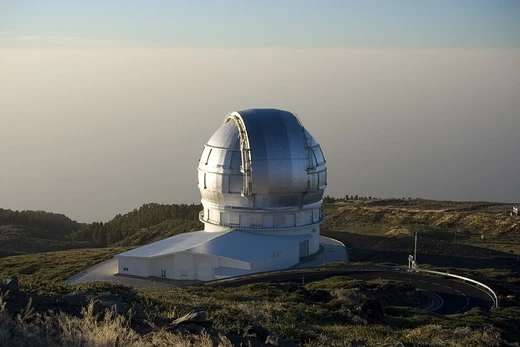
Sarah L. Krizmanich Telescope
A 0.8-m reflector used for undergraduate research and outreach at Notre Dame.

The Sarah L. Krizmanich Telescope (SLKT) is a 0.8-meter Optical Guidance Systems reflecting telescope located at the Jordan Hall of Science on the University of Notre Dame campus. It is used for undergraduate astronomy and astrophysics research and teaching, and has contributed to discoveries concerning cataclysmic variable stars and a potential exoplanet.
Quick Facts
- Organization
- University of Notre Dame, Optical Guidance Systems
- Location
- Jordan Hall of Science, University of Notre Dame, du lac, Notre Dame, IN
- Wavelength
- Visible
- First Light
- Sep 21, 2013
- Diameter
- 0.8 m (31.5 in)
- Focal Length
- f/8 (6.4 m)
- Mounting
- Altazimuth
- Dome
- Ash Dome, Plainfield, IL
Facts from the source article.
Lore & Background
The telescope was installed in 2013 in a rooftop observatory at the Jordan Hall of Science, which opened in September 2006 after construction began in November 2003. The $70 million, 200,000 square foot facility was underwritten by 1969 Notre Dame graduate John W. 'Jay' Jordan III. Late Notre Dame professor Terrence Rettig (1946-2021) played an important role in establishing the campus observatory and digital visualization theater, and was described by professor Peter Garnavich as 'the founder of astronomy at Notre Dame.' The telescope was a gift from the Krizmanich family and is named in memory of Notre Dame student Sarah L. Krizmanich, who, according to her sister Amy Krizmanich, 'had a love for teaching and a passion for helping others.'
The telescope features a Ritchey-Chretien optical system designed for imaging with a CCD camera, and employs an altazimuth mount. Light can be diverted to a sensor or eyepiece behind the primary mirror or, using a third mirror, to a Nasmyth focus along the altitude axis. It uses a Santa Barbara Instruments Group CCD camera and colored filters. The telescope can also be equipped with an eyepiece for public outreach events. The observatory, telescope, and camera are operated remotely from an adjacent workroom or from researchers' homes.
Reader's Guide
The Krizmanich Telescope is notable as one of the largest telescopes in Indiana and is specifically built for undergraduate research and as a testing instrument for new instrumentation. Its convenient location on campus facilitates student use. Research conducted with the telescope includes the 2016 discovery by Peter Garnavich and Colin Littlefield of an unusual dimming in the cataclysmic variable star system FO Aquarii. In 2018, Garnavich, Littlefield, and Robert Stiller published observations of the AR Scorpii binary system, the first known white dwarf pulsar, using data from the telescope to measure the slowing of the white dwarf's rotation. Undergraduate McKenna Leichty, under Garnavich's tutelage, used the telescope to observe cataclysmic variable V808 Aurigae, revealing a potential 7 Jupiter-mass exoplanet in an eccentric orbit about the white dwarf/red dwarf binary, named V808 Aurigae b. The telescope has also been used for public outreach, including a 'Summer Stargazing' event on July 6, 2018, that drew an estimated 1,500 people, hosted by professor Jonathan Crass.
Did You Know?
- The telescope helped discover a potential exoplanet, V808 Aurigae b, with an orbital period of about 11 years.
- The telescope can be operated remotely from researchers' homes.
Frequently Asked Questions
What is the Sarah L. Krizmanich Telescope (SLKT)?
The SLKT is a 0.8-meter (32-inch) Ritchey-Chretien reflecting telescope that serves as a hands-on research and teaching instrument for undergraduate astronomy and astrophysics students at the University of Notre Dame.
Where is the SLKT located and when was it installed?
It sits at the Jordan Hall of Science on the Notre Dame campus and was brought online in 2013, giving students a dedicated optical system for their coursework and projects.
What are the key optical and mechanical specs of the SLKT?
The telescope uses a Ritchey-Chretien reflecting design at f/8, rides on an altazimuth mount, and provides an 0.8-meter collecting aperture for its Optical Guidance Systems work.
What notable discoveries has the SLKT helped produce?
Students working with the instrument have contributed observations related to cataclysmic variable stars as well as a candidate exoplanet detection, showing that a modest campus reflector can still yield publishable science.
Why is the SLKT important to the Notre Dame astronomy community?
It gives undergraduates direct, repeated access to a real research-grade reflector, bridging the gap between classroom theory and actual data collection in a way that larger, professor-only facilities typically do not.
More in Optical Telescopes, Part 3 1-21
Spotted an error? Know more?
Reader corrections go straight into our review queue. Suggest an edit · How this site is sourced