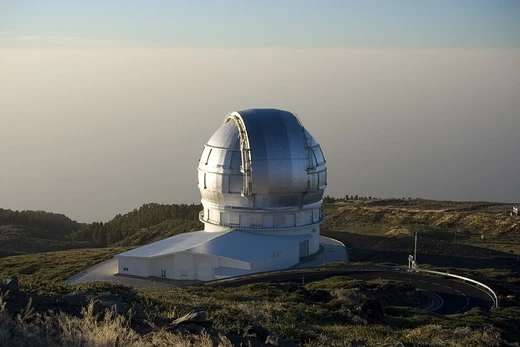
Arago telescope
38 cm refractor at Paris Observatory, used for photometry and double stars.

The Arago telescope, also known as the Lunette Arago, is a refracting telescope with a 38 cm (15 inch) aperture located at the Paris Observatory, where it was installed in 1857. The instrument was ordered in 1839 by François Arago from the firm Lebreours, but development was prolonged, with the objective lens completed by 1844 and the full telescope finished by 1855. The name "Lunette Arago" is a modern designation; historically, it has been referred to by various names tied to its aperture, its position on the observatory's East tower, or its equatorial mount built by Brunner. In English, it has been called the "east equatorial" or "38 cm refractor," while in French it is known as *La lunette équatoriale de 38 cm de l'Observatoire de Paris*. The objective lens measured 14 *pouces* (Paris inches), equivalent to about 38 cm (or 14.96 English inches, usually rounded to 15). The equatorial mounting, made by Brunner, was delivered in 1859, and the clock drive was supplied by Breguet. The mounting was not ordered until the early 1850s, after the new dome work, completed in 1847, had been finished. The telescope was placed in this new east dome, built atop the observatory, and the dome's floor was designed to be movable. The Paris Observatory building itself underwent significant modifications to support the weight of the telescope and dome, including a new cement support structure and a steel lattice. The original lens had issues and was re-polished in 1874. In the early 1880s, a new objective lens made by the Henry Brothers was installed, and the dome and mounting were modified at that time, including replacing an earlier wooden tube with an iron one. The telescope was used for observing double stars, minor planets (asteroids), and some photographic astronomy in the late 19th century. When it debuted in the late 1850s, it was noted for its Lerebours objective, Brunner mount, and potential for astrophotography. The telescope is particularly noted for photometric observations of Jupiter's Galilean satellites (Io, Europa, Callisto, and Ganymede) in the 1880s. Astronomers Corunu and Obrecht used it to photometrically detect eclipses of Jupiter by its moons at the Paris Observatory. The first such detection occurred on June 23, 1878, using the East Equatorial (the Arago). Various photometers were employed with the telescope, including polarizing types.
- Aperture
- 38 cm (15 inches)
- Type
- refracting telescope
- Location
- Paris Observatory
- Installation year
- 1857
- Objective maker
- Lerebours
- Mount maker
- Brunner
- Clock drive maker
- Breguet
Lore & Background
Francois Arago ordered the telescope from the firm Lebreours in 1839, and after a protracted development it was completed by 1855. The original objective lens was completed by Lerebours by 1844. The equatorial mounting made by Brunner was delivered in 1859, and the clock drive was made by Breguet. The telescope was installed in a new east dome built for it on top of the Paris Observatory building, and the floor of the dome was designed to move. The equatorial mounting was not ordered until the early 1850s, after the new dome work, completed in 1847, had been finished. The telescope has gone by a variety of names, including 'east equatorial', '38 cm refractor', and in French 'La lunette équatoriale de 38 cm de l'Observatoire de Paris'. The objective lens had some issues and was re-polished in 1874. In the early 1880s a new objective lens was installed, made by the Henry Brothers, and the dome and mounting were modified at that time, including replacing an earlier wooden tube with one of iron. The Paris Observatory building was significantly modified to support the weight of the new telescope and dome, including a new cement support structure and a steel lattice.
Reader's Guide
The Arago telescope is significant for its role in photometric astronomy, particularly the photometric detection of eclipses of Jupiter's moons. On June 23, 1878, the East Equatorial (the Arago) was first used for photometric detection of an eclipse of Jupiter's moons. In the 1880s, Corunu and Obrecht photometrically detected the eclipses of Jupiter by its moons at Paris Observatory. The telescope was used with various photometers, including polarizing types, such as Photometers R, T, W, and H. Photometer R was a roughly half meter long brass tube, 5 cm in diameter with two quartz prisms inside; Photometer T had a drum 12.5 cm in diameter and over 17 cm long. The telescope was also used to photometrically study double stars with Photometer H. Over 1800 double stars were observed with the 38 cm between 1966 and 1971. It was used for PHEMU85, an international collaboration to view the moons of Jupiter in 1985. The telescope was also noted for its use in observing double stars, minor planets, and some photographic astronomy in the late 19th century.
Did You Know?
- The telescope's objective lens was originally 14 pouces (Paris Inches) across, about 38 cm.
- The equatorial mounting was made by Brunner and delivered in 1859.
- A Nicol prism was used at the eyepiece for certain instrumentation setups.
- The telescope was used for the PHEMU85 international collaboration to view Jupiter's moons in 1985.
The Hierarchy of Giant Refractors
Refracting telescopes gather and concentrate starlight through a lens rather than a mirror, and among these instruments a small handful stand at the very top of the size ranking. The Swedish 1-metre Solar Telescope holds the technical title for the largest refractor in existence, boasting a lens diameter of 43 inches with 39 inches of clear aperture. Just behind it sits the legendary 40-inch (102 cm) refractor at Yerkes Observatory, an instrument that has served astronomical and scientific research for well over a century. Following the Yerkes come the James Lick telescope and the Meudon Great Refractor, both celebrated as part of the classical tradition of great refractors. These instruments typically employed achromatic doublet lenses mounted on equatorial frameworks, a design philosophy that dominated the field for generations. While the Swedish solar telescope is technically the largest, its single-element, non-achromatic lens means it is not directly comparable to the doublet-based giants that define the classical category.
Achromatic Doublets and the Classical Formula
Most of the world's great refractors share a common optical recipe: an achromatic doublet lens paired with an equatorial mount. This design pairs a crown-glass element with a flint-glass element to cancel out chromatic aberration, delivering sharper images across the visible spectrum. The Yerkes, Lick, and Meudon instruments all followed this formula, representing the mature expression of nineteenth-century refractor engineering. However, not every large refractor fits this mould. The Swedish 1-metre Solar Telescope, for instance, employs a single-element, non-achromatic lens, making its optical configuration fundamentally different from the doublet-based instruments it outsizes. In the twenty-first century the field has also seen the rise of catadioptric telescopes, which blend refractive and reflective elements in the image-forming section. These later designs have incorporated larger meniscus lenses, pushing the boundary of what a refractive component can contribute within a hybrid optical system.
The Great Paris Exhibition Telescope of 1900
Among the most unusual entries in the catalogue of large refractors is the Great Paris Exhibition Telescope, a short-lived instrument built for the 1900 World's Fair. Unlike the steady equatorial-mounted giants that dominate the list, this telescope employed a radically different approach to directing light into its optical train. At its heart was a 78-inch (200 cm) Focault siderostat, a large mirror assembly used to aim incoming light into the image-forming section of the telescope. That section housed a 125 cm diameter lens, substantial in its own right. The trade-off for using a siderostat was an unavoidable reflective loss, as each mirror surface absorbed a fraction of the light before it reached the lens. The instrument also incorporated a mirror in its overall configuration, setting it apart from the purely refractive designs that make up the bulk of the list. Its brief existence and exhibition context make it a fascinating outlier in the history of large refracting optics.
The Eternal Balance: Cost, Scale, and Utility
From the earliest great refractors through to modern solar instruments, builders have faced the same fundamental tension: how to make a telescope as large and as optically pure as possible without the cost and engineering complexity becoming prohibitive. This struggle mirrors the challenges long familiar to reflecting-telescope designers, where every increment in aperture demands proportionally greater structural support, more precise grinding, and higher financial outlay. The Yerkes 40-inch refractor, which has remained in active scientific use for over a century, stands as a testament to what can be achieved when that balance is struck well. Meanwhile, the Swedish 1-metre Solar Telescope shows that pushing beyond the classical doublet formula—using a single, non-achromatic element—can yield a technically larger aperture, even if it sacrifices some of the optical refinement that defined the earlier generation of great refractors. The history of these instruments is, in many ways, a history of compromise.
Frequently Asked Questions
What is the Arago telescope?
The Arago telescope, commonly called the Lunette Arago, is a 38-centimeter refracting telescope housed at the Paris Observatory. It was installed in 1857 and has been used for photometric work and studying double stars.
Who commissioned and built the Arago telescope?
François Arago ordered the instrument in 1839 from the optical firm Lerebours, while the equatorial mount was constructed by Brunner. The objective lens was finished around 1844, though the complete telescope was not ready until 1855.
Why is it called the 'Lunette Arago' if that name came later?
The name 'Lunette Arago' is a modern label; historically the instrument was identified by its aperture size, its placement in the East tower of the observatory, or its Brunner-built equatorial mount. The Arago name persisted because he was the astronomer who commissioned the build.
What is the Arago telescope used for?
At the Paris Observatory, the 38 cm refractor has served primarily for photometry and the observation of double stars. Its relatively large aperture for the mid-nineteenth century made it well suited to resolving close stellar pairs.
How long did it take to build the Arago telescope?
From Arago's 1839 order to the telescope's completion in 1855, the project spanned roughly sixteen years. The objective lens alone took until 1844 to finish, and the finished instrument was not installed at the observatory until 1857.
More in Optical Telescopes, Part 3 1-21
Spotted an error? Know more?
Reader corrections go straight into our review queue. Suggest an edit · How this site is sourced