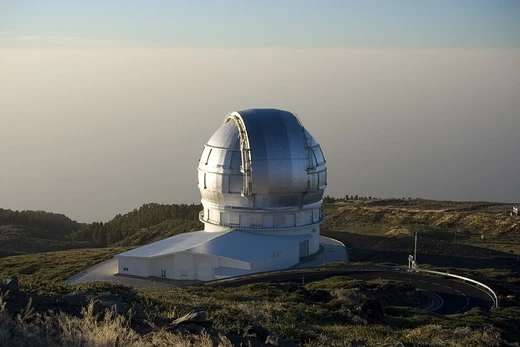
VLT Survey Telescope
Largest telescope designed exclusively for visible-light sky surveys.

The VLT Survey Telescope (VST) is a wide-field survey telescope located at ESO's Paranal Observatory in the Atacama Desert of northern Chile, housed in an enclosure adjacent to the four Very Large Telescope (VLT) Unit Telescopes on Cerro Paranal. It is notable as the largest telescope in the world designed exclusively to survey the sky in visible light, with a field of view twice as broad as the full Moon.
- Primary mirror diameter
- 2.65 meters
- Field of view
- 1 square degree (roughly two full moons)
- Location
- ESO Cerro Paranal Observatory, Atacama Desert, northern Chile
- Construction period
- 2007 to 2011
- Camera
- OmegaCAM (32 2Kx4K CCDs, 268 megapixels total)
- Mirror material
- Sitall (crystalline ceramic)
- First images released
- June 8, 2011
Lore & Background
The VST program began in 1997 as a cooperation between the Osservatorio Astronomico di Capodimonte (OAC) in Naples, Italy, and the European Southern Observatory (ESO). The OAC, part of Istituto Nazionale di AstroFisica (INAF), created the Centro VST a Napoli (VSTceN) to coordinate technological and scientific aspects, founded and directed by Prof. Massimo Capaccioli. ESO handled civil engineering and the dome, while VSTceN collaborated in the commission phase; ESO now solely manages operations and maintenance.
The telescope's original mirrors, manufactured at the Lytkarino Glass Factory in Moscow, were completed ahead of schedule but arrived in Chile in 2002 with the primary broken and the secondary damaged. A new primary and repaired secondary arrived in 2006. The primary mirror is 265 cm in diameter and 14 cm thick; the secondary is 93.8 cm in diameter and 13 cm thick. An active optics system controls the shape of the primary via 84 axial motors and 24 radial actuators, and the secondary via a deformable platform. A Shack–Hartmann wavefront sensor provides optical correction feedback.
OmegaCAM, at the Cassegrain focus, is a mosaic of 32 CCDs produced by an international consortium. It operates at about −140 degrees Celsius behind a dewar window that also acts as a corrector lens. Up to 12 filters from ultraviolet to near-infrared are available. The VST began observations and its first images were released on June 8, 2011, including the star-forming region Messier 17 and the globular cluster Omega Centauri.
Reader's Guide
The VST's primary function is to support the Very Large Telescope by providing surveys—both extensive multi-colour imaging surveys and specific searches for rare objects. Three public surveys began in October 2011: the Kilo-Degree Survey (KiDS), VST ATLAS, and VST Photometric Hα Survey of the Southern Galactic Plane (VPHAS+), anticipated to take five years. These focus on issues from searching for quasars to understanding dark energy. The VST aims to discover trans-Neptunian objects, extrasolar planet transits, and study the Milky Way's structure and evolution. It will explore nearby galaxies, extragalactic planetary nebulae, and perform surveys of faint objects and microlensing events. In cosmology, it targets medium-redshift supernovae and cosmic structures at medium-high redshift to understand galaxy formation and the Universe's early history. The VST ATLAS survey specifically targets baryon wiggles to determine the dark energy equation of state. The data volume is about 30 terabytes per year, processed by software developed at Groningen and Naples, with funding for data analysis uncertain in 2011.
Did You Know?
- The VST's primary mirror is 2.65 meters in diameter and only 14 cm thick, made from Sitall ceramic.
- The original primary mirror was broken during transport from Europe to Chile in 2002, causing delays.
- OmegaCAM operates at about −140 degrees Celsius and uses 32 CCDs totaling 268 megapixels.
- The VST's field of view is twice as broad as the full Moon, covering one square degree.
International Partnership & Institutional Framework
The VST Survey Telescope emerged from a long-standing collaboration that began in 1997 between Italy's Osservatorio Astronomico di Capodimonte and the European Southern Observatory. The Italian side, part of the broader INAF research network, established a dedicated coordination body called Centro VST a Napoli (VSTceN) to oversee both the technological and scientific dimensions of the project. Prof. Massimo Capaccioli founded and directed this center, which was physically hosted at the Capodimonte observatory in Naples. During the commissioning phase, ESO and VSTceN worked side by side, with ESO handling the civil engineering and dome construction at the Paranal site. Once the telescope entered regular operations, responsibility for day-to-day management and maintenance shifted entirely to ESO. This layered partnership—spanning a national institute, a dedicated project center, and an international observatory—gave the VST a governance structure that balanced scientific vision with operational expertise, ensuring the instrument could fulfill its survey mandate from the Atacama Desert.
Optical Architecture & Active Control
The VST employs a two-mirror Cassegrain design in which a 265-centimeter primary and a 93.8-centimeter secondary reflect sky light down to the OmegaCAM detector. Both optics are fabricated from Sitall, a crystalline ceramic prized for its minimal thermal expansion, making them well suited to the temperature swings at Cerro Paranal. What distinguishes the VST from a passive reflector is its computer-driven active optics system. Beneath the primary surface, 84 axial actuators and 24 laterally offset radial motors continuously reshape the mirror to preserve image fidelity. The secondary rides on a deformable platform that can tilt it mid-exposure. A Shack–Hartmann wavefront sensor, paired with a local guide system, supplies real-time correction feedback. Additionally, the primary cell houses a swappable optical module: a double-lens corrector for standard imaging or a counter-rotating prism pair that compensates for atmospheric dispersion as the telescope changes altitude. Together, these subsystems allow the VST to guide, track, and correct itself autonomously throughout an observing night.
OmegaCAM & the Data Deluge
At the Cassegrain focus sits OmegaCAM, a wide-field imaging camera built by an international consortium spanning the Netherlands, Germany, Italy, and ESO. Its detector mosaic comprises 32 CCDs, each with a 2K-by-4K pixel array, yielding a combined 268 megapixels. Four smaller auxiliary CCDs handle auto-guiding and on-line image analysis, while up to 12 filters covering ultraviolet through near-infrared wavelengths give astronomers flexible photometric capability. The entire detector assembly operates in a vacuum at roughly minus 140 degrees Celsius behind a large dewar window, which simultaneously shields the sensors from moisture and serves as an additional corrector lens. The scientific output is enormous: approximately 30 terabytes of raw data are generated each year, streaming back to European data centers. Sophisticated processing software, developed collaboratively in Groningen and Naples, transforms this torrent into catalogues of detected objects and calibrated images that are distributed to the global astronomical community.
A Bumpy Road to First Light
The path from design to operational telescope was marked by several setbacks. The original primary and secondary mirrors, manufactured at the Lytkarino Glass Factory in Moscow, were completed ahead of schedule. However, when they arrived in Chile in 2002, the primary was discovered to be broken and the secondary was damaged, forcing a return to the workshop. The replacement primary and repaired secondary did not reach Paranal until 2006. After Italian testing, the telescope was disassembled, painted, packed, and shipped; the first components landed in June 2007, and the initial integration phase at the observatory was finished by April 2008. Yet delays persisted: the primary mirror cell sustained water damage during transit to Chile and had to be sent back to Europe for repair while the mirrors waited in storage. These compounding logistical problems stretched the construction timeline from 2007 to 2011, a reminder that even the most carefully engineered instruments face the unpredictability of long-distance transport and international coordination.
Frequently Asked Questions
Who is VLT Survey Telescope?
The VLT Survey Telescope (VST) is a 2.65-meter wide-field instrument operating at ESO's Paranal Observatory in Chile's Atacama Desert, housed in its own enclosure beside the four VLT Unit Telescopes on Cerro Paranal. It holds the distinction of being the largest telescope on Earth built exclusively for visible-light sky surveys.
What are VLT Survey Telescope's powers/role?
The VST captures a field of view spanning one square degree—about twice the area of the full Moon—through its OmegaCAM camera, which integrates 32 CCDs into a 268-megapixel sensor. Its core mission is to systematically map vast stretches of the visible sky, cataloging stars, galaxies, and transient events far faster than any narrow-field instrument could.
Why is VLT Survey Telescope important?
As the world's largest dedicated visible-light survey telescope, it can cover enormous sky areas in a single exposure, making it uniquely suited for all-sky mapping and time-domain astronomy programs. Its primary mirror, made from Sitall (a crystalline ceramic), also represents a materials-science milestone for large optical surfaces.
Where does VLT Survey Telescope live?
The VST sits in a purpose-built enclosure on Cerro Paranal in northern Chile, sharing the ESO site with the four Very Large Telescope units. Its Atacama Desert perch delivers the extremely dry, dark, and stable seeing conditions that high-precision visible-light photometry demands.
More in Optical Telescopes, Part 3 1-21
Spotted an error? Know more?
Reader corrections go straight into our review queue. Suggest an edit · How this site is sourced