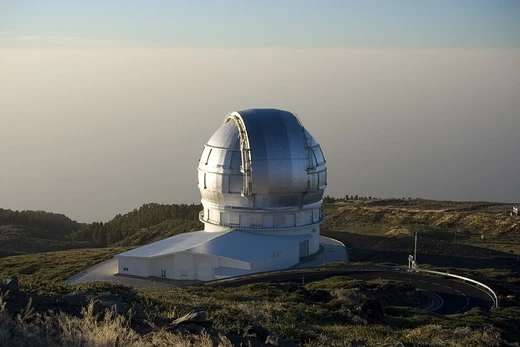
Space Surveillance Telescope
A US Space Force telescope tracking space debris and near-Earth objects.

The Space Surveillance Telescope (SST) is a U.S. Space Force telescope based in the Southern Hemisphere. Its mission is to detect, track, and catalog satellites, near-Earth objects, and space debris. The telescope first achieved first light in 2011 at the White Sands Missile Range in New Mexico. In 2017, it was taken apart and moved to the Harold E. Holt Naval Communication Station in Exmouth, Western Australia, a site about 65 meters above sea level. From there, it began observing the southern sky and feeding data to the U.S. Space Surveillance Network. The relocated telescope saw first light in Australia on March 5, 2020, and reached initial operational capability on October 4, 2022. It was originally run by the Royal Australian Air Force’s 1 Remote Sensor Unit under U.S. Space Force command and control. In early 2023, No. 1 Space Surveillance Unit took over operations. The SST’s main job is to help the military track and identify objects and threats in space, including debris, and to predict and avoid potential collisions. Whether for managing space traffic or protecting vital space assets, the telescope provides real-time awareness of the space domain for both the U.S. and Australia. Tracking space debris is a growing challenge. Of the 20,000 to 30,000 large objects in orbit that are monitored, an estimated 100 million objects—some as small as paint flecks—are too small to track easily but large enough to cause damage if they hit a spacecraft, mainly because of their extreme orbital speeds. This creates a problem: objects too big to shield against but too small to track. Another concern is Kessler syndrome, a chain reaction of collisions that could produce even more debris dangerous to working satellites. The SST also tracks near-Earth asteroids as part of its mission. The telescope was sponsored by DARPA and designed by the Massachusetts Institute of Technology Lincoln Laboratory. It has a 3.5-meter aperture mirror. Two key design features are its Mersenne-Schmidt optics and curved CCD sensors. The large curved focal surface array is considered an innovative design. The system offers improved detection sensitivity, a short focal length, a wide field of view, and better step-and-settle abilities. The SST can detect and track small, faint objects in deep space using a wide field of view.
- Field of view
- None
- Limiting magnitude
- None
- Record observations in single year
- None
Lore & Background
The SST achieved first light in 2011 at the White Sands Missile Range, New Mexico, United States. In 2017, it was dismantled and moved to the Harold E. Holt Naval Communication Station, Exmouth, Western Australia, at an altitude of about 65 meters (213 ft). From there it began observing the Southern Celestial Hemisphere and collecting data for the US Space Surveillance Network. The repositioned SST achieved first light in Australia on 5 March 2020, entered initial operational capability on 4 October 2022, and was originally operated by the Royal Australian Air Force's 1 Remote Sensor Unit under the command and control of the U.S. Space Force. No. 1 Space Surveillance Unit assumed responsibility for operating the SST in early 2023.
Reader's Guide
The Space Surveillance Telescope is significant primarily for its military role in tracking and identifying objects and threats in space, including space debris, and for predicting and avoiding potential collisions. It maintains real-time awareness of the space domain for both the U.S. and Australia, supporting space traffic management and protection of critical space-based capabilities. The discovery and tracking of space debris is a growing problem: among the 20–30 thousand large tracked objects in orbit, an estimated 100 million objects as small as paint flecks are harder to track but large enough to shield against if they collide with a space asset. Paint flecks cause damage due to their extreme orbital velocity, creating a category of objects too big to easily shield against but too small to track. The SST also addresses concerns such as the Kessler syndrome—a chain reaction of collisions creating more debris dangerous to working satellites—and near-Earth asteroids, which it tracks as part of its mission. Its legacy includes holding the world record for most observations in a single year, demonstrating its efficiency and sensitivity in surveying the sky.
Did You Know?
- The SST was originally located at White Sands Missile Range, New Mexico, before being moved to Western Australia.
- It uses a Mersenne-Schmidt design with a curved CCD focal plane array, an innovative feature.
- In 2015, the SST made a record 6.97 million observations, the most of any telescope in a single year.
- The SST can detect objects down to apparent magnitude 20.5 and has a field of view of 6 square degrees.
Operational Journey: From New Mexico to Western Australia
The Space Surveillance Telescope began its operational life in 2011 when it achieved first light at the White Sands Missile Range in New Mexico. However, its mission demanded a vantage point in the Southern Hemisphere, prompting a major relocation in 2017. The instrument was fully dismantled at its American site and transported to the Harold E. Holt Naval Communication Station at Exmouth in Western Australia, where it was reassembled at an altitude of roughly 65 metres. From this new position, the telescope turned its gaze southward, beginning to collect data for the United States Space Surveillance Network. After a period of commissioning, it recorded first light in Australia on 5 March 2020. Two years later, on 4 October 2022, the system reached initial operational capability. During its early Australian service, day-to-day operations fell to the Royal Australian Air Force's 1 Remote Sensor Unit, operating under the command and control of the U.S. Space Force. In early 2023, responsibility shifted to No. 1 Space Surveillance Unit, which continues to manage the telescope's ongoing surveillance duties.
Guarding the Orbital Environment
The primary strategic role of the Space Surveillance Telescope is to give the United States and Australia continuous, real-time awareness of what occupies their shared space domain. Beyond cataloguing the twenty to thirty thousand large objects already under surveillance, the telescope addresses a far more troubling problem: the estimated hundred million smaller fragments, some no larger than paint flecks, that orbit at extreme velocities and can puncture spacecraft shielding. These mid-sized debris pieces occupy a dangerous gap—they are too small to be reliably tracked yet too large to ignore as a collision threat. The telescope also contributes to understanding the Kessler syndrome, a cascading scenario in which one collision generates additional fragments that trigger further impacts, exponentially multiplying the debris population. In addition to debris and operational satellites, the system tracks near-Earth asteroids as part of its broader mission. Whether the goal is space traffic management or protecting critical space-based assets, the SST provides the detection and tracking data needed to predict and avoid potential collisions.
Optical Engineering and Agile Design
Sponsored by DARPA and engineered by the Massachusetts Institute of Technology's Lincoln Laboratory, the Space Surveillance Telescope packs an ambitious set of optical features into a single instrument. Its 3.5-metre primary mirror operates at an exceptionally fast F/1.0 focal ratio within a Mersenne-Schmidt optical configuration. Rather than a flat detector, the system employs an array of charge-coupled device sensors mounted on a curved focal plane, a design choice the developers regard as a significant innovation. This curved CCD arrangement, combined with the short focal length, delivers a wide field of view spanning six square degrees while maintaining high detection sensitivity for small, dimly lit objects with low reflectivity. The telescope's mount incorporates advanced servo-control technology that makes it one of the fastest and most agile instruments of its size, enabling rapid step-and-settle movements. On a clear night, the SST can scan the visible sky down to apparent magnitude 20.5, completing multiple full searches in a single evening and sweeping the entire geostationary belt within its field. The system can also pinpoint precise object locations, extrapolate individual orbital courses, and assess the stability of tracked bodies.
A Record-Breaking Observation Machine
Perhaps no single statistic better captures the sheer throughput of the Space Surveillance Telescope than its standing with the Minor Planet Center, which currently lists the SST as the world record holder for the greatest number of observations recorded in a single year. In 2015, the telescope logged an extraordinary 6.97 million observations, a figure that dwarfed every other instrument in the global catalogue. The runner-up, Pan-STARRS, managed 5.25 million observations in its best year (2014), a substantial gap that underscores the SST's unique combination of capabilities. Achieving such volume requires a telescope that is simultaneously sensitive enough to detect small, faint, low-reflectivity objects in deep space and fast enough to sweep large portions of the visible sky in a short time. Most optical instruments must sacrifice one of these traits for the other, making the SST's dual capability a genuinely difficult engineering achievement. The wide field of view system, paired with the agile mount and curved detector array, allows the telescope to conduct repeated, comprehensive sky surveys night after night, generating the vast observational datasets that underpin its space surveillance and asteroid-detection missions.
Frequently Asked Questions
What is the Space Surveillance Telescope?
The Space Surveillance Telescope is a U.S. Space Force optical instrument dedicated to spotting, tracking, and cataloging artificial satellites, near-Earth objects, and orbital debris. It currently operates from a site in Western Australia, giving it a clear view of the southern sky that complements northern-hemisphere assets.
Where is the Space Surveillance Telescope located and why was it moved there?
After earning first light in 2011 at White Sands Missile Range in New Mexico, the telescope was disassembled in 2017 and reassembled at the Harold E. Holt Naval Communication Station in Exmouth, Western Australia, roughly 65 metres above sea level. The relocation lets it survey the southern celestial hemisphere, a region that was previously poorly covered by the U.S. Space Surveillance Network.
What exactly does the Space Surveillance Telescope track?
Its core mission is threefold: detect new objects in orbit, track the trajectories of known satellites and space debris, and monitor near-Earth objects that could pose a hazard. All of that data is fed into the broader U.S. Space Surveillance Network for operational use.
When did the Space Surveillance Telescope first operate?
The telescope achieved first light at its original New Mexico site in 2011. After the 2017 move to Exmouth, it was reassembled and saw first light again from its Australian position, resuming southern-sky observations.
Why is the Space Surveillance Telescope important to the space-surveillance community?
Because it is one of the few dedicated optical trackers positioned in the Southern Hemisphere, it fills a critical gap in global coverage that northern-only networks simply cannot see. Its continuous cataloging of debris and near-Earth objects helps operators plan safe maneuvers and gives scientists early warning of potentially hazardous approaches.
More in Optical Telescopes, Part 3 1-21
Spotted an error? Know more?
Reader corrections go straight into our review queue. Suggest an edit · How this site is sourced