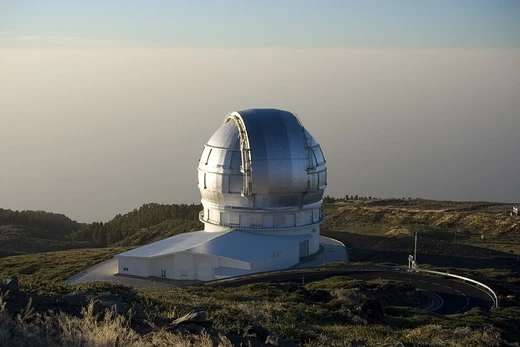
Carnegie telescope
Twin refractor for astrophotographic surveys of stellar motion.

The Carnegie telescope, also known as the Carnegie double astrograph, is a twin 20-inch (510 mm) refractor telescope located at Lick Observatory in California, United States. It consists of two 20-inch telescopes mounted side by side on a single precision equatorial mount, giving it the appearance of a large set of binoculars. The telescope was designed not for visual observation but for astrophotographic surveys, using two lenses each corrected for a specific wavelength of light recorded on film emulsion. It is notable for its role in photographic sky surveys in the late 20th century, particularly the Lick Proper Motion Survey, which studied galactic rotation and proper motion.
- Type
- Twin 20-inch (510 mm) refractor
- Location
- Lick Observatory, California, United States
- Construction start
- 1930s
- Completion
- 1960s (second lens added)
- First lens installed
- 1946 (Ross-Fecker lens, corrected for blue light)
- Second lens installed
- 1962 (Perkin-Elmer lens, corrected for yellow light, four elements)
- Mount
- Precision equatorial mount
Lore & Background
The Carnegie telescope's construction began in the 1930s with a grant from the Carnegie Institution, though it was not completed until the 1960s when a second lens was added. The first survey was conducted between 1947 and 1954 using the blue-light corrected Ross-Fecker lens installed in 1946. The second lens, manufactured by Perkin-Elmer, was added in 1962 and corrected for yellow light; it has four elements (two crown, two flint) with a clear aperture of 21.5 inches on the first element surface and weighs 820 pounds. The telescope was built by Warner & Swasey according to a design by Doctor F.E. Ross.
The double telescope is housed in a mid-sized dome at Lick Observatory. Because it is actually two 20-inch telescopes side by side on a single mount, it looks more like a large set of very long binoculars. One side photographs blue light and the other yellow light. The Carnegie was built expressly to measure the motions of as many stars as possible in our local area of the Milky Way, a project called the Lick Proper Motion Survey. Its mission was to photograph the entire night sky twice: once in the 1950s and again 20 years later. By comparing both sets of photographs, much was learned about the motion of stars and the structure of our galaxy.
Reader's Guide
The Carnegie telescope's significance lies in its dedicated use for astrophotographic surveys that advanced understanding of galactic structure and stellar motion. Its twin-lens design allowed simultaneous photography in blue and yellow light, enabling precise measurements of star positions over time. Two noted results were the Shane-Wirtanen galaxy counts and the Lick Northern Proper Motion project. The overall goal was to study the 'problem of galactic rotation and proper motion,' and the surveys were successfully completed. The telescope is not used today except when photographs of a wide area of the sky are needed, but its legacy endures through the data it produced, which provided insights into the motions of stars and the structure of the Milky Way. The Carnegie's method of comparing photographic plates taken decades apart was a pioneering approach to proper motion studies, contributing to the field of astrometry.
Did You Know?
- The Carnegie telescope is actually two 20-inch refractors mounted side by side, resembling a large set of binoculars.
- Its first lens, corrected for blue light, was installed in 1946 and used for a survey from 1947 to 1954.
- The second lens, added in 1962, was manufactured by Perkin-Elmer and weighs 820 pounds.
Aperture: The Yardstick of Giant Optics
When astronomers rank the world's most powerful light collectors, they reach for a single number first: the effective optical aperture. Expressed as the diameter of a circle whose collecting area matches the instrument's total, this figure has served as a practical shorthand for decades, encoding limiting resolution, physical scale, and construction cost into one comparable value. The list in question sets its entry threshold at three metres, capturing every reflecting telescope whose visible or near-infrared aperture meets or exceeds that mark. The rule is not without nuance, however. A mirror's physical diameter can exceed the usable aperture, and instruments that cannot deploy their full primary surface at once—such as the HET or LAMOST—are catalogued by their maximum effective aperture rather than their total glass area. Segmented or multi-mirror systems mounted together and producing a single combined image are ranked by their equivalent combined aperture, while telescopes that occasionally function as interferometers are listed as individual instruments rather than as a merged array. This careful bookkeeping ensures that the ranking reflects genuine collecting power rather than raw mirror size.
Interferometry: Stretching Resolution Beyond a Single Dish
A single mirror, no matter how vast, has limits. Interferometry pushes past those limits by combining light from separated apertures, and the largest optical reflectors have become natural candidates for this technique. The twin Keck telescopes, when paired as the Keck Interferometer, can achieve a baseline of up to eighty-five metres, yielding resolutions far beyond either mirror alone. The trade-off is a narrower observational range: the high resolution comes at the cost of a more restricted field and wavelength coverage. The Large Binocular Telescope takes a different architectural approach. Its two mirrors share a single mount with a combined spacing of twenty-two-point-eight metres, a geometry that permits fuller exploitation of aperture synthesis because the two apertures move and track as one unit. This design choice means the LBT can use its combined light-gathering and resolution advantages more flexibly across a broader set of observations than a pair of independently steered mirrors could. In both cases, the principle is the same: separation between collecting surfaces translates directly into finer angular detail, but the engineering constraints of how those surfaces are arranged determine how practically useful that detail becomes.
Ground vs. Orbit: Why Bigger Is Not Always Better
A common assumption is that the largest mirror automatically delivers the best science, yet the overall light-gathering power of an optical system can be a misleading proxy for performance. Space-based instruments like the Hubble Space Telescope sidestep the turbulence of Earth's atmosphere entirely, achieving higher resolution and accumulating photons over longer, uninterrupted exposures that ground-based optics simply cannot match. Terrestrial sites face additional constraints: a telescope in the northern hemisphere cannot observe the southern sky and vice versa, and local climate dictates how many clear nights are available each year. Nevertheless, the largest Earth-based reflectors have found a counter-advantage. By pairing enormous mirrors with carefully chosen sites featuring stable atmospheric conditions, and by deploying active and adaptive optics to correct residual turbulence in real time, they can now surpass Hubble in resolution for certain observations. A further practical benefit is maintenance: upgrading or replacing instruments on a ground-based telescope is far less costly and logistically complex than servicing a spacecraft in orbit, giving ground facilities a flexibility that no space mission can replicate.
The Next Decade of Giants
The frontier of optical astronomy is being reshaped by a wave of telescopes in various stages of construction and design. In Chile, the Extremely Large Telescope, with a thirty-nine-point-five-metre aperture, began construction in 2018 and targets first light in 2029. The Giant Magellan Telescope, also in Chile, will combine seven eight-point-four-metre mirrors on a single mount, delivering an effective aperture of twenty-one-point-four metres and resolving power equivalent to a twenty-four-point-five-metre mirror, with first light also planned for 2029. In Hawaii, the Thirty Metre Telescope started construction in 2014 but was halted the following year and, as of 2025, has not resumed. Mexico's San Pedro Martir Telescope, at six-point-five metres, was slated for first light in 2023. New Mexico's Magdalena Ridge Observatory Interferometer, an array of ten one-point-four-metre telescopes with light-gathering power equivalent to a four-point-four-metre single aperture, paused in 2019 over funding and resumed in 2021. Indonesia's Timau National Observatory, at three-point-eight metres, is expected to be completed by early 2025. Beyond these, proposals include the Habitable Worlds Observatory for the early 2040s, a six-point-five-metre spectroscopic survey telescope called MUST, and China's Giant Solar Telescope with light-gathering power equivalent to a five-metre aperture.
Frequently Asked Questions
What is the Carnegie telescope?
The Carnegie telescope is a twin 20-inch (510 mm) refractor pair housed at Lick Observatory in California. It looks like a giant set of binoculars because two separate optical tubes share one precision equatorial mount. Rather than being meant for direct visual use, it was purpose-built to photograph the sky.
How does the Carnegie double astrograph work?
Each of the two 20-inch lenses is optically corrected for a different wavelength: the Ross-Fecker lens targets blue light while the Perkin-Elmer lens targets yellow light. Photographs taken through the two channels are compared to measure how stars shift position over time. This dual-wavelength design made it a dedicated instrument for astrophotographic surveys of stellar motion.
When was the Carnegie telescope built and completed?
Planning and construction began in the 1930s, but the first lens (the blue-light Ross-Fecker element) was not installed until 1946. The second, four-element Perkin-Elmer lens for yellow light was added in 1962, finally completing the twin configuration. So the telescope took roughly two decades to reach its full operational form.
Where is the Carnegie telescope located?
It sits at Lick Observatory in California, United States, where it has served as a fixed survey instrument. Its position at a well-established astronomical site allowed it to participate in long-running photographic sky-survey programs throughout the late twentieth century.
Why is the Carnegie telescope notable among refractors?
Its side-by-side twin design on a single mount is extremely rare, making it one of the largest refractor pairs ever built. It was never intended for visual astronomy but specifically for recording stellar positions on film at two carefully chosen wavelengths. That niche role in late-20th-century photographic surveys of proper motion gives it a distinctive place in telescope history.
More in Optical Telescopes, Part 3 1-21
Spotted an error? Know more?
Reader corrections go straight into our review queue. Suggest an edit · How this site is sourced