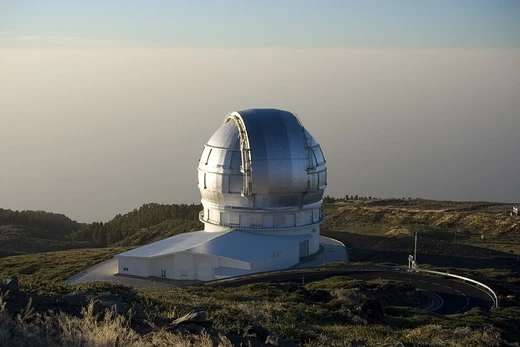
Southern African Large Telescope
Largest optical telescope in the Southern Hemisphere, optimized for spectroscopy.

The Southern African Large Telescope (SALT) is a 9.2-metre optical telescope designed mainly for spectroscopy, located near Sutherland in the Karoo, South Africa. It is the largest optical telescope in the Southern Hemisphere, enabling spectroscopic, polarimetric, and imaging observations of astronomical objects not viewable from Northern Hemisphere telescopes.
Quick Facts
- Built
- 2005
- Angular Resolution
- EE(50) ≤ 0.6"
- Area
- 79 m / 2 / (91 × 0.87 m / 2 / ) / 66.5 m / 2 / (effective aperture)
- Mounting
- 45 ton steel structure
- Dome
- 25 m spherical
Facts from the source article.
Lore & Background
SALT is closely based on the Hobby–Eberly Telescope (HET) at McDonald Observatory, with design changes especially to the spherical aberration corrector to improve the field of view. It shares the same fixed mirror altitude design, limiting access to 70% of the visible sky. The primary mirror consists of 91 hexagonal segments of low-expansion Sitall glass, each 1 meter in inscribed diameter, forming a spherical primary 11.1 by 9.8 m. The telescope uses a four-mirror spherical aberration corrector providing a corrected flat focal plane with an 8-arcminute field of view at prime focus. During observations, the mirror remains fixed at a zenith angle of 37 degrees, optimized for the Magellanic clouds, while the payload tracks the target. The entrance pupil varies in size during tracking.
First light with the full mirror occurred on 1 September 2005, producing 1-arc-second resolution images of globular cluster 47 Tucanae, open cluster NGC 6152, spiral galaxy NGC 6744, and the Lagoon Nebula. The official opening by President Thabo Mbeki took place on 10 November 2005. South Africa contributed about a third of the total US$36 million budget for the first 10 years, with the rest from Germany, Poland, the United States, the United Kingdom, and New Zealand. The telescope is connected to the SAAO site in Cape Town via a 1 Gbit/s fibre connection over the SANREN network.
Reader's Guide
SALT is a facility of the South African Astronomical Observatory, the national optical observatory of South Africa. Its design, based on HET, reduces construction cost by fixing the primary mirror and transferring tracking complexity to the lighter payload. The telescope enables research on quasars, stars, and galaxies a billion times too faint for the naked eye. First-generation instruments include SALTICAM (a digital camera), the Robert Stobie Spectrograph (a multi-purpose spectrograph and spectropolarimeter), and a fiber-fed High Resolution Spectrograph. Research using SALT has led to discoveries about compact stars, black holes, and Type Ia supernovae used to show the universe's expansion is speeding up. It has also aided studies of polar binary star systems, galactic structure, and stellar astrophysics. Despite initial estimates of 30,000 annual tourists, SALT has brought about 14,000 visitors to Sutherland, creating at least 300 jobs in the town of 5,000.
Did You Know?
- SALT's primary mirror is composed of 91 hexagonal segments, each 1 meter in inscribed diameter.
- First light images included globular cluster 47 Tucanae and the Lagoon Nebula.
Optical Architecture and Light-Gathering Power
The ELT employs a five-mirror anastigmat configuration that distinguishes it from earlier reflecting telescopes. Its first three mirrors are non-spherical and work together to deliver exceptional image quality across a field of view spanning ten arcminutes—roughly one-third the apparent width of the full Moon. The fourth and fifth mirrors are flat; the fourth handles adaptive-optics correction of atmospheric turbulence, while the fifth provides tip-tilt stabilization. Together they redirect the light beam sideways to one of two Nasmyth focal stations positioned on either side of the telescope structure. The primary mirror, 39.3 metres in diameter, is segmented, while the secondary measures 4.25 metres. Six laser guide star units assist the adaptive system. In raw collecting power, the instrument will capture roughly a hundred million times more light than the unaided human eye and about ten times what the largest optical telescopes operating in 2025 can gather. Compared with the Hubble Space Telescope, the ELT offers approximately 250 times the light-gathering area and, per its specifications, images fifteen times sharper.
Scientific Ambitions and Research Priorities
The ELT was conceived to push astrophysical inquiry into territory previously out of reach. Its 40-metre-class aperture is specifically sized to make detailed atmospheric studies of planets orbiting other stars feasible. Beyond exoplanet work, the telescope is tasked with probing the very first galaxies that formed after the Big Bang, characterizing supermassive black holes at galactic centres, and investigating the so-called dark sector of the Universe, encompassing dark matter and dark energy. A further key objective is detecting water vapour and organic molecules within protoplanetary disks, the swirling rings of gas and dust from which new planetary systems are born. Within European research-infrastructure planning, the ELT holds the highest priority ranking, featured prominently in both the Astronet Science Vision and Infrastructure Roadmap and the ESFRI Roadmap. A Phase B study conducted in 2014 involved industry contracts to design and manufacture prototypes of critical components, including primary mirror segments, the adaptive fourth mirror, and the mechanical structure, alongside concept studies for eight scientific instruments.
Site Selection and Construction Milestones
In April 2010, the ESO Council chose Cerro Armazones in the Atacama Desert of northern Chile as the baseline location, situating the new facility 23 kilometres from the existing Paranal Observatory. Competing proposals had included Cerro Macon in Salta, Argentina; Roque de los Muchachos on the Canary Islands; sites in Morocco; and even Antarctica. Civil engineering work at the chosen site commenced in June 2014, following the ESO Council's approval in June 2012 and the securing of over 90 percent of the nominal budget by December 2014. The first stone of the telescope was ceremonially laid on 26 May 2017, marking the start of dome and telescope construction. The project had originally been projected to run eleven years, from 2014 to 2025, but the timeline has since shifted. By July 2023 the ELT had passed its halfway development and construction milestone. Technical first light is now scheduled for March 2029, with the first dedicated scientific observations targeted for December 2030.
Design Evolution and Global Context
The ELT did not arrive at its final form overnight. An earlier feasibility study had examined a 100-metre Overwhelmingly Large Telescope, but the projected cost of 1.5 billion euros and extreme engineering complexity led ESO to abandon that concept. The initial baseline design called for a 42-metre primary mirror and a 5.9-metre secondary. In 2011, a revised proposal trimmed the overall size by 13 percent, reducing the primary to 39 metres and the secondary to 4.2 metres. This smaller secondary was a practical advantage: it fell within the manufacturing capability of multiple suppliers and eliminated the need for high-strength materials in the mirror support structure. Projected costs dropped from 1.275 billion to 1.055 billion euros, and the build schedule tightened to ten or eleven years. By 2017, with first-generation instruments included, the estimate stood at 1.15 billion euros. The project was originally branded the European Extremely Large Telescope before the name was shortened in 2017. In the broader global landscape, the ELT follows the segmented-mirror approach pioneered by the Keck Telescopes, the Gran Telescopio Canarias, and the Southern African Large Telescope, each of which assembles hexagonal segments into a composite aperture just over ten metres across.
Frequently Asked Questions
What is the Southern African Large Telescope?
SALT is a 9.2-metre optical telescope situated near Sutherland in South Africa's Karoo region. It holds the distinction of being the largest optical telescope in the entire Southern Hemisphere.
Where is SALT located and why does that matter?
The observatory sits at roughly 1,837 metres above sea level near Sutherland, in the Karoo of South Africa. Its southern latitude grants access to vast stretches of the night sky that are simply invisible to telescopes operating in the Northern Hemisphere.
What is special about SALT's primary mirror?
The primary mirror measures 11.1 by 9.8 metres and is assembled from 91 individually inscribed segments, each one metre in diameter. This segmented construction lets the telescope reach a 9.2-metre effective aperture while keeping the structure practical to build and maintain.
What is SALT's main scientific purpose?
The telescope is optimized primarily for spectroscopy, though it also handles polarimetric and imaging observations. This makes it a powerful instrument for probing the chemical composition, motion, and physical properties of celestial objects.
Why is SALT important to the global astronomy community?
As the largest optical instrument in the Southern Hemisphere, SALT fills a critical gap by observing sky regions—such as the galactic centre and the Magellanic Clouds—that northern-based telescopes cannot reach. It gives the world a high-resolution spectroscopic capability aimed squarely at the southern sky.
More in Optical Telescopes, Part 3 1-21
Spotted an error? Know more?
Reader corrections go straight into our review queue. Suggest an edit · How this site is sourced