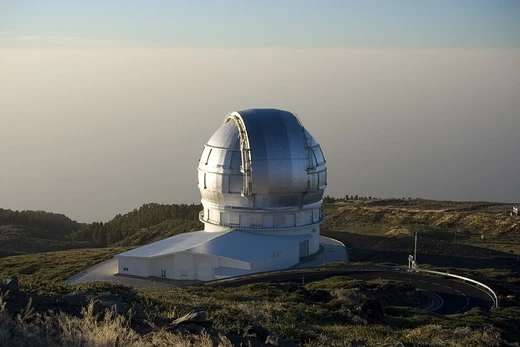
Southern Astrophysical Research Telescope
Modern 4.1-meter telescope on Cerro Pachón, Chile, commissioned in 2003.

The Southern Astrophysical Research Telescope, or SOAR, sits atop Cerro Pachón in Chile at 2,738 meters. Its main mirror measures 4.1 meters across, and it was built to observe both optical and near-infrared light. First used in 2003, the telescope is run by a group that includes Brazil, Chile, Michigan State University, the Cerro Tololo Inter-American Observatory (part of the National Optical Astronomy Observatory), and the University of North Carolina at Chapel Hill. Each partner gets a guaranteed share of observing time, ranging from 10 to 30 percent.
To keep images sharp, the telescope uses active optics on its primary and secondary mirrors. At a wavelength of 500 nanometers, the median image quality is 0.7 arcseconds. Several instruments are kept ready, mounted at Nasmyth foci that can handle heavy loads, plus two lighter-duty bent-Cassegrain foci. Switching between them takes just a few minutes, done by rotating a 45-degree tertiary mirror. That mirror’s pointing is adjusted quickly to stop wind shaking the telescope from blurring the view.
The primary mirror has a total diameter of 4,300 millimeters, with an entrance pupil diameter of 4,100 millimeters and a central obstruction of 980 millimeters. Its working f-number is 1.6855—there is no prime focus. The focal plane works at f/16.625, giving an effective focal length of 68,176.3 millimeters. The gamma ratio, which relates focus shifts to secondary mirror movements, is 100.5. The field of view with no vignetting is 14.4 arcminutes across. The focal plane curves with a radius of 966.3 millimeters, and the sag at the maximum field is 10.59 millimeters.
As of mid-2014, the available instruments include a 16-million-pixel UV-optical imager (SOI, from CTIO); a near-infrared imager and spectrograph using a 1-million-pixel HgCdTe detector (OSIRIS, from Ohio State University and CTIO); a 16-million-pixel UV-optical imager and spectrograph (Goodman Spectrograph, from UNC); a 16-million-pixel near-infrared HgCdTe imager (SPARTAN, from MSU); and an adaptive optics module (SAM, from CTIO). A UV-optical integral-field spectrograph (SIFS, from Brazil) was being commissioned. Individual astronomers or teams can also bring their own instruments, though those are not available to everyone.
- Aperture
- 4.1 meters (13 ft)
- Location
- Cerro Pachón, Chile
- Elevation
- 2,738 meters (8,983 ft)
- Commissioned
- 2003
- Primary mirror diameter
- 4300 mm
- Entrance pupil diameter
- 4100 mm
- Effective focal length
- 68176.3 mm
- Median image quality
- 0.7 arcsec at 500 nm
Lore & Background
The SOAR telescope uses active optics on its primary and secondary mirrors to achieve a median image quality of 0.7 arcsec at a wavelength of 500 nm. Multiple instruments are available on standby, mounted at unusually high weight-capacity Nasmyth foci and two lower capacity bent-Cassegrain foci. Switching between instruments is accomplished within a few minutes by rotating the 45° tertiary mirror, whose pointing is adjusted at high speed to prevent image blur from wind-shake vibrations.
The telescope's optical specifications include a primary mirror total diameter of 4300 mm, entrance pupil diameter of 4100 mm, and a central obstruction of 980 mm. The focal plane working f/# is 16.625, with an effective focal length of 68176.3 mm. The zero-vignetting field diameter is 14.4 arcmin, and the focal plane radius of curvature is 966.3 mm.
Current instruments as of May 2014 include the UV–optical 16-million pixel imager (SOI), near-infrared imager and spectrograph (OSIRIS), UV–optical imager and spectrograph (Goodman Spectrograph), near-infrared imager (SPARTAN), and an adaptive optics module (SAM). Additional facility instruments, such as the UV–optical integral-field spectrograph (SIFS), were being commissioned. The dome is a $2 million, 66-foot-diameter structure weighing over 70 tons.
Reader's Guide
The SOAR telescope is significant as a modern 4.1-meter-class facility operated by an international consortium, providing guaranteed observing time shares ranging from 10 to 30 percent to its partners. Its active optics system and rapid instrument switching via the tertiary mirror enable efficient, high-quality observations across optical and near-infrared wavelengths. The telescope's design, with high-weight-capacity Nasmyth foci and bent-Cassegrain foci, accommodates a diverse suite of instruments, including imagers, spectrographs, and an adaptive optics module. Remote access is provided over Internet 2 for US astronomers and high-speed networks for Chilean and Brazilian astronomers, with an on-site operator controlling pointing while the remote astronomer manages instruments and data retrieval. The telescope's legacy lies in its collaborative model and technical innovations, such as wind-shake compensation, which contribute to its role in astronomical research.
Aperture and the Hierarchy of Light
The ranking of the world's most powerful optical reflecting telescopes rests on a single, deceptively simple metric: effective aperture. Defined as the diameter of a circle whose collecting area matches that of the instrument, aperture has served astronomers for generations as a proxy for resolution, physical scale, and construction cost. The list of instruments meeting the three-metre threshold captures every reflecting telescope whose primary mirror or mirror assembly gathers visible or near-infrared light at that scale or beyond. Mirrors themselves may extend past the usable aperture, and some systems employ segmented or multiple mirrors on a shared mount, ranked by their combined equivalent diameter. Within this hierarchy, the Southern Astrophysical Research Telescope occupies a position among the largest Earth-based optical reflectors, its substantial collecting area placing it firmly in the upper echelon of instruments that have shaped modern observational astronomy. The aperture criterion, while historically useful, is only one lens through which a telescope's true capability is measured.
The Interferometry Frontier
Beyond the limits of a single mirror, some of the most ambitious optical instruments push into the realm of interferometry, where multiple telescopes combine their light to synthesize an aperture far exceeding any individual element. The Keck I and Keck II telescopes, when operated together as the Keck Interferometer, achieve a baseline of up to eighty-five metres, delivering extraordinary angular resolution—albeit across a narrower band of wavelengths than a conventional single-aperture system. The Large Binocular Telescope takes a different structural approach: its two mirrors share a single mount with a combined spacing of twenty-two point eight metres, enabling a fuller exploitation of aperture synthesis within one instrument. These techniques illustrate a fundamental trade-off in large-scale astronomy. For the Southern Astrophysical Research Telescope, which relies on its own large primary mirror rather than interferometric pairing, the comparison underscores how different engineering philosophies can each claim a place at the frontier of what ground-based optics can resolve.
Grounded Advantage: Earth-Based versus Space-Based
Space-based observatories like the Hubble Space Telescope enjoy a natural advantage: operating above the turbulent layer of Earth's atmosphere, they achieve sharper images and can accumulate photons over longer exposure times without atmospheric interference. Yet the story is not one-sided. The largest ground-based reflectors, including the Southern Astrophysical Research Telescope, harness active and adaptive optics systems that correct for much of the atmospheric distortion in real time, allowing them to reach resolutions that surpass Hubble's in certain regimes. There is also a practical economic argument in favor of terrestrial instruments: upgrading or replacing detector packages and spectrographs on a ground-based telescope is comparatively inexpensive compared to the extraordinary cost of servicing or replacing hardware in orbit. Of course, hemisphere placement constrains which portion of the sky an observatory can access, and local climate determines how many clear nights are available each year—factors that shape the operational rhythm of any large-aperture facility.
The Next Generation of Giants
The current generation of large optical reflectors, including the Southern Astrophysical Research Telescope, is already being shadowed by a new wave of instruments under construction or in advanced design. In Chile, the Extremely Large Telescope will boast a thirty-nine point five metre aperture, with construction underway since 2018 and first light targeted for 2029. The Giant Magellan Telescope, also in Chile, will combine seven eight-point-four-metre mirrors on a single mount to produce an effective aperture of twenty-one point four metres and resolving power equivalent to twenty-four point five metres, with first light also planned for 2029. In Hawaii, the Thirty Metre Telescope saw its construction start in 2014 before being suspended the following year, and as of 2025 work has yet to pick up again. Smaller but still significant projects include the San Pedro Martir Telescope in Baja California and the Timau National Observatory in Indonesia. These upcoming giants will redefine the aperture hierarchy that currently ranks the world's largest optical instruments.
Frequently Asked Questions
What is the Southern Astrophysical Research Telescope?
SOAR is a 4.1-meter optical and near-infrared research telescope perched on Cerro Pachón in Chile at an elevation of 2,738 meters. It was commissioned in 2003 and is operated as a multi-partner facility rather than by a single institution.
Who runs SOAR and how is observing time shared?
The telescope is jointly managed by Brazil, Chile, Michigan State University, the Cerro Tololo Inter-American Observatory (under the National Optical Astronomy Observatory), and the University of North Carolina at Chapel Hill. Each partner receives a guaranteed block of time between 10 and 30 percent of the total available hours.
What are SOAR's key physical specifications?
The primary mirror spans 4.3 meters (4,300 mm) in diameter, while the entrance pupil measures 4.1 meters (about 13 feet). The instrument sits at roughly 8,983 feet above sea level, which places it above a large fraction of the atmosphere's water vapor and turbulence.
What wavelengths can SOAR observe?
SOAR is designed to collect both visible (optical) and near-infrared light, letting astronomers study everything from star formation to the faint glow of distant galaxies. Its adaptive-optics system corrects atmospheric distortion in real time to preserve image sharpness across those bands.
Why is SOAR important to the astronomical community?
By guaranteeing each of its five partners a meaningful slice of telescope time, SOAR gives a broad international group of researchers access to a modern 4-meter-class facility that would otherwise be out of reach. Its high, dry Chilean site and dual optical/near-infrared capability make it a workhorse for surveys and targeted observations alike.
More in Optical Telescopes, Part 3 1-21
Spotted an error? Know more?
Reader corrections go straight into our review queue. Suggest an edit · How this site is sourced