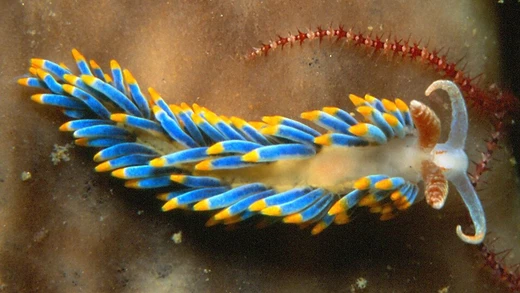
Tritoniacea
Suborder of nudibranchs containing the family Tritoniidae.

Tritoniacea is a suborder of nudibranchs—shell-less marine gastropods, also known as sea slugs—that consists of a single superfamily, Tritonioidea, which itself contains only the family Tritoniidae. Some of the largest nudibranchs belong to this group; for example, the Northeast Atlantic species *Tritonia hombergii* can grow up to 20 cm long. These nudibranchs are found worldwide in warm and temperate seas, as well as in very cold waters and the deep sea, wherever their food—octocorals—is present. Members of Tritoniidae feed on octocorals such as sea pens, alcyonarian soft corals, and gorgonians, and they often blend in with these prey in shape and color. This camouflage is also seen in the Arminidae, a family once thought to be only distantly related, but recent research has shown that Arminidae are actually close relatives of Tritoniidae. The family Tritoniidae is divided into two subfamilies. The subfamily Marioniinae includes the genera *Marionia*, *Marioniopsis*, and *Paratritonia*. The subfamily Tritoniinae includes *Candiella*, *Marianina*, *Myrella*, *Tochuina*, *Tritonia*, *Tritonicula*, *Tritonidoxa*, *Tritoniella*, and *Tritoniopsis*.
Quick Facts
- Grandparent Authority
- Lamarck, 1809 sensu Minichev and Starobogatov, 1979
- Taxon
- Tritoniidae
Facts from the source article.
Lore & Background
Members of the family Tritoniidae feed exclusively on octocorals, including sea pens, alcyonarian soft corals, and gorgonians. They are often cryptic in shape and colouration upon these prey organisms, blending in with their surroundings. This trait is shared with the Arminidae, which were previously thought to be only distantly related but have been shown by a recent study to be closely related to the Tritoniidae. The family Tritoniidae is the only member of the superfamily Tritonioidea and the suborder Tritoniacea. It is distributed among two subfamilies: Marioniinae and Tritoniinae. The subfamily Marioniinae includes the genera Marionia, Marioniopsis, and Paratritonia, while the subfamily Tritoniinae includes the genera Candiella, Marianina, Myrella, Tochuina, Tritonia, Tritonicula, Tritonidoxa, Tritoniella, and Tritoniopsis. These nudibranchs occur worldwide in warm and temperate seas, as well as in the coldest waters and deep sea, wherever the octocorals they eat are found. The NE Atlantic species Tritonia hombergii is among the largest known nudibranchs, reaching 20 cm in length.
Reader's Guide
The suborder Tritoniacea, containing only the family Tritoniidae, holds significance as the sole representative of the superfamily Tritonioidea. Its members are notable for including some of the largest known nudibranchs, with the NE Atlantic species Tritonia hombergii reaching 20 cm in length. The family's ecological role is defined by its feeding on octocorals, including sea pens, alcyonarian soft corals, and gorgonians, and its cryptic shape and colouration upon these prey. This trait is shared with the Arminidae, which a recent study has shown to be closely related to the Tritoniidae, challenging previous assumptions of distant relation. The family's taxonomy is organized into two subfamilies, Marioniinae and Tritoniinae, encompassing 13 genera. Their distribution is global, occurring in warm and temperate seas, as well as in the coldest waters and deep sea, wherever their octocoral prey is found. This broad range underscores their adaptability and the importance of octocorals as a food source across diverse marine environments.
Did You Know?
- Tritoniacea is a suborder containing only the superfamily Tritonioidea and its sole family, Tritoniidae.
- The NE Atlantic species Tritonia hombergii reaches 20 cm in length, making it one of the largest known nudibranchs.
- A recent study showed that Arminidae are closely related to Tritoniidae, despite previous beliefs of distant relation.
More in Nudibranchs and Sea Slugs 1-24
Spotted an error? Know more?
Reader corrections go straight into our review queue. Suggest an edit · How this site is sourced