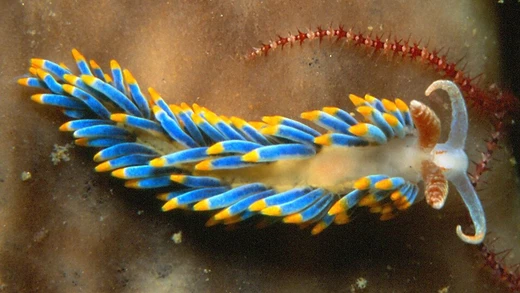
Dexiarchia
A suborder of shell-less sea slugs in Nudibranchia.

Dexiarchia is a suborder of sea slugs, specifically shell-less marine gastropod mollusks that belong to the order Nudibranchia. The group was defined in a 2001 study by Schrödl and colleagues, who split it into two main clades: Pseudoeuctenidiacea and Cladobranchia.
Under Pseudoeuctenidiacea (also called Doridoxida) is the superfamily Doridoxoidea, which contains only the family Doridoxidae.
Cladobranchia (also known as Cladohepatica) includes three subclades: Euarminida, Dendronotida, and Aeolidida. Several families are not assigned to any superfamily within Cladobranchia: Charcotiidae, Dironidae, Embletoniidae, Goniaeolididae, Heroidae, Madrellidae, Pinufiidae, and Proctonotidae.
The subclade Euarminida contains the superfamily Arminoidea, which includes the families Arminidae and Doridomorphidae.
The subclade Dendronotida consists of the superfamily Tritonioidea, with families Tritoniidae, Aranucidae, Bornellidae, Dendronotidae, Dotidae, Hancockiidae, Lomanotidae, Phylliroidae, Scyllaeidae, and Tethydidae.
The subclade Aeolidida is divided into three superfamilies. Flabellinoidea (also known as Pleuroprocta) includes Flabellinidae and Notaeolidiidae. Fionoidea contains Fionidae, Calmidae, Eubranchidae, Pseudovermidae, and Tergipedidae. Aeolidioidea includes Aeolidiidae, Facelinidae, Glaucidae, and Piseinotecidae.
Quick Facts
- Taxon
- Dexiarchia
Facts from the source article.
Lore & Background
The Dexiarchia suborder was established by Schrödl et al. in 2001, dividing it into two clades: Pseudoeuctenidiacea (also known as Doridoxida) and Cladobranchia (also known as Cladohepatica). Pseudoeuctenidiacea contains a single superfamily Doridoxoidea and family Doridoxidae. Cladobranchia is further divided into three subclades: Euarminida, Dendronotida, and Aeolidida. Euarminida includes the superfamily Arminoidea with families Arminidae and Doridomorphidae. Dendronotida comprises the superfamily Tritonioidea, which contains nine families including Tritoniidae, Dendronotidae, and Tethydidae. Aeolidida includes three superfamilies: Flabellinoidea (also called Pleuroprocta), Fionoidea, and Aeolidioidea, each with multiple families such as Flabellinidae, Fionidae, and Aeolidiidae. Additionally, several families are listed as not assigned to a superfamily under the Metarminoidea group, including Charcotiidae, Dironidae, and Embletoniidae.
Reader's Guide
The significance of Dexiarchia lies in its role as a taxonomic framework for shell-less nudibranchs, based on the 2001 study by Schrödl et al. This classification organizes a diverse group of sea slugs into two primary clades, Pseudoeuctenidiacea and Cladobranchia, with the latter further subdivided into three subclades. The system provides a structured hierarchy for understanding relationships among families such as Tritoniidae, Aeolidiidae, and Flabellinidae, as well as several families not assigned to a superfamily. The legacy of this classification is its use in subsequent taxonomic and evolutionary studies of nudibranchs, though the article notes no further updates or disputes beyond the original 2001 work. The inclusion of alternative names like Doridoxida and Cladohepatica reflects historical synonymy, and the listing of families without superfamily assignment indicates areas of taxonomic uncertainty that remain unresolved.
Did You Know?
- Dexiarchia is a suborder of shell-less marine gastropod molluscs in the order Nudibranchia.
- The classification was based on a 2001 study by Schrödl et al.
- Dexiarchia contains two clades: Pseudoeuctenidiacea and Cladobranchia.
- Cladobranchia includes the subclades Euarminida, Dendronotida, and Aeolidida.
Frequently Asked Questions
What is Dexiarchia?
Dexiarchia is a suborder of shell-less marine gastropods that falls under the order Nudibranchia. It groups together several lineages of sea slugs that lack an external shell and are characterized by their soft, often brightly colored bodies.
Who established Dexiarchia as a taxonomic group?
The suborder was formally defined by Schrödl and colleagues in their 2001 phylogenetic study. Their work reorganized nudibranch relationships and carved out Dexiarchia as a distinct clade within Nudibranchia.
What are the two main clades within Dexiarchia?
Schrödl's 2001 framework splits Dexiarchia into Pseudoeuctenidiacea (sometimes called Doridoxida) and Cladobranchia (also referred to as Cladohepatica). Pseudoeuctenidiacea houses the superfamily Doridoxoidea and its single family, Doridoxidae, while Cladobranchia is the larger, more diverse branch.
What subclades make up Cladobranchia?
Cladobranchia is divided into three recognized subclades: Euarminida, Dendronotida, and Aeolidida. In addition, several families—such as Charcotiidae, Dironidae, Embletoniidae, Goniaeolididae, Heroidae, Madrellidae, Pinufiidae, and Proctonotidae—remain unassigned to any superfamily within this clade.
Why is the 2001 Schrödl classification still the reference point for Dexiarchia?
It was the first study to formally delineate the suborder and its two principal clades based on phylogenetic evidence. Even as molecular data continue to refine nudibranch taxonomy, the Pseudoeuctenidiacea/Cladobranchia split from that paper remains the backbone of how fans and researchers discuss Dexiarchia's internal structure.
More in Nudibranchs and Sea Slugs 1-24
Spotted an error? Know more?
Reader corrections go straight into our review queue. Suggest an edit · How this site is sourced