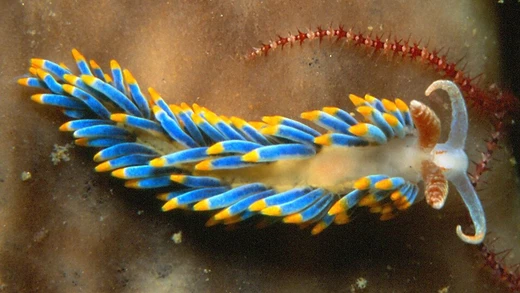
Bathydevius
A deep-sea nudibranch with a bell-shaped hood and bioluminescence.

Bathydevius is a genus of sea slug that stands out for its strange appearance and lifestyle. Its name comes from Greek and Latin roots meaning "deep" and "out of the way." This nudibranch lives in the deep North Pacific Ocean and contains just one species, *B. caudactylus*, which has finger-like projections on its tail. It is the only member of its family, Bathydeviidae.
Unlike most nudibranchs, which live on the seafloor, *Bathydevius* is one of the few that swim freely in open water. It is the first nudibranch known to inhabit the bathypelagic zone. Its large, bell-shaped oral hood can catch prey like a Venus flytrap, similar to the hood of the nudibranch *Melibe*. However, genetic studies show *Bathydevius* is not closely related to *Melibe*. Depending on the DNA analyzed, it is either the most primitive nudibranch or a close relative of the Bathydorididae family.
Most sightings of *Bathydevius* come from the Monterey Canyon off California, but it has also been seen near Davidson Seamount, Point Conception, and the Oregon coast. Two similar individuals were observed near the Mariana Trench, which may extend the genus’s range to the western Pacific.
The animal ranges from 56 to 145 millimeters in length, and its hood can expand to 89 millimeters in diameter. The hood is flexible and can form notches, helping it catch planktonic prey like the shrimp *Boreomysis*. Its tail has finger-like protrusions. *Bathydevius* is bioluminescent, producing blue light across its hood and tail protrusions. It is only the third nudibranch lineage known to have this ability, which appears to have evolved independently in each. When suspended in water, it neither sinks nor rises, suggesting its density matches seawater.
*Bathydevius* usually swims in midwater but descends to the seafloor to breed. While attached there, it releases a ribbon of eggs. Like most gastropods, it is hermaphroditic. At least 20 individuals have been observed attached to the seafloor.
The species was first discovered in February 2000 by the Monterey Bay Aquarium Research Institute using the ROV *Tiburon* at a depth of 2,614 meters in Monterey Bay. The holotype was collected in January 2004. Over 157 individuals were documented between 2000 and 2021, during which it was nicknamed the "mystery mollusk" until its taxonomy was determined. It was formally described in November 2024.
Quick Facts
- Grandparent Authority
- Robison & Haddock, 2024
- Taxon
- Bathydevius caudactylus
Facts from the source article.
Lore & Background
Bathydevius was first discovered in February 2000 by the Monterey Bay Aquarium Research Institute using the ROV Tiburon, at a depth of 2,614 metres in Monterey Bay, California. The holotype specimen was collected in January 2004, and over 157 individuals were documented in dives spanning from 2000 to 2021; during this period of study, it came to be nicknamed the 'mystery mollusk' until its taxonomic identity was determined. It was finally described in November 2024.
Bathydevius has a large, bell-shaped oral hood that it can use to catch prey, superficially similar to that of a Venus flytrap and closely resembling that of the nudibranch Melibe. However, phylogenetic studies indicate that Bathydevius is not closely related to Melibe, and is rather either (based on rRNA) the most basal nudibranch genus or (based on mtDNA) the sister genus to the Bathydorididae. It is bioluminescent, having the ability to scintillate blue across the surface of the oral hood and the protrusions on its tail, and is only the third known nudibranch lineage to display bioluminescence, which appears to have been independently evolved in each.
A majority of observations are off the coast of California from the Monterey Canyon, but individuals have also been observed near Davidson Seamount, off the coast of Point Conception, and off the coast of Oregon. Two individuals of a similar nudibranch were observed near the Mariana Trench, potentially extending the range to the western Pacific. Bathydevius appears to neither sink nor rise when suspended in water, suggesting a density roughly equivalent to seawater. Although it generally swims in midwater, it descends and attaches to the seafloor when ready to breed, releasing a ribbon of eggs.
Reader's Guide
Bathydevius is significant as the first known nudibranch to inhabit the bathypelagic zone, challenging the typical benthic lifestyle of the group. Its discovery in February 2000 by the Monterey Bay Aquarium Research Institute using the ROV Tiburon, and subsequent documentation of over 157 individuals from 2000 to 2021, provided extensive data on its taxonomy, ecology, and life history, leading to its formal description in November 2024. Its unusual morphology—a large, flexible oral hood used to catch planktonic prey like the shrimp Boreomysis, and a tail with finger-like protrusions—along with its bioluminescence (only the third nudibranch lineage to display it, independently evolved) mark it as highly distinctive. Phylogenetic studies place it either as the most basal nudibranch genus or as sister to the Bathydorididae, underscoring its taxonomic uniqueness as the sole member of the family Bathydeviidae. Its ability to survive capture and spawn in an aquarium, with larvae successfully developing, offers insights into its life history. The potential range extension to the Mariana Trench suggests a broader distribution in the deep Pacific.
Did You Know?
- It is bioluminescent, scintillating blue across its oral hood and tail protrusions.
- Its specific epithet caudactylus means 'finger tail'.
- At least one spawning individual survived capture and released an egg ribbon in an aquarium that developed into larvae.
Discovery and Taxonomic Identity
Bathydevius was formally described in 2024, making it one of the most recent additions to the roughly 3,000 known nudibranch species. Its recovery from a depth approaching 2,500 metres (8,200 feet) immediately set it apart from the vast majority of its relatives, which favour warm, shallow reef environments. Taxonomically, it sits within the order Nudibranchia, a group of soft-bodied marine gastropod molluscs in the phylum Mollusca that shed their protective shells once they pass beyond the larval stage. The very name "nudibranch" carries a layered linguistic heritage: Latin nudus meaning "naked" paired with the Ancient Greek bránkhia for "gills," a nod to the exposed respiratory structures visible on many members of this order. Bathydevius also stands as one of the very few nudibranchs known to produce bioluminescence, a trait that distinguishes it sharply from the colourful, visually conspicuous species that dominate public imagination—those given nicknames such as "clown," "dragon," "dancer," or "sea rabbit."
A Bathypelagic Outlier
The overwhelming majority of nudibranchs are benthic creatures, spending their adult lives crawling across the ocean floor. A small handful of exceptions break this pattern: the neustonic Glaucus species that float inverted just beneath the surface, the pelagic Cephalopyge trematoides that swim freely in the water column, and two pelagic species of Phylliroe. Bathydevius, however, occupies a category entirely its own—it is the only nudibranch confirmed to lead a bathypelagic existence, dwelling in the deep mid-water rather than on the substrate. This makes it evolutionarily distinct within the order. While nudibranchs are documented from the Arctic to the Southern Ocean around Antarctica and from the intertidal zone to depths exceeding 700 metres, the greatest concentration of species diversity clusters in warm, shallow tropical reefs. Bathydevius, found near 2,500 metres, represents a dramatic departure from that shallow-water norm. Like nearly all nudibranchs, it is restricted to salt water, though a small number of species tolerate the lower salinities of brackish environments.
Anatomical Blueprint of a Nudibranch
As a member of the nudibranch order, Bathydevius shares the fundamental body plan common to all members of this group. Because nudibranchs are opisthobranchs, they have undergone secondary detorsion, giving them an externally bilaterally symmetrical appearance even though internal asymmetry persists—evidenced by the placement of both male and female sexual openings on the right side of the body. They lack a mantle cavity entirely. Vision in nudibranchs is rudimentary: their eyes, set into the body at roughly a quarter of a millimetre in diameter, consist of a simple lens and five photoreceptors capable of distinguishing light from dark. Sensory navigation relies on cephalic tentacles responsive to touch, taste, and smell, alongside club-shaped rhinophores tuned to detecting odours. In the adult form, no shell or operculum remains; the coiled shell of the swimming veliger larva is shed at metamorphosis, or in some species even before the animal leaves the egg mass. Adult nudibranchs range from 4 to 600 millimetres in length.
Defence Without a Shell
Having surrendered the hard shell that protects most gastropods, nudibranchs evolved a remarkable arsenal of alternative defences, and Bathydevius inherits this legacy. Some species rely on camouflage, adopting textures and colouration that mimic the sponges or soft corals they prey upon. Others, such as Chromodoris quadricolor, flash intensely bright, contrasting patterns—a strategy long cited as aposematism, though the evidence remains debated, particularly because red wavelengths attenuate rapidly with depth and many species are nocturnal or cryptic. A more mechanical defence involves kleptocnidae: certain nudibranchs that feed on hydrozoids sequester the prey's nematocysts in their dorsal body wall or cerata, deploying them against would-be predators. Chemical defences are equally widespread; sponge-eating species concentrate toxic secondary metabolites from their prey, and the general consensus is that distastefulness, rather than lethality, is the more effective evolutionary strategy. Bathydevius adds bioluminescence to this repertoire, a trait shared by only a very small number of nudibranchs.
Frequently Asked Questions
What is Bathydevius?
Bathydevius is a monotypic genus of deep-sea nudibranch that belongs to its own family, Bathydeviidae, with its single species B. caudactylus set apart by finger-like appendages running along its tail. The name fuses Greek and Latin roots that together evoke the ideas of "deep" and "out of the way."
Where does Bathydevius live?
This slug occupies the bathypelagic zone of the North Pacific, making it the first nudibranch ever confirmed in that depth layer. Its initial sighting was recorded at roughly 2,614 meters below the surface.
What makes Bathydevius unique among sea slugs?
Rather than crawling along the ocean floor like most nudibranchs, Bathydevius drifts and swims freely through open water. It also bears a large bell-shaped oral hood that can spread to about 89 mm across, and it produces bioluminescent light.
How large is Bathydevius?
Specimens measure anywhere from 56 mm up to 145 mm in overall body length. When the oral hood is fully expanded, its diameter reaches approximately 89 mm.
When was Bathydevius first discovered and how many individuals have been recorded?
The genus was first observed in February 2000, though the formal holotype was not collected until January 2004. Between 2000 and 2021, researchers documented more than 157 individual animals.
More in Nudibranchs and Sea Slugs 1-24
Spotted an error? Know more?
Reader corrections go straight into our review queue. Suggest an edit · How this site is sourced