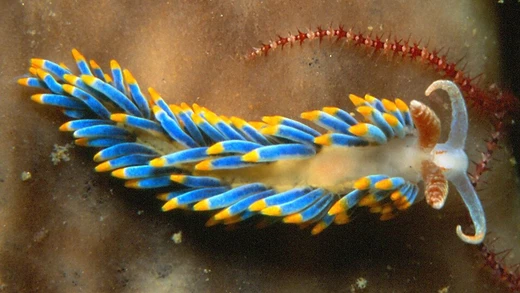
Aeolidacea
A suborder of shell-less marine gastropod molluscs, or sea slugs.

Aeolidacea is a suborder of nudibranchs, which are sea slugs—shell-less marine gastropod molluscs. Its classification includes several superfamilies and families, as revised in 2025 by Korshunova and colleagues using molecular phylogenetic analysis. Some families listed here are considered synonyms under the 2026 scheme by Ekimova and colleagues.
The recognized superfamilies and families are:
Superfamily Aeolidioidea Gray, 1827: Aeolidiidae, Babakinidae, Facelinidae, Favorinidae, Glaucidae, Myrrhinidae, Pleurolidiidae.
Superfamily Apataoidea Korshunova et al., 2017: Apataidae.
Superfamily Cumanotoidea Odhner, 1907: Cumanotidae, Pseudovermidae.
Superfamily Chudoidea Korshunova, Fletcher & Martynov, 2025: Chudidae.
Superfamily Embletonioidea Pruvot-Fol, 1954: Embletoniidae.
Superfamily Fionoidea Gray, 1857: Abronicidae, Calmidae, Cuthonellidae, Cuthonidae, Eubranchidae, Fionidae, Murmaniidae, Tergipedidae, Trinchesiidae, Xenocratenidae.
Superfamily Flabellinoidea Bergh, 1889: Coryphellidae (proposed junior synonym of Flabellinidae), Flabellinidae, Paracoryphellidae (proposed junior synonym of Flabellinidae).
Superfamily Flabellinopsoidea Korshunova et al., 2017: Flabellinopsidae, Hantazuidae.
Superfamily Notaeolidioidea Eliot, 1910: Notaeolidiidae.
Superfamily Samloidea Korshunova et al., 2017: Samlidae.
Superfamily Unidentioidea Millen and Hermosillo, 2012: Unidentiidae (proposed junior synonym of Piseinotecidae).
Superfamily incertae sedis: Piseinotecidae.
Quick Facts
- Taxon
- Aeolidacea
Facts from the source article.
Lore & Background
The taxonomy of Aeolidacea has been revised in 2025 by Korshunova and colleagues, based on molecular phylogenetic analyses. This revision recognizes multiple superfamilies and families, with some families proposed as junior synonyms under an alternative scheme by Ekimova et al. (2026). For example, within the superfamily Flabellinoidea, the families Coryphellidae and Paracoryphellidae are proposed as junior synonyms of Flabellinidae. Similarly, the family Unidentiidae is proposed as a junior synonym of Piseinotecidae.
Reader's Guide
The significance of Aeolidacea lies in its role as a taxonomically complex suborder of nudibranchs, with ongoing revisions reflecting advances in molecular phylogenetics. The 2025 revision by Korshunova and colleagues provides a comprehensive framework of 12 superfamilies and 30 families, while the 2026 scheme by Ekimova et al. offers alternative synonymies, indicating areas of scientific debate. This dynamic classification underscores the group's importance for understanding evolutionary relationships among sea slugs. The inclusion of families like Chudidae and Hantazuidae, newly described in 2025, highlights continued discovery. The legacy of Aeolidacea taxonomy is its reliance on molecular data to resolve long-standing uncertainties, though some placements remain provisional, such as the superfamily incertae sedis for Piseinotecidae.
Did You Know?
- Aeolidacea is a suborder of nudibranchs, which are shell-less marine gastropod molluscs.
- The 2025 revision of Aeolidacea taxonomy was conducted by Korshunova and colleagues using molecular phylogenetic analyses.
- The family Chudidae was newly described in 2025 within the superfamily Chudoidea.
- The family Piseinotecidae is placed in superfamily incertae sedis within Aeolidacea.
Identity and Place in the Marine World
Aeolidacea occupies a distinctive niche within the animal kingdom as a suborder of nudibranchs, the shell-less marine gastropod molluscs commonly known as sea slugs. Unlike many molluscs that retain a protective external shell, members of this group have entirely shed that armor, living as soft-bodied creatures in marine environments. Their placement within the broader nudibranch lineage connects them to one of the most morphologically varied assemblages of sea slugs. The suborder designation signals that Aeolidacea is not a single family but a higher-level grouping encompassing multiple superfamilies and, in turn, numerous families. This hierarchical nesting reflects the extraordinary diversity found among these shell-less molluscs, from the well-known aeolids to lesser-known lineages that taxonomists have only recently disentangled. Understanding Aeolidacea therefore requires appreciating both its intimate biological identity as a group of soft-bodied marine slugs and its position as a taxonomic container for a wide array of related but distinct evolutionary lineages.
Taxonomic Architecture and Breadth
The recognized classification of Aeolidacea reveals a remarkably layered architecture. At the superfamily level, the suborder is divided into at least eleven named groups plus an incertae sedis category, ranging from the long-established Aeolidioidea (Gray, 1827) to the newly erected Chudoidea (Korshunova, Fletcher & Martynov, 2025). Within these superfamilies sit dozens of families, with Fionoidea standing out as the most family-rich superfamily, housing ten distinct families including Fionidae, Eubranchidae, Cuthonidae, and others. At the opposite extreme, several superfamilies such as Apataoidea, Cumanotoidea, Chudoidea, Embletonioidea, Notaeolidioidea, and Samloidea each contain a single family, suggesting that molecular evidence has carved out lineages too distinct to be lumped with their neighbors. The dates attached to each family name span nearly two centuries, from Gray's 1827 descriptions to the 2025 additions, illustrating how the suborder's boundaries have been continually refined as new species are discovered and older groupings are re-evaluated.
The Molecular Revolution in Classification
A pivotal shift in how Aeolidacea is organized emerged from molecular phylogenetic analyses, most prominently the 2025 revision authored by Korshunova and colleagues. This work did not merely tweak existing categories; it erected entirely new taxa, including the superfamily Chudoidea and its sole family Chudidae, as well as the family Hantazuidae within Flabellinopsoidea. The molecular approach also validated earlier splits, such as the 2017 creation of Apataoidea, Flabellinopsoidea, and Samloidea by Korshunova and team, and the 2020 description of Xenocratenidae by Martynov and colleagues. Even the 2012 establishment of Unidentioidea by Millen and Hermosillo fits within this broader trajectory of using genetic data to resolve relationships that morphology alone could not clarify. The 2025 revision thus represents the culmination of a multi-decade effort to replace intuitive, shape-based groupings with a phylogenetically grounded framework, ensuring that each superfamily and family reflects genuine evolutionary branching rather than superficial resemblance.
Uncertainty and the Living Debate
Despite the clarity of the 2025 framework, Aeolidacea's taxonomy remains a work in progress, and the published list itself carries the marks of ongoing scholarly disagreement. Three families bear question marks—Coryphellidae, Paracoryphellidae, and Unidentiidae—flagging them as proposed junior synonyms of other families (Flabellinidae and Piseinotecidae, respectively) rather than fully accepted entities. The superfamily incertae sedis category exists solely to house Piseinotecidae, a family that resists placement within any of the named superfamilies. Furthermore, a 2026 scheme by Ekimova and colleagues identifies additional families as synonyms under their interpretation, introducing a layer of taxonomic tension between competing classification systems. These ambiguities underscore that the suborder's boundaries are not settled dogma but an active area of debate, where molecular data, morphological interpretation, and the sheer pace of new species discovery continue to reshape which lineages are recognized as distinct and which are folded into existing groups.
Frequently Asked Questions
What is Aeolidacea?
Aeolidacea is a suborder within the nudibranchs, a group of shell-less marine gastropod molluscs commonly known as sea slugs. It sits below the broader nudibranch order and above the superfamilies and families that make up its internal structure.
How many families are recognized in Aeolidacea?
Under the 2025 revision by Korshunova and colleagues, Aeolidacea comprises 30 recognized families spread across 12 superfamilies. Notably, some of those families are treated as synonyms in the separate 2026 scheme proposed by Ekimova and colleagues.
Who revised the Aeolidacea taxonomy in 2025?
The 2025 taxonomic revision was carried out by Korshunova and colleagues, who relied on molecular phylogenetic analysis to reorganize the suborder's superfamilies and families.
Which superfamilies belong to Aeolidacea?
Twelve superfamilies are recognized, including the well-known Aeolidioidea (containing families such as Aeolidiidae, Facelinidae, and Glaucidae) and the more recently described Apataoidea (home to Apataidae).
Is Aeolidacea the same thing as all nudibranchs?
No—Aeolidacea is one suborder within the larger nudibranch order, so not every sea slug or nudibranch falls under this particular grouping. It represents a specific clade defined by shared evolutionary ancestry rather than the entire shell-less gastropod diversity.
More in Nudibranchs and Sea Slugs 1-24
Spotted an error? Know more?
Reader corrections go straight into our review queue. Suggest an edit · How this site is sourced