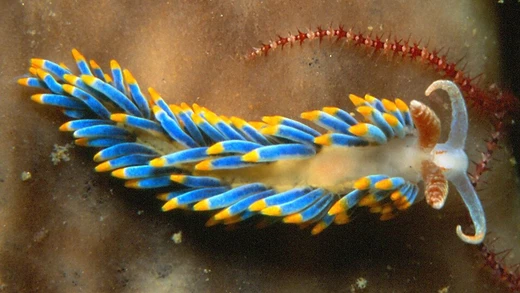
Bathydorididae
A deep-sea family of dorid nudibranchs, sole in its superfamily.

Bathydorididae is a family of dorid nudibranchs, a type of shell-less marine gastropod mollusk. This family is the sole member of the superfamily Bathydoridoidea, which itself belongs to the infraorder Bathydoridoidei. The family includes two genera: *Bathydoris* and *Prodoris*. The genus *Bathydoris*, established by Bergh in 1884, contains species that inhabit deep water, typically below 1,500 meters. Its type species is *Bathydoris abyssorum*. Other species in this genus include *B. aioca*, *B. antoni*, *B. hodgsoni*, *B. ingolfiana*, *B. japonensis*, and *B. spiralis*. The genus *Prodoris*, named by Baranetz in 1997, includes the species *Prodoris clavigera*.
Quick Facts
- Grandparent Authority
- Minichev & Starobogatov, 1979
- Taxon
- Bathydorididae
- Type Genus
- Bathydoris
- Type Genus Authority
- Bergh, 1884
Facts from the source article.
Lore & Background
The family Bathydorididae was established with the genus Bathydoris, described by Bergh in 1884. The type species is Bathydoris abyssorum, also described by Bergh in 1884. These nudibranchs are notable for living in deep water, below 1,500 meters. The family includes two genera: Bathydoris and Prodoris. Prodoris was introduced by Baranetz in 1997, with the species Prodoris clavigera originally described by Thiele in 1912. Several species of Bathydoris have been described over time, including Bathydoris aioca by Er. Marcus and Ev. Marcus in 1962, Bathydoris antoni by Ekimova and colleagues in 2021, Bathydoris hodgsoni by Eliot in 1907, Bathydoris ingolfiana by Bergh in 1899, Bathydoris japonensis by Hamatani and Kubodera in 2010, and Bathydoris spiralis by Á. Valdés in 2002.
Reader's Guide
Bathydorididae holds a unique position in nudibranch taxonomy as the only family within the superfamily Bathydoridoidea and the infraorder Bathydoridoidei. This exclusivity underscores its distinct evolutionary lineage among dorid nudibranchs. The family's deep-water habitat, below 1,500 meters, sets it apart from many other nudibranch groups that inhabit shallower waters. The genus Bathydoris, with its type species Bathydoris abyssorum, represents the core of the family, while the later addition of Prodoris by Baranetz in 1997 expanded the family's diversity. The species within Bathydorididae have been described by various researchers over more than a century, from Bergh's original work in 1884 to recent descriptions in 2021. The family's significance lies in its role as a primitive or basal group within the nudibranchs, as suggested by studies on its radular and respiratory apparatus variability, though the source article does not resolve these interpretations. Its deep-sea occurrence also makes it a subject of interest for understanding adaptation to extreme environments.
Did You Know?
- Bathydorididae is the only family in the superfamily Bathydoridoidea.
- The type species is Bathydoris abyssorum, described by Bergh in 1884.
- These nudibranchs live in deep water, below 1,500 meters.
The Twenty-Four-Year Mystery
In February 2000, the remotely operated vehicle Tiburon, operated by the Monterey Bay Aquarium Research Institute, encountered a strange creature at a depth of 2,614 metres in Monterey Bay, California. For the next nearly quarter century, this enigmatic animal was known only as the "mystery mollusk," its true taxonomic identity remaining unresolved. The holotype specimen was not collected until January 2004, and over the course of dives between 2000 and 2021, researchers documented more than 157 individuals. It was not until November 2024, following extensive study of its taxonomy, ecology, and reproductive biology, that the species received its formal scientific description. One of the most remarkable episodes in its study involved a spawning individual that was captured alive and brought to the surface. In an aquarium tank, it released a ribbon of eggs that attached to the tank floor and successfully developed into larvae, offering a rare window into its early life stages that would have been impossible to observe in the deep ocean.
A Living Lantern in the Deep
Bathydevius caudactylus measures between 56 and 145 millimetres in length, but its most striking feature is the large, bell-shaped oral hood that can reach 89 millimetres in diameter when fully expanded. This flexible structure is remarkably versatile: its highly prehensile margin can be reshaped into a variety of configurations, even forming notches, and it functions as a capturing device for planktonic prey such as the shrimp Boreomysis. The hood superficially evokes a Venus flytrap and closely resembles the feeding apparatus of the nudibranch Melibe, yet phylogenetic analyses confirm the two are not closely related. The animal's tail bears finger-like protrusions, which gave rise to its species epithet. Perhaps most astonishing is its bioluminescence: Bathydevius can scintillate blue light across the surface of its hood and the protrusions along its tail. It is only the third known nudibranch lineage to possess this trait, and the ability appears to have evolved independently in each case.
An Evolutionary Oddity in the Bathypelagic Zone
Bathydevius occupies a taxonomic position unlike any other nudibranch. It is the first known member of this group to inhabit the bathypelagic zone, and it is one of very few pelagic, free-swimming genera within a class that is generally benthic. The genus is monotypic, containing only B. caudactylus, and it constitutes the sole known member of the equally monotypic family Bathydeviidae. Its name blends the Ancient Greek word for "deep" with the Latin for "out of the way," a fitting description for such an unusual organism. Phylogenetic evidence places it in a puzzling position: ribosomal RNA analyses suggest it is the most basal nudibranch genus, while mitochondrial DNA data instead position it as the sister genus to the Bathydorididae. Most observations have come from waters off California, including Monterey Canyon, Davidson Seamount, and the coast of Oregon, though two similar individuals near the Mariana Trench hint that close relatives may extend the genus's range into the western Pacific.
Drifting, Spawning, and Neutral Buoyancy
In its daily existence, Bathydevius generally swims through midwater, and it appears to possess a density roughly equivalent to that of surrounding seawater, meaning it neither sinks nor rises when suspended. This neutral buoyancy is a remarkable adaptation for a free-swimming mollusc in the deep ocean. When the time comes to breed, however, the animal descends and attaches itself to the seafloor, where it releases a ribbon of eggs. At least twenty individuals have been observed in this attached, spawning state. Like most gastropods, Bathydevius is hermaphroditic, carrying both male and female reproductive structures. The species' reproductive biology received an extraordinary boost when a spawning individual was captured alive, brought to the surface, and successfully spawned in an aquarium. The egg ribbon attached to the tank bottom and developed into larvae, providing researchers with the first direct evidence of its larval stage and confirming that the species can complete its reproductive cycle outside its natural deep-sea habitat.
Frequently Asked Questions
What is Bathydorididae?
Bathydorididae is a family of dorid nudibranchs, meaning it groups together shell-less, deep-sea sea slugs. It holds a unique spot as the only family in the entire superfamily Bathydoridoidea, so there is nothing else in that branch of the nudibranch tree.
Where do Bathydorididae live?
Every species in this family is a deep-water resident, typically encountered at depths of 1,500 meters or greater. They inhabit the dark, cold, high-pressure environment of the deep ocean floor, far below the light-penetrated zone.
What genera are included in Bathydorididae?
The family is made up of just two genera: Bathydoris (named by Bergh in 1884) and Prodoris. Bathydoris contains species such as B. abyssorum, B. aioca, B. antoni, B. hodgsoni, B. ingolfiana, B. japonensis, and B. spiralis, while Prodoris is represented by P. clavigera.
What is the type species of Bathydorididae?
The type species is Bathydoris abyssorum, first described by Bergh in 1884. It anchors the genus Bathydoris, which itself serves as the type genus for the whole family.
How does Bathydorididae fit into the broader nudibranch classification?
Bathydorididae belongs to the infraorder Bathydoridoidei and is the sole family within the superfamily Bathydoridoidea. This makes it a small, self-contained offshoot of the dorid nudibranch lineage, set apart from the more commonly known shallow-water sea slugs.
More in Nudibranchs and Sea Slugs 1-24
Spotted an error? Know more?
Reader corrections go straight into our review queue. Suggest an edit · How this site is sourced