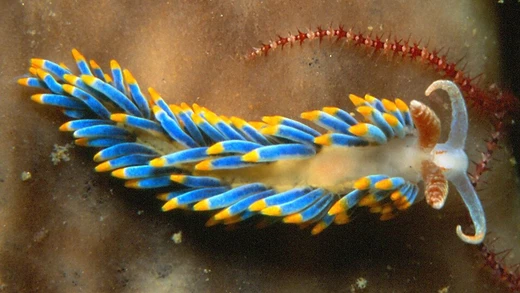
Doridoidei
An infraorder of dorid nudibranchs, shell-less marine gastropod mollusks.

Doridoidei is an infraorder of dorid nudibranchs, shell-less marine gastropod mollusks. In most members of this group, the mantle extends over the sides of the foot, though in some families the tail remains uncovered. Within the superfamily Polyceroidea and the family Goniodorididae, the mantle is often reduced to a ridge that may carry processes. A ring of external, branched gills usually surrounds the anus near the rear of the body, but in the families Phyllidiidae and Corambidae, these gills are located beneath the sides of the mantle. Two rhinophores with lamellae typically emerge through the mantle toward the front of the animal. The infraorder is divided into five superfamilies: Chromodoridoidea (including families Actinocyclidae, Cadlinellidae, Cadlinidae, Chromodorididae, Hexabranchidae, and Showajidaiidae), Doridoidea (families Dorididae and Discodorididae), Onchidoridoidea (families Acanthodorididae, Acanthomiridae, Aegiridae, Akiodorididae, Calycidorididae, Corambidae, Goniodorididae, Onchidorididae, and Onchimiridae), Phyllidioidea (families Dendrodorididae, Forjacellidae, Mandeliidae, and Phyllidiidae), and Polyceroidea (family Polyceridae).
Quick Facts
- Taxon
- Doridoidei
Facts from the source article.
Lore & Background
Doridoidei is an infraorder of dorid nudibranchs, shell-less marine gastropod mollusks. Its taxonomy includes five superfamilies: Chromodoridoidea, Doridoidea, Onchidoridoidea, Phyllidioidea, and Polyceroidea, each containing multiple families such as Chromodorididae, Dorididae, and Phyllidiidae. Nudibranchs in this grouping have a mantle which overlaps the sides of the foot, apart from the tail in some families. In the Superfamily Polyceroidea and the Family Goniodorididae, this mantle is often reduced to a ridge that may bear processes. There is usually a ring of external branched gills surrounding the anus towards the back of the body, but in some subgroups like the Family Phyllidiidae and Family Corambidae, these gills are located beneath the sides of the mantle. Typically there are two rhinophores with lamellae which arise through the mantle towards the front of the animals.
Reader's Guide
The significance of Doridoidei lies in its taxonomic organization of dorid nudibranchs, grouping them into five superfamilies and numerous families based on shared anatomical features. The mantle overlapping the foot sides is a defining characteristic, with notable variations in the Superfamily Polyceroidea and Family Goniodorididae where the mantle is reduced to a ridge. The arrangement of gills—either as a ring around the anus or beneath the mantle sides in Phyllidiidae and Corambidae—highlights morphological diversity within the infraorder. The presence of lamellate rhinophores arising through the mantle further distinguishes these shell-less mollusks. This classification provides a framework for understanding the evolutionary relationships and anatomical adaptations among dorid nudibranchs, as documented in the source article.
Did You Know?
- The mantle overlaps the sides of the foot in most Doridoidei, apart from the tail in some families.
- Gills are located beneath the sides of the mantle in the Family Phyllidiidae and Family Corambidae.
Frequently Asked Questions
What is Doridoidei?
Doridoidei is an infraorder grouping together several superfamilies of dorid nudibranchs—shell-less marine gastropods. It sits below the order Nudibranchia and above the family level in the taxonomic hierarchy.
Which superfamilies and families are included in Doridoidei?
The infraorder spans five superfamilies: Chromodoridoidea, Doridoidea, Onchidoridoidea, Phyllidioidea, and Polyceroidea. Within those you'll find families ranging from Chromodorididae and Dorididae to Hexabranchidae, Cadlinidae, and Goniodorididae.
What does the mantle look like on Doridoidei nudibranchs?
In most members the mantle drapes over the lateral edges of the foot, leaving the tail region bare. In Polyceroidea and Goniodorididae the mantle is reduced to a narrow ridge that may carry small projections.
Where are the gills positioned on Doridoidei?
A ring of branched, externally visible gills typically encircles the anus near the posterior end of the body. In Phyllidiidae and Corambidae, however, the gills sit tucked beneath the lateral mantle flaps instead of being exposed.
How do Doridoidei detect chemicals in the water?
They rely on a pair of lamellated rhinophores that project from the head region. These two sensory organs allow the slug to sample dissolved chemical cues while it moves across the seafloor.
More in Nudibranchs and Sea Slugs 1-24
Spotted an error? Know more?
Reader corrections go straight into our review queue. Suggest an edit · How this site is sourced