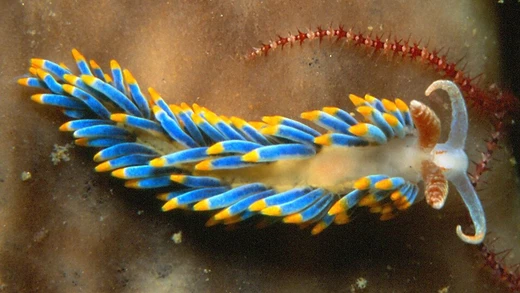
Doridina
Doridina is a suborder of marine gastropod molluscs in Nudibranchia.

Doridina is a taxonomic suborder of sea snails or slugs, marine gastropod molluscs in the order Nudibranchia. It is also known by the common name dorid nudibranchs. The name Anthobranchia was rejected by Bouchet & Rocroi (2005) because it originally included Onchidium; Doridina is equivalent and used in the latest classification.
Quick Facts
- Taxon
- Doridina
Facts from the source article.
Lore & Background
A morphological phylogenetic study published in 2000 by Wägele & Willan showed that the subclade Gnathodoridacea (= Bathydoridoidea) and the subclade Doridacea (= Phanerobranchia + Cryptobranchia + Porostomata) each form a monophyletic group. In a later study published in 2002, A. Valdés concluded that the superfamilies Doridoidea and Phyllidioidea (called by him Cryptobranchia + Porostomata) formed a clade. He expanded the usage of Cryptobranchia to encompass the whole subclade Doridacea, but this move was not followed in the taxonomy of Bouchet and Rocroi.
The taxonomy presented in Bouchet et al. (2017) lists two infraorders: Bathydoridoidei (with superfamily Bathydoridoidea and family Bathydorididae) and Doridoidei (with superfamilies Doridoidea, Polyceroidea, Chromodoridoidea, Onchidoridoidea, and Phyllidioidea, each containing multiple families). This classification reflects the ongoing refinement of dorid nudibranch relationships.
Reader's Guide
Doridina is significant as a major suborder within Nudibranchia, representing a diverse group of marine gastropods. The rejection of the name Anthobranchia by Bouchet & Rocroi (2005) highlights the importance of taxonomic precision, as that name originally included Onchidium. The phylogenetic studies by Wägele & Willan (2000) and Valdés (2002) demonstrate the evolving understanding of dorid relationships, with Valdés proposing an expanded Cryptobranchia that was not adopted by Bouchet and Rocroi. The taxonomy of Bouchet et al. (2017) provides the current framework, dividing Doridina into two infraorders and multiple superfamilies. This structure reflects both morphological and molecular insights, though disputes remain, such as the non-acceptance of Valdés' expanded Cryptobranchia. The legacy of Doridina lies in its role as a model for studying nudibranch evolution and classification, with ongoing refinement of its internal relationships.
Did You Know?
- Doridina is equivalent to the rejected name Anthobranchia, which originally included Onchidium.
- A 2000 study by Wägele & Willan found that Gnathodoridacea and Doridacea each form a monophyletic group.
- A. Valdés in 2002 expanded Cryptobranchia to cover the whole subclade Doridacea, but this was not followed by Bouchet and Rocroi.
Identity and Nomenclatural History
Doridina is the formal taxonomic suborder that encompasses what are commonly referred to as dorid nudibranchs—marine gastropod molluscs situated within the broader order Nudibranchia. These sea snails and slugs occupy a well-defined and recognized position in the overall classification of opisthobranch molluscs. The nomenclature surrounding this group carries a particular history worth noting. In 2005, Bouchet and Rocroi formally rejected the alternative name Anthobranchia on the grounds that, at the time of its original publication, that name had also encompassed the genus Onchidium, rendering it an inappropriate and imprecise label for the group in question. Doridina therefore stands as the accepted equivalent in the most recent taxonomic frameworks, providing a cleaner and more precise designation for this distinct lineage of dorid nudibranchs within the nudibranch order.
Phylogenetic Architecture and Monophyly
A landmark morphological phylogenetic study by Wägele and Willan, published in 2000, established the deep evolutionary structure within Doridina. Their work demonstrated that two major subclades—Gnathodoridacea (equivalent to Bathydoridoidea) and Doridacea (comprising Phanerobranchia, Cryptobranchia, and Porostomata)—each constitute a monophyletic group, meaning each descended from a single common ancestor exclusive to that particular lineage. This finding provided a robust and well-supported framework for understanding how the considerable diversity of dorid nudibranchs is organized at the deepest branching level. Building on this foundational work, A. Valdés published a follow-up study in 2002 in which he concluded that the superfamilies Doridoidea and Phyllidioidea (which he termed Cryptobranchia plus Porostomata) together form a single clade, further refining the overall picture of evolutionary relationships within the Doridacea subclade.
Taxonomic Diversity and Hierarchical Structure
The current taxonomic framework for Doridina, as presented by Bouchet and colleagues in their 2017 publication, reveals a richly structured and highly diverse group divided into two distinct infraorders. The first, Bathydoridoidei, is comparatively simple, containing a single superfamily, Bathydoridoidea, represented by the family Bathydorididae. The second and far more diverse infraorder, Doridoidei, encompasses six superfamilies with multiple families each: Doridoidea (including Dorididae and Discodorididae), Polyceroidea (Polyceridae and Okadaiidae), Chromodoridoidea (Chromodorididae, Actinocyclidae, Hexabranchidae, and Cadlinidae), Onchidoridoidea (Onchidorididae, Aegiridae, Akiodorididae, Calycidorididae, Corambidae, and Goniodorididae), and Phyllidioidea (Phyllidiidae, Dendrodorididae, and Mandeliidae). This detailed hierarchical architecture underscores the considerable morphological and ecological variety packed within a single suborder of marine gastropod molluscs, illustrating the breadth of evolutionary experimentation among dorid nudibranchs.
Taxonomic Controversy and Competing Frameworks
The classification of Doridina has not been without scholarly disagreement among systematists. A notable point of contention arose from Valdés's 2002 study, in which he proposed expanding the term Cryptobranchia to encompass the entire subclade Doridacea, effectively redefining the scope and application of that name in a way that would carry significant implications for how the group is organized. However, this broader usage was not adopted by Bouchet and Rocroi in their taxonomic system, who maintained a more restricted application of the term, creating a divergence in how different researchers classify and discuss these organisms. The earlier rejection of the name Anthobranchia by Bouchet and Rocroi in 2005—on the grounds that it had originally included the genus Onchidium at the time of its first publication—further illustrates how historical nomenclatural complications and competing interpretive frameworks continue to shape which names are considered valid and appropriate for describing evolutionary relationships among dorid nudibranchs.
Frequently Asked Questions
What is Doridina?
Doridina is a suborder of marine gastropod molluscs that sits within the order Nudibranchia. It groups together what hobbyists and divers commonly call dorid nudibranchs, the flat-backed sea slugs you'll often spot on coral reefs.
What is Doridina's taxonomic rank and where does it fit?
Doridina holds the rank of suborder, placing it one level below the order Nudibranchia. It serves as the container for all dorid-type sea slugs within the broader nudibranch family tree.
Why was the name Anthobranchia rejected?
Bouchet & Rocroi (2005) struck Anthobranchia from use because the original publication had lumped Onchidium into that group, which doesn't belong there. Doridina was confirmed as the equivalent, correct name in the updated classification.
What is the common name fans use for Doridina?
In everyday reef-diver and nudibranch-identification circles, members of this suborder are simply called dorid nudibranchs. That colloquial label tracks directly to the formal suborder name Doridina.
Why does Doridina matter in modern nudibranch taxonomy?
It is the currently accepted suborder name in the latest classification, replacing the rejected synonym Anthobranchia. Using Doridina keeps the grouping clean and free of the misplaced Onchidium that caused the earlier name to be discarded.
More in Nudibranchs and Sea Slugs 1-24
Spotted an error? Know more?
Reader corrections go straight into our review queue. Suggest an edit · How this site is sourced