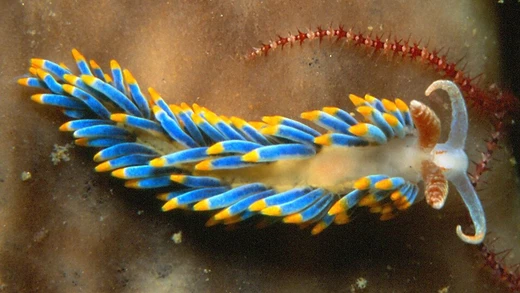
Mandelia
A monotypic dorid nudibranch genus named after Nelson Mandela.

Mandelia is a genus of sea slug, a dorid nudibranch, containing the single species Mandelia mirocornata. It is the only member of the family Mandeliidae. The genus and family name honor Nelson Mandela, the former President of South Africa.
Quick Facts
- Taxon
- Mandelia
Facts from the source article.
Lore & Background
Mandela's nudibranch, Mandelia mirocornata, is a marine gastropod mollusc and the only species in the genus Mandelia and family Mandeliidae. The genus and family name honor Nelson Mandela, the former President of South Africa. This species has so far only been found around the southern African coast from the Atlantic coast of the Cape Peninsula to Port Elizabeth in 10–400 m of water, and is probably endemic.
Mandela's nudibranch has a bumpy dirty white to brown skin with black spots scattered over the notum. Its gills and rhinophores are large and creamy-coloured. The rhinophores are perfoliate but oblong rather than round. The animal may also have irregular brown stripes rather than spots on the notum, radiating out to the margins. It may reach a total length of 70 mm. The body is dirty white or pale brown with irregular solid black spots and a bumpy surface texture. In water, the oblong, creamy rhinophores are visible. The dorsal surface is often translucent, partially revealing internal organs. The body is white to cream with brown or black blotches, accompanied by creamy rhinophores and gills. This species feeds on sponges.
Reader's Guide
Mandelia is notable as a monotypic genus and family, with its sole species Mandelia mirocornata being the only member of Mandeliidae. Its naming after Nelson Mandela, the former President of South Africa, gives it a unique cultural and political significance among nudibranchs. The species is probably endemic to southern African waters, having only been found from the Atlantic coast of the Cape Peninsula to Port Elizabeth at depths of 10–400 m. Its distinguishing features include a bumpy dirty white to brown skin with black spots or irregular brown stripes, large creamy gills and oblong perfoliate rhinophores, and a translucent dorsal surface that partially reveals internal organs. Reaching up to 70 mm in length, it feeds on sponges. The genus and family thus represent a distinct evolutionary lineage within dorid nudibranchs, named to honor a prominent historical figure.
Did You Know?
- Mandelia is the only genus in the family Mandeliidae.
- The genus and family are named after Nelson Mandela, former President of South Africa.
- It feeds on sponges.
More in Nudibranchs and Sea Slugs 1-24
Spotted an error? Know more?
Reader corrections go straight into our review queue. Suggest an edit · How this site is sourced