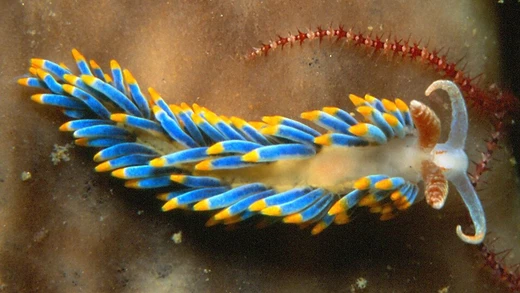
Leminda millecra
The sole species of the family Lemindidae, endemic to South Africa.

Leminda millecra, commonly known as the frilled nudibranch, is a species of shell-less marine gastropod mollusc or sea slug. It is the sole member of the monotypic genus Leminda and the family Lemindidae, making it notable as the only representative of its taxonomic group.
Quick Facts
- Grandparent Authority
- R. J. Griffiths, 1985
- Genus
- Leminda
- Species
- millecra
Facts from the source article.
Lore & Background
Leminda millecra is a large, smooth-bodied nudibranch reaching up to 90 mm, with a frilled appearance. Its body is robust and elevated, bearing a velum (anterior veil). Pigmentation may be pink or brown, depending on food color in its digestive gland ducts, and the mantle margin has a white or bright bluish edge. The margin is expanded and waving with large sinuous folds, held above the body, with an anterior break between its rhinophores. The rhinophores are pale, smooth, tapering, and do not retract into pockets. The foot is large and well-developed, and the radula is broad with hook-shaped teeth arranged in multiple series. The digestive gland branches extensively into the mantle margin. The animal has no eyes. A copulatory bag opens between the male and female reproductive openings.
The species is endemic to the South African coast, found from the Atlantic coast of the Cape Peninsula to Port Elizabeth at depths of 10–40 m. Deep water specimens have been trawled off the KwaZulu-Natal coast. It feeds on the soft coral Alcyonium fauri. The egg mass consists of fat white convoluted curls with large eggs distinctly visible.
The genus name Leminda comes from an adaptation of the describing author's daughter's name.
Reader's Guide
Leminda millecra holds significance as the only member of the genus Leminda and the family Lemindidae, making it a unique taxonomic entity among nudibranchs. Its distribution is restricted to the South African coast, where it is endemic, and it has been recorded from the Atlantic coast of the Cape Peninsula to Port Elizabeth, with deeper specimens trawled off KwaZulu-Natal. The species is notable for its large size (up to 90 mm) and frilled appearance, with a mantle margin that is expanded and waving. Its pigmentation varies based on the color of food in its digestive gland ducts, reflecting its diet of the soft coral Alcyonium fauri. The absence of eyes and the presence of a copulatory bag between reproductive openings are distinctive anatomical features. The egg mass, described as fat white convoluted curls with large visible eggs, provides insight into its reproductive biology. The genus name, derived from the author's daughter's name, adds a personal historical note. As a monotypic taxon, Leminda millecra represents the entirety of its family, underscoring its importance in nudibranch systematics.
Did You Know?
- Leminda millecra is the only species in the genus Leminda and the family Lemindidae.
- It has no eyes and its rhinophores do not retract into pockets.
- Its pigmentation (pink or brown) depends on the color of food in its digestive gland ducts.
More in Nudibranchs and Sea Slugs 1-24
Spotted an error? Know more?
Reader corrections go straight into our review queue. Suggest an edit · How this site is sourced