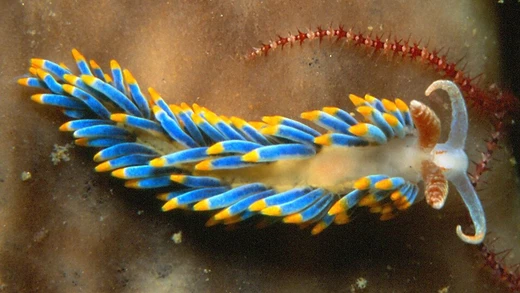
Janolus fuscus
A nudibranch found from Alaska to California and Japan.

Janolus fuscus is a nudibranch, a type of marine gastropod mollusk belonging to the family Janolidae. This sea slug has a semi-translucent, whitish-grey body that grows to about 35 millimeters. Its body is covered with short cerata that have brown centers, fading to orange and then white at the tips. The rhinophores, which have roughly 20 lamellae, are also tipped in white. A distinguishing feature from similar nudibranchs is the presence of cerata both in front of and behind the rhinophores.
The species ranges from the Kenai Peninsula in Alaska down to central California, and also appears in northern Japan. It lives in shallow, rocky intertidal and subtidal zones, never deeper than 30 meters.
Janolus fuscus feeds on bryozoans, specifically *Bugula californica* and *Tricellaria*. Its lifespan is about five months. In California, it is preyed upon by *Navanax*, which tracks its slime using chemoreceptors. When threatened, *Janolus* rolls into a ball, exposing its cerata; if a water current is present, it may be passively rolled away.
A common parasitic threat is the crustacean *Ismaila belciki*, which infects up to 80% of some monitored populations, such as those in Coos Bay, Oregon. The parasite lives inside the body cavity, with only its egg sacs visible externally. It does not hinder the host’s growth but diverts resources meant for egg production to its own reproduction, slowing the host’s reproduction and lowering its overall survival rate.
Quick Facts
- Taxon
- Janolus fuscus
Facts from the source article.
Lore & Background
Janolus fuscus inhabits shallow, rocky intertidal and subtidal zones, not deeper than 30m. Its body is semi-translucent and whitish-grey, reaching lengths of about 35mm. The body is covered in short cerata with brown cores, fading to orange and then white at the tip. Its rhinophores have around 20 lamellae and are also white tipped. The cerata in front of the rhinophores, as well as on the standard back of them, are a distinguishing factor between it and other similar nudibranch species.
Janolus species feed on Bryozoa, specifically Bugula californica and Tricellaria. The fuscus species lives for approximately five months. In California, Navanax is a known predator, tracking the slime of Janolus using chemoreceptors. When Janolus is about to be caught, it rolls into a ball, leaving its cerata exposed; if there is a water current, the sea slug may then be passively rolled away from the predator.
Janolus fuscus can be infected with a parasitic crustacean called Ismaila belciki. This is fairly common, and in some monitored populations such as Coos Bay, Oregon's, the rate of infection is up to 80%. The parasite is covertly located inside the body cavity so only egg sacs are visible externally. It does not interfere with the growth of its host, but it poaches resources used for egg production, making reproduction slow for the host and lowering survival rates.
Reader's Guide
Janolus fuscus is significant as a representative of the family Janolidae, with a distribution spanning the North Pacific from Alaska to central California and northern Japan. Its distinguishing cerata arrangement helps differentiate it from similar species. The species' life habits, including feeding on specific Bryozoa and a short lifespan of about five months, illustrate its ecological niche in shallow rocky zones. Its predator-prey interaction with Navanax, involving chemoreception and a rolling escape behavior, highlights a specialized defense mechanism. The high infection rate (up to 80%) by the parasitic crustacean Ismaila belciki in some populations, such as Coos Bay, Oregon, demonstrates a significant parasitic threat that reduces host reproductive output and survival, without affecting growth. This parasite-host relationship provides insight into the ecological pressures faced by the species.
Did You Know?
- Janolus fuscus is found from the Kenai Peninsula, Alaska to central California and also in northern Japan.
- When threatened by the predator Navanax, Janolus fuscus rolls into a ball, leaving its cerata exposed, and may be passively rolled away by water currents.
- The parasitic crustacean Ismaila belciki infects up to 80% of some Janolus fuscus populations, such as in Coos Bay, Oregon.
- Janolus fuscus lives for approximately five months and feeds on the Bryozoa Bugula californica and Tricellaria.
Frequently Asked Questions
What is Janolus fuscus?
Janolus fuscus is a small marine sea slug classified as a nudibranch within the family Janolidae. It is a shell-less adult gastropod mollusk commonly encountered by tide-poolers and underwater photographers along the Pacific coast.
What does Janolus fuscus look like?
The slug has a pale, semi-translucent body in whitish-grey tones, studded with short cerata that show a brown core transitioning to orange and then white at the tips. Its rhinophores carry roughly twenty lamellae and also end in a white tip.
Where can I find Janolus fuscus in the wild?
You can encounter this species along the Pacific coast from the Kenai Peninsula in Alaska southward to central California, as well as in Japanese waters. It inhabits intertidal and subtidal zones and is typically found at depths no greater than 30 meters.
How long does a Janolus fuscus live and how big does it get?
Adults reach a maximum length of roughly 35 millimeters, and their total lifespan is only about five months. Notably, some monitored populations—such as those around Coos Bay, Oregon—show parasite infection rates as high as 80 percent.
How do I distinguish Janolus fuscus from look-alike nudibranchs?
The key tell is that cerata are present on both the front and the rear of the rhinophores, a feature that sets it apart from closely related species. Combined with its pale body and the orange-to-white gradient on the cerata tips, this makes identification fairly straightforward.
More in Nudibranchs and Sea Slugs 1-24
Spotted an error? Know more?
Reader corrections go straight into our review queue. Suggest an edit · How this site is sourced