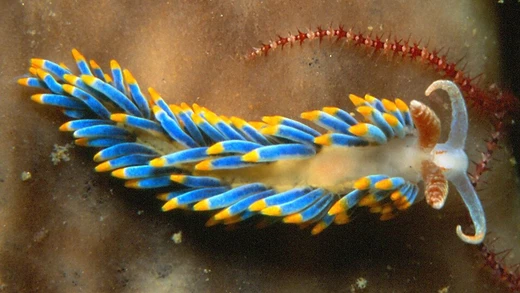
Glaucus (gastropod)
Small blue pelagic sea slugs that store venom from prey.

Glaucus is a genus of small blue pelagic sea slugs, known as aeolid nudibranchs, ranging in size from 20 to 40 mm. They are notable for feeding on colonial cnidarians such as Portuguese men o' war, blue buttons, and purple sails, and for storing the venomous nematocysts of their prey, which can produce painful and potentially dangerous stings when handled. Glaucus is the only genus in the family Glaucidae and includes five species.
Quick Facts
- Taxon
- Glaucus
- Type Species
- Glaucus atlanticus
- Type Species Authority
- Forster, 1777
Facts from the source article.
Lore & Background
The genus Glaucus was established by monotypy in 1777 by the British naturalist Johann Reinhold Forster, who described specimens of Glaucus atlanticus recovered during the second voyage of James Cook aboard HMS Resolution. The genus is named after the Greek sea-god Glaucus. In 1848, the German naturalist Johannes Gistel provided the substitute name Dadone for Glaucus, but it is unnecessary and now regarded as invalid. The family Glaucidae was established in 1827 by the British zoologist John Edward Gray to contain the genus. A second species in the family was described by the Danish malacologist Rudolph Bergh in 1860, placed under a new genus Glaucilla; however, synapomorphies between Glaucus and Glaucilla have made the maintenance of both genera irrelevant, so Glaucus is now regarded as the only genus within Glaucidae. Glaucidae is classified under the superfamily Aeolidioidea. In 2014, a careful DNA and anatomical study of the genus unexpectedly revealed a species complex: only one species was found in the Atlantic, but the name Glaucus marginatus was revealed to include four separate species (the 'marginatus' clade). There are three species in the North Pacific Subtropical Gyre System and another in the South Pacific Subtropical Gyre System. Glaucus atlanticus also occurs throughout the Indo-Pacific as well as in the Atlantic Ocean. In the North Pacific are Glaucus marginatus, Glaucus thompsoni, and Glaucus mcfarlanei, with Glaucus marginatus also occurring in the Indian Ocean and the South Pacific. Also in the South Pacific is Glaucus bennettae. Glaucus atlanticus has some genetic differences in different parts of its range but is considered a single species.
Reader's Guide
Glaucus is significant as the sole genus in the family Glaucidae, a position solidified after the genus Glaucilla was synonymized due to shared derived characteristics. The genus's ability to store venomous nematocysts from its cnidarian prey makes it notable for producing painful and potentially dangerous stings when handled, a defense mechanism derived from its diet. Its taxonomic history reflects shifts in classification: established by Forster in 1777, with an unnecessary substitute name proposed in 1848, and the family erected in 1827. The 2014 DNA and anatomical study revealed a cryptic species complex, expanding the known diversity from one to five species, with distinct distributions across Atlantic and Pacific gyre systems. This discovery underscores the importance of molecular methods in uncovering hidden biodiversity. Glaucus atlanticus, the type species, is widespread across the Indo-Pacific and Atlantic, while the other four species are restricted to specific Pacific gyres, with Glaucus marginatus also found in the Indian Ocean. The genus remains a subject of ongoing study due to genetic variation within Glaucus atlanticus across its range.
Did You Know?
- The genus was established in 1777 by Johann Reinhold Forster based on specimens from James Cook's second voyage.
- Glaucus stores venomous nematocysts from its prey, which can cause painful stings when handled.
- A 2014 study revealed that Glaucus marginatus actually comprises four separate species.
More in Nudibranchs and Sea Slugs 1-24
Spotted an error? Know more?
Reader corrections go straight into our review queue. Suggest an edit · How this site is sourced