Coryphella sanamyanae
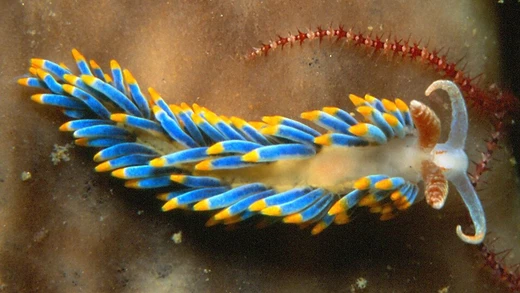
A translucent white aeolid nudibranch from the North West Pacific.

Coryphella sanamyanae is a type of sea slug, specifically an aeolid nudibranch, belonging to the marine mollusc family Flabellinidae. Its body is relatively broad, with a narrow notum and short foot corners. The rhinophores and oral tentacles are about the same size, and the rhinophores are described as robust and slightly wrinkled. The cerata are long, spindle-shaped, and taper to pointed tips; they attach to the body in a continuous line rather than in clusters. The body is translucent white. Inside the cerata, the digestive gland diverticula are dark-red to pinkish and take up much of the space, while the tips of the cerata are capped with opaque white pigment.
This species was named in honor of Nadezhda Sanamyan, a marine biologist from Kamchatka noted for her significant work collecting nudibranchs in the North West Pacific. The only known specimen was dredged from a depth of 17 meters near Matua Island in the Middle Kurile Islands, North West Pacific Ocean.
Quick Facts
- Genus
- Coryphella
- Species
- sanamyanae
Facts from the source article.
Lore & Background
Coryphella sanamyanae was named after Nadezhda Sanamyan, a marine biologist from Kamchatka credited with making 'a considerable contribution in collecting North West Pacific nudibranchs'. The species was described from a single specimen dredged at a depth of 17 meters at Matua Island, in the Middle Kurile Islands of the North West Pacific Ocean.
The body of this sea slug is relatively wide with a narrow notum and relatively short foot corners. Its rhinophores and oral tentacles are similarly sized, with the rhinophores described as 'slightly wrinkled, robust'. The cerata are long and fusiform with pointed apices, attached to the body continuously without forming clusters. The body is translucent white, while the digestive gland diverticula is dark-red to pinkish and fills a significant volume of the cerata, which are capped with opaque white pigment.
Reader's Guide
Coryphella sanamyanae is significant as a species described from a single specimen, highlighting the rarity and limited known distribution of this nudibranch. Its discovery at Matua Island in the Middle Kurile Islands adds to the biodiversity knowledge of the North West Pacific region. The species' naming honors Nadezhda Sanamyan, a marine biologist whose fieldwork contributed substantially to the collection of nudibranchs in that area. The detailed description of its morphology—including the relatively wide body, narrow notum, short foot corners, similarly sized rhinophores and oral tentacles, and the distinctive long fusiform cerata with pointed apices—provides a clear taxonomic reference. The coloration, with a translucent white body, dark-red to pinkish digestive gland diverticula filling much of the cerata, and opaque white caps on the cerata, aids in identification. As a member of the family Flabellinidae, it contributes to the understanding of aeolid nudibranch diversity and evolution, as discussed in the referenced work by Korshunova, Fletcher, and Martynov.
Did You Know?
- The species was described from a single specimen dredged at 17 m depth at Matua Island.
- Its cerata are long and fusiform with pointed apices, attached continuously without forming clusters.
More in Nudibranchs and Sea Slugs 1-24
Spotted an error? Know more?
Reader corrections go straight into our review queue. Suggest an edit · How this site is sourced