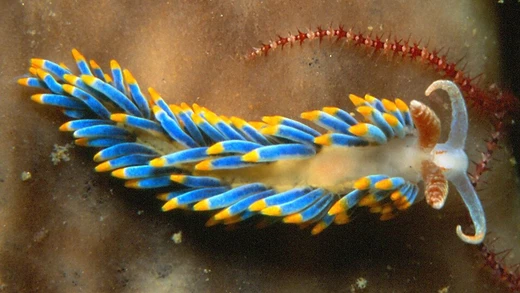
Coryphella pallida
A small, pale sea slug with disputed taxonomic placement.

Coryphella pallida is a marine sea slug, specifically an aeolid nudibranch, belonging to the family Flabellinidae. Its taxonomic placement is uncertain. Ekimova et al. consider its assignment to the genus *Coryphella* provisional, pending further study. Korshunova et al. treat *C. pallida* as a nomen dubium, arguing that it should be fully excluded from the family Coryphellidae (as defined by Korshunova et al., 2025) because there has never been any evidence it belonged there.
The species reaches a maximum length of 10 mm. A. E. Verrill’s original 1900 description is brief and based on a single specimen. He described the body as small and slender, with long, slender dorsal papillae arranged in two series of lateral clusters—numerous but not crowded, and often curved. The rhinophores are elongated, tapered, slightly plicated, and light yellow. The foot is narrow, with anterior lobes that are much prolonged, slender, acute, and usually curved back. The body is white, and the dorsal papillae are dark gray with white tips. Verrill titled his description “Coryphella (?) pallida, sp. nov.,” indicating his own doubt about its placement in *Coryphella*. No illustrations or details on internal anatomy were provided, and the location of the type material is unknown, if it still exists.
This species is found in the western Pacific Ocean, primarily around Bermuda.
Quick Facts
- Taxon
- Coryphella pallida
Facts from the source article.
Lore & Background
Coryphella pallida was originally described in 1900 by A. E. Verrill, who expressed uncertainty about its placement within the genus Coryphella by titling his description 'Coryphella (?) pallida, sp. nov.' The description was brief, based on a single specimen, and included no illustrations or details on internal anatomy. The location of the type material is unknown, if it exists at all.
The species is described as having a small, slender body up to 10mm in length, with long, slender dorsal papillae arranged in two series of lateral clusters. The rhinophores are elongated, tapered, slightly plicated, and light yellow. The foot is narrow with anterior lobes that are much prolonged, slender, acute, and usually curved back. The body is white, and the dorsal papillae are dark gray with white tips.
Taxonomic uncertainty persists: Ekimova et al. consider the placement of C. pallida under Coryphella as provisional, believing further study is needed. Korshunova et al. regard C. pallida as nomen dubium, stating it is necessary to fully exclude it from Coryphellidae sensu Korshunova et al. (2025) as there has never been any indication it belonged there.
Reader's Guide
Coryphella pallida holds significance primarily as a taxonomic puzzle. Its original description by A. E. Verrill in 1900 was tentative, as indicated by the question mark in the title, and was based on a single specimen with no illustrations or internal anatomy. The type material is lost or nonexistent, complicating any definitive identification. Modern researchers disagree on its status: Ekimova et al. treat its placement under Coryphella as provisional, while Korshunova et al. consider it a nomen dubium, arguing it should be excluded from Coryphellidae entirely. This species thus exemplifies the challenges of working with historical descriptions that lack sufficient detail. Its legacy lies in highlighting the need for careful taxonomic revision and the importance of type specimens. The brief physical description—a white body with dark gray papillae tipped in white, light yellow rhinophores, and a slender foot—remains the only concrete record of this enigmatic sea slug.
Did You Know?
- The original description by A. E. Verrill was based on only a single specimen.
- No illustrations or details on internal anatomy were included in the original description.
- Korshunova et al. regard Coryphella pallida as nomen dubium.
More in Nudibranchs and Sea Slugs 1-24
Spotted an error? Know more?
Reader corrections go straight into our review queue. Suggest an edit · How this site is sourced