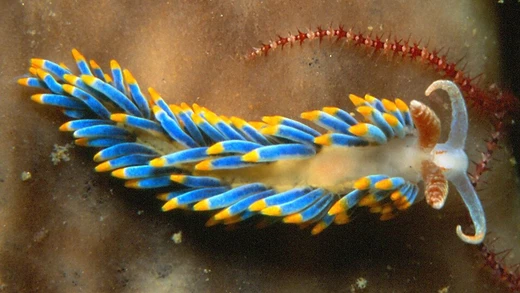
Bornella
A little-studied genus of dendronotid nudibranchs feeding on hydroids.

Bornella is a genus of dendronotid nudibranchs, a type of sea slug, placed within the family Bornellidae. Scientific study of this group is limited, and much of their biology remains unclear, though they are known to eat only hydroids. These sea slugs are found in the Indo-West Pacific, with one species also living in the tropical eastern Pacific and another in the western Atlantic. Their bodies feature dorsal and lateral outgrowths resembling cerata, which have finger-like branches. A cluster of gills is attached to the body. The rounded head has a tentacle on each side of the mouth, each covered in tiny finger-like papillae. The rhinophore sheath is tall and looks similar to the dorsal processes. Species are distinguished by their color patterns, the number of dorsal and lateral outgrowths, and the number of branches on the rhinophore sheath. Anatomically, Bornella has an unpaired oral gland. In the reproductive system, the male and female ducts are separate. Species in this genus include *Bornella anguilla*, *B. calcarata*, *B. dotoides*, *B. excepta*, *B. hermanni* (with synonym *B. japonica*), *B. irvingi*, *B. johnsonorum*, *B. pele*, *B. sarape*, *B. simplex*, *B. stellifer* (with synonyms *B. hancockana*, *B. arborescens*, *B. caledonica*, and *B. marmorata*), and *B. valdae*.
- Family
- Bornellidae
- Distribution
- Indo-West Pacific, with one species in the tropical eastern Pacific and one species in the western Atlantic
- Diet
- hydroids
- Anatomical features
- unpaired oral gland; separate male and female ducts in genital system
Lore & Background
Bornella nudibranchs occur in the Indo-West Pacific, with one species in the tropical eastern Pacific and one species in the western Atlantic. Their body is covered with cerata-like dorsal and lateral outgrowths with finger-like branches, and they have an attached cluster of gills. The rounded head shows on each side of the mouth a tentacle with tiny finger-like papillae, and the sheath of the rhinophore stands high and resembles the dorsal processes. The various species differ in their color pattern, number of dorsal and lateral outgrowths, and number of branches on their rhinophore sheath. Anatomically, these nudibranchs are characterized by an unpaired oral gland, and in their genital system the male duct is separate from the female duct. The genus includes several named species, such as Bornella anguilla, Bornella calcarata, Bornella dotoides, Bornella excepta, Bornella hermanni (with synonym Bornella japonica), Bornella irvingi, Bornella johnsonorum, Bornella pele, Bornella sarape, Bornella simplex, Bornella stellifer (with multiple synonyms including Bornella hancockana, Bornella arborescens, Bornella caledonica, and Bornella marmorata), and Bornella valdae.
Reader's Guide
Bornella represents a genus of dendronotid nudibranchs within the family Bornellidae, notable primarily for the lack of research conducted on it. The article states that their biology is mostly unknown, with the sole confirmed dietary habit being exclusive feeding on hydroids. This limited knowledge underscores the genus as a subject for future investigation. The distribution spans the Indo-West Pacific, with isolated species in the tropical eastern Pacific and western Atlantic, indicating a broad but patchy range. The anatomical description highlights distinctive features such as cerata-like outgrowths, a high rhinophore sheath, and an unpaired oral gland, as well as a genital system with separate male and female ducts. The species list includes several named taxa, with some synonyms noted, and one invalid name (B. semperi) identified as a nomen nudum. The genus's significance lies in its understudied status, offering a clear gap in nudibranch research that could yield insights into evolution, ecology, and anatomy within the Bornellidae family.
Did You Know?
- Bornella nudibranchs feed exclusively on hydroids.
- The genus has an unpaired oral gland and separate male and female ducts in the genital system.
- Species differ in color pattern, number of dorsal and lateral outgrowths, and rhinophore sheath branches.
More in Nudibranchs and Sea Slugs 1-24
Spotted an error? Know more?
Reader corrections go straight into our review queue. Suggest an edit · How this site is sourced