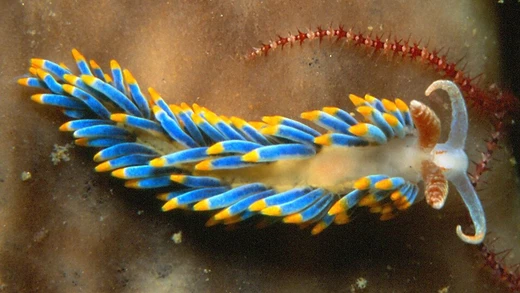
Aegires albopunctatus
A small nudibranch with salt-and-pepper spots and a firm, spicule-filled body.

Aegires albopunctatus, called the salt-and-pepper doris, is a type of sea slug, or nudibranch, belonging to the family Aegiridae. It is also known as the salt-and-pepper nudibranch, small white nudibranch, white knight nudibranch, and white-spotted doris.
This species lives in the Eastern Pacific Ocean, from British Columbia, Canada, down to Baja California, Mexico. It is found in the low intertidal zone and shallow subtidal waters, at depths up to 100 feet (30 meters), often in sheltered, rocky tide pools and on wharf pilings.
The salt-and-pepper doris reaches a maximum length of 0.9 inches (23 mm). Its body is somewhat squarish and torpedo-shaped, colored from bright white to duller yellowish-gray. As its common name suggests, it is covered in small dark and white spots that resemble ground table salt and black pepper. The larger dark spots are black or dark brown, while the white flecks are more visible on grayer individuals and may be indistinct on brighter white ones. Some individuals have few or no dark spots. Like other members of its genus, its body wall feels firm because it contains spicules from the sponges it eats. The body has irregular rows of short, cylindrical tubercles. Its rhinophores are yellowish, truncated, and simple in shape. It has three small, tripinnate gills, each sheltered by a large, irregularly shaped tubercle. Near its mouth are small, lobe-like oral tentacles. The mouth is roofed by a thick, quadrangular mandibular plate, and its radula is broad and deeply grooved, with 16 to 22 rows of 17 teeth each.
The salt-and-pepper doris feeds exclusively on calcareous sponges from the genera *Leucetta*, *Leucilla*, and possibly *Leucosolenia*. Like all nudibranchs, it is a simultaneous hermaphrodite. During mating, individuals wrestle for dominance, each trying to penetrate and impregnate the other with its penis, which is lined with small, hooked spines.
Quick Facts
- Taxon
- Aegires albopunctatus
Facts from the source article.
Lore & Background
The salt-and-pepper doris grows up to 0.9 inches in length, with a body shaped like a squarish torpedo. Its color ranges from bright white to duller, yellowish-gray shades, and it is covered with small dark and white spots resembling ground table salt and black pepper. The larger 'pepper' spots appear black or dark brown, while the white 'salt' flecks are more apparent on grayer individuals; some individuals may have very few or no dark spots. Its body wall is firm to the touch, filled with spicules from the sponges it consumes, and lined with irregular rows of short, cylindrical tubercles. The rhinophores are yellowish, truncated, and simple in shape, and it has three small, tripinnate gills, each sheltered by a large, irregularly shaped tubercle. Near its mouth, it has small, lobe-like oral tentacles, and its mouth is roofed by a thick, quadrangular mandibular plate.
Reader's Guide
The salt-and-pepper doris is a specialized predator, feeding exclusively on calcareous sponges of the genera Leucetta, Leucilla, and possibly Leucosolenia. This diet contributes to the firmness of its body wall, which is reinforced by spicules derived from its prey. As a simultaneous hermaphrodite, it engages in mating behavior where individuals wrestle for dominance, attempting to penetrate and impregnate the other with a penis lined with small, hooked spines. Its distribution along the Eastern Pacific coast from British Columbia to Baja California, and its occurrence in low intertidal and shallow subtidal zones down to 30 meters, make it a recognizable species in rocky tide pools and on wharf pilings. The species' common names—including salt-and-pepper nudibranch, small white nudibranch, white knight nudibranch, and white-spotted doris—reflect its varied appearance and the attention it draws from naturalists.
Did You Know?
- Its body wall is firm because it is filled with spicules from the sponges it eats.
- During mating, individuals wrestle for dominance and use a penis lined with small, hooked spines.
More in Nudibranchs and Sea Slugs 1-24
Spotted an error? Know more?
Reader corrections go straight into our review queue. Suggest an edit · How this site is sourced