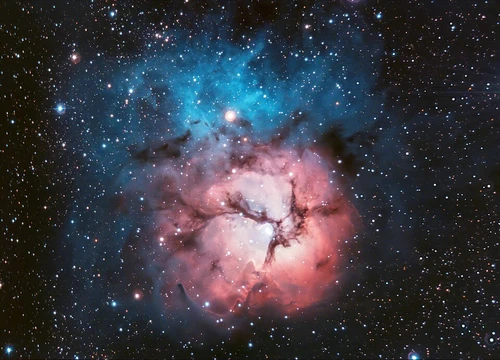
Wolf–Rayet nebula
Nebula formed by stellar winds from Wolf–Rayet stars.

A Wolf–Rayet nebula forms from the powerful winds blasted into space by a Wolf–Rayet star. These stars are extremely hot, bright, and short-lived, burning through helium or even heavier elements in their cores. The winds they produce are dense streams of charged particles racing at thousands of kilometers per second. When these winds crash into the surrounding interstellar material, they create shock waves that heat and ionize the gas and dust, making it glow across visible and other wavelengths.
- Type
- Nebula
- Created by
- Stellar winds from Wolf–Rayet stars
- Characteristic structure
- Multi-ring structure with shells and cavities
- Visibility
- Visible light, infrared, X-ray, and other wavelengths
- Notable examples
- NGC 6888, NGC 2359, M1-67, NGC 3199
Lore & Background
Wolf–Rayet stars represent a brief late stage in the evolution of some very massive stars. They have shed their outer hydrogen envelopes and their stellar winds now consist of heavier elements like helium, carbon, nitrogen, and oxygen. As a Wolf–Rayet star evolves and loses mass, its winds shape the surrounding gas and dust into bubble-like nebular structures. The inner region forms from the current stellar wind, while outer shells are remnants of previous mass-loss episodes.
Reader's Guide
Wolf–Rayet nebulae are significant because they provide insight into the powerful stellar winds and evolutionary processes around Wolf–Rayet stars. These nebulae exhibit intricate structures revealed in visible light as well as infrared, X-ray, and other wavelengths. The process of their formation involves stellar winds traveling at thousands of kilometers per second slamming into the interstellar medium, generating shock waves that heat and ionize gas and dust. Notable examples include NGC 6888 (Crescent Nebula), NGC 2359 (Thor's Helmet Nebula), M1-67 (Luminous Blue Variable Nebula), and NGC 3199 (Nebula around WR 18). Eventually, the Wolf–Rayet star will end its life in a spectacular supernova explosion that will dramatically alter the nebula's structure and composition.
Did You Know?
- Wolf–Rayet nebulae are created from stellar winds expelled by Wolf–Rayet stars.
- The stellar winds travel at speeds of thousands of kilometers per second.
- Wolf–Rayet stars are fusing helium or heavier elements in their cores.
- Notable Wolf–Rayet nebulae include NGC 6888, NGC 2359, M1-67, and NGC 3199.
Frequently Asked Questions
What is a Wolf–Rayet nebula?
It is a glowing cloud of ionized gas and dust produced when the supersonic outflows from a Wolf–Rayet star slam into the surrounding interstellar medium. The resulting shock fronts excite the material so it radiates light across a wide range of wavelengths.
How does a Wolf–Rayet nebula form?
A Wolf–Rayet star, which is fusing helium or heavier elements in its core, hurls dense, charged-particle winds outward at thousands of kilometers per second. When those winds collide with nearby gas and dust, the impact generates shock waves that heat and ionize the material, producing the characteristic glowing shell.
What does the structure of a Wolf–Rayet nebula look like?
These nebulas typically display a multi-ring architecture, with concentric shells and hollow cavities carved out by the star's persistent stellar wind. The layered appearance reflects different episodes of mass loss over the star's brief, violent lifetime.
Which Wolf–Rayet nebulae are the most well-known?
Popular examples among stargazers and researchers include NGC 6888 (the Crescent Nebula), NGC 2359, M1-67, and NGC 3199. Each showcases the signature shell-and-cavity morphology produced by its parent Wolf–Rayet star.
Why do astronomers care about Wolf–Rayet nebulae?
They serve as natural laboratories for studying extreme stellar evolution, since the parent stars are among the hottest, brightest, and shortest-lived objects in the galaxy. Observing them across visible, infrared, and X-ray bands helps scientists understand how massive stars end their lives and enrich the interstellar medium.
More in Nebulae 1-24
Spotted an error? Know more?
Reader corrections go straight into our review queue. Suggest an edit · How this site is sourced