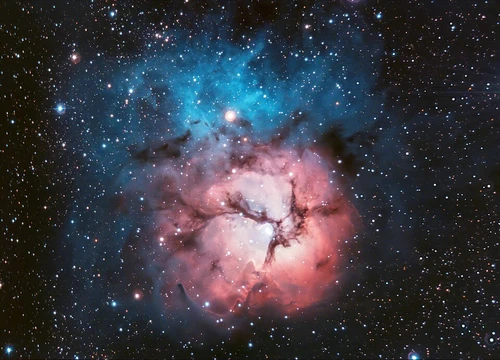
G12.82-0.02
Relatively young supernova remnant in the Milky Way.

G12.82-0.02, also cataloged as SNR G012.8-0.02, is a supernova remnant and pulsar wind nebula located in the constellation Sagittarius. It sits in the Galactic Plane and is associated with the star-forming region W33, placing it roughly 15,000 light-years (4,500 parsecs) away. The remnant was identified in 2005 as the home of the X-ray source and pulsar HESS J1813-178. A nearby gas cloud has a molecular mass of 2.5×10⁵ solar masses.
This supernova remnant is relatively young, with an estimated age of about 1,000–2,000 years. Its small size—a diameter of 12.8 light-years (4 parsecs), corresponding to an angular diameter of 3 arcminutes—indicates it is still in an early evolutionary phase. The supernova was a core-collapse (type II) event, and its progenitor was a red supergiant of 20 to 30 solar masses, typical for this kind of explosion. Dust obscured the event, so it was not visible from Earth.
The central neutron star, designated PSR J1813-1749, is a pulsar with a rotation period of 44.7 milliseconds. It is highly energetic, with one of the highest velocities recorded for a neutron star in the Milky Way—between 900 and 1,600 km/s. Its magnetic field is very strong, at 2.7×10¹² gauss. The pulsar has a luminosity of 0.832 solar luminosities. It originally formed in a nearby star cluster with a mass of 2,000 to 6,500 solar masses.
Quick Facts
- Event Type
- Supernova
- Discovery
- c. 1708-1720 (discovered in 2005)
- Constellation
- Sagittarius
- Ra
- 18 · 13 · 36.0
- Dec
- -17 · 49 · 00
- Epoch
- J2000
- Distance
- c. 14,700 ly (4,500 pc)
- Host
- Milky Way
- Progenitor
- Red supergiant
- Names
- G12.82-0.02, SNR G012.8-00.0, GAL 012.82-00.02
- Predecessor
- Cassiopeia A
- Successor
- G1.9+0.3
Facts from the source article.
Lore & Background
G12.82-0.02 is a supernova remnant located in the Galactic Plane, roughly 15,000 light years away based on its likely association with the star-forming region W33. It was discovered in 2005 as the host of the X-ray source and pulsar HESS J1813-178. The remnant is relatively young, with an estimated age of about 1,000–2,000 years, and has a diameter of only 12.8 light years.
Reader's Guide
G12.82-0.02 is significant as the second youngest known supernova remnant in the Milky Way, providing a rare opportunity to study a very recent core collapse supernova and its aftermath. Its extreme youth—the explosion occurred between 1708 and 1720—means the remnant is still small and the central neutron star is highly energetic. The pulsar PSR J1813-1749 is notable for its millisecond rotation, extremely high velocity, and strong magnetic field, making it a key object for understanding neutron star physics and supernova kick mechanisms. The remnant's association with the star-forming region W33 and its location in the Galactic Plane help link supernovae to their birth environments. Because the supernova was obscured by dust, it was not observed historically, but its discovery in 2005 via X-ray and pulsar emissions highlights the importance of multi-wavelength astronomy in uncovering hidden events. The remnant's age places it between Cassiopeia A and G1.9+0.3, offering a chronological sequence of recent Galactic supernovae.
Did You Know?
- G12.82-0.02 is a relatively young supernova remnant, estimated to be about 1,000–2,000 years old.
- The supernova exploded roughly 1,000–2,000 years ago and could not be seen from Earth due to dust obscuration.
- The central pulsar PSR J1813-1749 has a velocity of 900 to 1,600 km/s, one of the highest of any Milky Way neutron star.
- The pulsar PSR J1813-1749 has a rotation period of 44.7 milliseconds, classifying it as a normal pulsar.
Discovery and Galactic Neighborhood
In 2005, astronomers identified G12.82-0.02 (also catalogued as SNR G012.8-0.00) while tracing the X-ray source and pulsar HESS J1813-178, revealing it as the host nebula. Situated in the constellation Sagittarius along the Galactic Plane, this object lies roughly 15,000 light years (about 4,500 parsecs) from Earth, a distance inferred from its probable connection to the star-forming region W33. The remnant's immediate environment is dense with interstellar material: a nearby gas cloud carries a molecular mass of 2.5×10⁵ solar masses, hinting at the rich, dusty landscape that surrounds this young explosion site. As both a supernova remnant and a pulsar wind nebula, G12.82-0.02 occupies a transitional phase in stellar evolution, where the shockwave from the initial detonation still interacts with the energetic outflows of its central neutron star. Its position in the Galactic Plane and its association with active star formation make it a valuable laboratory for studying how massive stars end their lives amid crowded, molecule-laden regions of the Milky Way.
The Explosion and Its Progenitor
The supernova that birthed G12.82-0.02 detonated sometime between 1708 and 1720, making it the second-youngest known supernova remnant in our galaxy, surpassed only by G1.9+0.3, whose explosion occurred in the late nineteenth century. The remnant's remarkably small diameter—just 12.8 light years (4 parsecs), corresponding to an angular size of 3 arcminutes—confirms its extreme youth. Classified as a core-collapse event (type II), the explosion was the final act of a red supergiant star whose mass ranged from 20 to 30 solar masses, a typical progenitor for this class of supernova. Despite occurring within human historical times, the detonation was never witnessed from Earth; thick interstellar dust along the line of sight in the Galactic Plane absorbed and scattered the light before it could reach our telescopes. In the chronological sequence of well-known Milky Way core-collapse remnants, this event followed Cassiopeia A and preceded G1.9+0.3, placing it in a narrow window of recent stellar death.
The Millisecond Pulsar at Its Heart
At the center of G12.82-0.02 spins PSR J1813-1749, a millisecond pulsar whose rotation period is a mere 44.7 milliseconds. This neutron star is extraordinarily energetic, boasting one of the highest space velocities recorded for any pulsar in the Milky Way, estimated between 900 and 1,600 kilometers per second. Its magnetic field strength reaches 2.7×10¹² gauss, a value that drives the powerful winds shaping the surrounding nebula. The pulsar's luminosity is 0.832 times that of the Sun, and its effective surface temperature soars to 3,481,000 kelvin, consistent with a compact diameter of approximately 3.49 kilometers. Remarkably, PSR J1813-1749 was not born in isolation; it originated within a nearby star cluster whose total mass spanned 2,000 to 6,500 solar masses. The combination of extreme spin rate, enormous velocity, and intense magnetic output makes this object a prime example of how a core-collapse supernova can leave behind a neutron star that continues to power a visible nebula centuries after the initial explosion.
A Rare Window into Recent Stellar Death
G12.82-0.02 holds a singular place in the catalog of Milky Way supernova remnants because of its extreme youth. Only G1.9+0.3, which exploded in the late 1800s, is younger, and the next well-known core-collapse remnant in chronological order, Cassiopeia A, predates it. This tight sequence—Cassiopeia A, then G12.82-0.02, then G1.9+0.3—offers astronomers a rare opportunity to compare how remnants of different ages evolve from the initial shock breakout through the pulsar-wind phase. Because the 1708–1720 explosion was hidden behind dense Galactic dust, no historical records of a bright transient exist, making the remnant's physical properties its sole witness to the event. The fact that the remnant is still only 12.8 light years across after roughly three centuries means the shock front has barely had time to decelerate, preserving conditions that are difficult to observe in older, more diffuse remnants. For researchers studying the interplay between a young pulsar's wind and the expanding ejecta, G12.82-0.02 represents one of the most accessible laboratories in the galaxy for probing the earliest stages of post-supernova evolution.
Frequently Asked Questions
What is G12.82-0.02?
G12.82-0.02 (also cataloged as SNR G012.8-0.02) is a young supernova remnant that also functions as a pulsar wind nebula. It sits in the constellation Sagittarius, embedded within the star-forming region W33 along the Galactic Plane.
How old is G12.82-0.02?
Current estimates place the remnant at roughly 1,000 to 2,000 years since the original stellar explosion, making it one of the youngest known supernova remnants in the Milky Way.
What pulsar sits at the heart of G12.82-0.02?
The central engine is PSR J1813-1749, a rapidly spinning pulsar with a rotation period of 44.7 milliseconds. It was identified in 2005 when the source was linked to the X-ray emitter HESS J1813-178.
How far away and how large is G12.82-0.02?
The remnant measures about 12.8 light-years (4 parsecs) across and lies roughly 15,000 light-years from Earth. A nearby molecular cloud contributes an additional 250,000 solar masses of gas to the local environment.
Why do astronomers find G12.82-0.02 interesting?
Its youth gives observers a rare window into the early phases of a supernova remnant's evolution before it has had time to expand and fade. Its proximity to the dense star-forming region W33 also makes it a natural laboratory for studying how shock fronts interact with massive molecular clouds.
More in Nebulae 1-24
Spotted an error? Know more?
Reader corrections go straight into our review queue. Suggest an edit · How this site is sourced