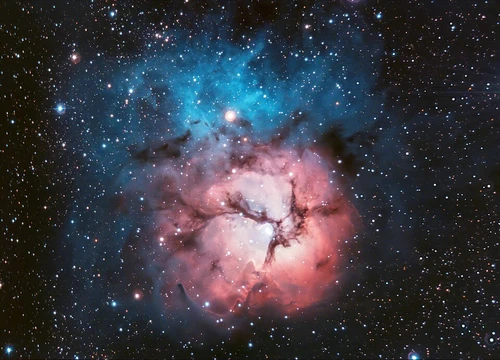
Evaporating gaseous globule
Dense hydrogen globules that can birth protostars.

In space, an evaporating gaseous globule (EGG) is a pocket of hydrogen gas about 100 astronomical units across. Its own gas blocks out ionizing ultraviolet light, shielding the denser material behind it. This shielded, dense gas can encourage the formation of new stars. The first clear identification of EGGs came from 1995 Hubble Space Telescope images of the Pillars of Creation in the Eagle Nebula.
EGGs are thought to be the precursors of protostars. Inside an EGG, gas and dust are packed more tightly than in the surrounding cloud. Gravity pulls the cloud even closer together as the EGG draws in more material from its environment. As the density rises, the globule heats up under the pressure of its outer layers, and a protostar forms within it.
A protostar may not have enough mass to become a full star; if so, it becomes a brown dwarf. If it does have enough mass, the density reaches a critical point where the core temperature exceeds 10 million kelvin. At that stage, nuclear fusion begins, converting hydrogen into helium and releasing vast energy. The protostar then becomes a star and enters the main sequence on the Hertzsprung-Russell diagram.
A study using the Very Large Telescope examined 73 EGGs in the Pillars of Creation and found that only 15% show signs of star formation. This process is not uniform: the largest pillar contains a small cluster of such star-forming sources at its tip.
- Size
- approximately 100 astronomical units
- Composition
- hydrogen gas
- First identified
- 1995 via Hubble Space Telescope photographs of the Pillars of Creation
- Location
- Eagle Nebula (Pillars of Creation)
- Role
- likely predecessors of new protostars
- Star-formation rate
- 15% of 73 studied EGGs show signs of star-formation
Lore & Background
EGGs are the likely predecessors of new protostars. Inside an EGG the gas and dust are denser than in the surrounding dust cloud. Gravity pulls the cloud even more tightly together as the EGG continues to draw in material from its surroundings. As the cloud density builds up the globule becomes hotter under the weight of the outer layers, a protostar is formed inside the EGG.
A protostar may have too little mass to become a star. If so it becomes a brown dwarf. If the protostar has sufficient mass, the density reaches a critical level where the temperature exceeds 10 million kelvin at its center. At this point, a nuclear reaction starts converting hydrogen to helium and releasing large amounts of energy. The protostar then becomes a star and joins the main sequence on the HR diagram.
A study of 73 EGGs in the Pillars of Creation (Eagle Nebula) with the Very Large Telescope showed that only 15% of the EGGs show signs of star-formation. The star-formation is not everywhere the same: The largest pillar has a small cluster of these sources at the head of the pillar.
Reader's Guide
Evaporating gaseous globules represent a key stage in the process of star formation, acting as shielded nurseries where dense gas and dust can collapse under gravity to form protostars. Their identification in 1995 via Hubble Space Telescope images of the Eagle Nebula's Pillars of Creation provided the first conclusive evidence of these structures. The fact that only 15% of studied EGGs show signs of star formation highlights the selective nature of stellar birth, with the largest pillar hosting a small cluster of such sources. EGGs are significant because they bridge the gap between diffuse interstellar clouds and the formation of stars or brown dwarfs, depending on the mass of the protostar. Their study continues to inform models of stellar evolution and the conditions necessary for nuclear ignition.
Did You Know?
- An evaporating gas globule is approximately 100 astronomical units in size.
- EGGs were first conclusively identified via 1995 Hubble Space Telescope photographs of the Pillars of Creation.
- Only 15% of 73 EGGs studied in the Pillars of Creation show signs of star-formation.
- If a protostar inside an EGG has too little mass, it becomes a brown dwarf rather than a star.
Discovery Through the Hubble Telescope
The existence of evaporating gas globules was not confirmed until the mid-1990s, when the Hubble Space Telescope captured photographs of the Pillars of Creation within the Eagle Nebula. These 1995 images provided the first conclusive identification of EGGs as distinct structures in the interstellar medium. Prior to this observation, the specific role these hydrogen-rich regions played in the broader cosmic landscape remained unclear. The Eagle Nebula, with its dramatic columnar formations, proved to be an ideal natural laboratory for studying these objects. The Hubble photographs revealed that within these towering pillars of gas and dust, there existed compact regions of hydrogen approximately one hundred astronomical units across. This discovery opened an entirely new window into understanding how the raw materials of star formation are organized and protected in the vastness of outer space, transforming what had been theoretical speculation into confirmed astrophysical reality.
Structure and the Shielding Mechanism
An evaporating gas globule is fundamentally a compact region of hydrogen gas suspended in the depths of outer space, spanning roughly one hundred astronomical units in diameter. What makes this structure particularly significant is its capacity to act as a protective barrier. The dense hydrogen within the globule casts a shadow over the gas and dust immediately behind it, effectively blocking the ionizing ultraviolet radiation that would otherwise strip atoms of their electrons and disrupt chemical processes. This shielding creates a relatively calm micro-environment where denser pockets of material can accumulate without being torn apart by energetic radiation. It is precisely within these protected, dense regions that the conditions become favorable for the birth of new stars. The globule's interior contains gas and dust at higher density than the surrounding cloud, and as it continues to accrete material from its environment, gravity draws the cloud even more tightly inward, setting the stage for the next phase of stellar evolution.
From Protostar to Main-Sequence Star
Once the dense core within an EGG begins to collapse under its own gravity, the process of stellar birth accelerates. The globule draws in additional material from its surroundings, and the increasing weight of outer layers compresses the interior, raising its temperature. At this stage, a protostar takes shape at the heart of the globule. However, not every protostar will go on to become a full-fledged star. If the accumulated mass falls below a critical threshold, the object will instead settle into existence as a brown dwarf, a celestial body that never ignites sustained nuclear fusion. For protostars that do gather sufficient mass, the central density climbs until temperatures surpass ten million kelvin. At that extraordinary threshold, hydrogen nuclei begin fusing into helium, unleashing tremendous energy. This ignition marks the transition from protostar to true star, and the newly formed object takes its place on the main sequence of the Hertzsprung-Russell diagram, beginning its long, stable life of nuclear burning.
Observational Evidence and Distribution Patterns
Ground-based observations have provided crucial context for understanding how widespread active star formation actually is among EGG populations. A dedicated study conducted with the Very Large Telescope examined seventy-three individual EGGs located within the Pillars of Creation in the Eagle Nebula. The results revealed that only about fifteen percent of these globules displayed clear signs of ongoing star formation. This finding underscores that while EGGs are the likely precursors of new protostars, the vast majority remain in a quiescent state, their cores not yet dense or hot enough to trigger the collapse that leads to stellar ignition. Furthermore, the distribution of active star formation is not uniform across the pillars. In the largest of the three pillars, a small cluster of EGGs showing signs of star birth was concentrated at the head of the formation, suggesting that local conditions play a significant role in determining where within a globule population the next generation of stars will emerge.
Frequently Asked Questions
What exactly is an Evaporating Gaseous Globule?
An EGG is a compact pocket of hydrogen gas roughly 100 astronomical units in diameter. It acts as a shield, blocking ionizing ultraviolet radiation from reaching the denser material tucked behind it, which creates a protected zone where new stars can begin to form.
How were Evaporating Gaseous Globules first discovered?
The first clear identification of EGGs came in 1995 when the Hubble Space Telescope captured detailed images of the Pillars of Creation inside the Eagle Nebula. Those photographs revealed the small, dense gas pockets nestled within the larger nebular structures.
What is the role of an EGG in star formation?
EGGs are considered the likely precursors of protostars because their interior gas and dust are packed more tightly than the surrounding cloud. As gravity draws that dense material inward, conditions become ripe for a new star to ignite; roughly 15 percent of the 73 EGGs studied to date show clear signs of ongoing star-formation.
Why do fans and astronomers consider EGGs important?
They represent a critical transitional stage where diffuse nebular gas begins its collapse into a future star. Without the shielding effect of an EGG, ionizing ultraviolet light would strip away the dense core before gravity could do its work, so these globules are essentially the cradles where protostars are born.
Where can you observe Evaporating Gaseous Globules?
The most famous examples sit within the Pillars of Creation in the Eagle Nebula, where they were first catalogued in 1995. Because EGGs are small—only about 100 AU across—resolving them clearly requires the kind of detail only a space-based instrument like Hubble can provide.
More in Nebulae 1-24
Spotted an error? Know more?
Reader corrections go straight into our review queue. Suggest an edit · How this site is sourced