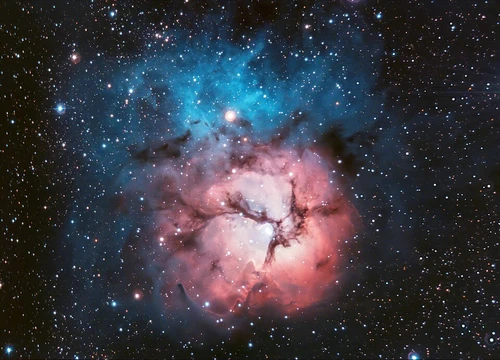
High-velocity cloud
Fast-moving gas clouds in the galactic halo.

High-velocity clouds (HVCs) are large accumulations of gas with unusually rapid motion relative to their surroundings, found throughout the galactic halo of the Milky Way and in other nearby galaxies. Their bulk velocities in the local standard of rest exceed 100 km/s, and they can be massive, some on the order of millions of solar masses, covering large portions of the sky. HVCs are important to understanding galactic evolution because they account for a large amount of baryonic matter in the galactic halo and, as they fall into the galactic disk, add material that can form stars, helping to maintain the star formation rate of the galaxy.
- Discovered
- 1963
- Typical velocity
- >100 km/s relative to local standard of rest
- Total mass in milky way
- estimates vary widely, no single authoritative value
Lore & Background
In the mid-1950s, dense pockets of gas were first discovered outside the galactic plane, contradicting models that predicted gas density decreasing with distance from the plane. In 1956, it was proposed that these pockets were stabilized by a hot, gaseous corona surrounding the Milky Way. Then, in 1963, high-velocity clouds were detected via their neutral hydrogen radio emission, traveling toward the galactic disk at very high velocities. Inspired by this discovery, Jan Oort proposed that cold gas clouds might exist far from the galactic plane. The first two clouds were named Complex A and Complex C, and were dubbed 'high-velocity clouds' to distinguish them from normal gas and slower intermediate-velocity clouds.
Reader's Guide
High-velocity clouds are significant because they represent a major reservoir of baryonic matter in the galactic halo, with an estimated total mass in the Milky Way of 7.4×10⁷ solar masses, increasing to 7×10⁸ solar masses if the Magellanic Clouds are included. Their infall into the galactic disk supplies material for star formation, helping sustain the galaxy's star formation rate. The origins of HVCs remain uncertain, with no single theory explaining all of them; some are known to be spawned by interactions between the Milky Way and satellite galaxies like the Large and Small Magellanic Clouds, producing the Magellanic Stream. Distance measurements, first achieved in the late 1990s using data from observatories including the Hubble Space Telescope, allow estimates of size, mass, and pressure. Observations of Complex C revealed that some sections have higher metallicity than the bulk, indicating mixing with other halo gas. The multi-phase structure of HVCs—cold neutral interiors surrounded by ionized gas—is evidenced by OVI absorption lines, showing interaction between cool clouds and the hot halo medium.
Did You Know?
- HVCs were first detected in 1963 via their neutral hydrogen radio emission.
- The Magellanic Stream, a string of HVCs, was discovered in the early 1970s.
- Distance to an HVC was first gauged in the late 1990s using data from the Hubble Space Telescope and other observatories.
- Complex C contains some sections with higher metallicity than the bulk, indicating mixing with other gas in the halo.
The Long Road to Detection
In the mid-1950s, astronomers made a startling discovery: dense concentrations of gas existed well beyond the galactic plane, a finding that contradicted prevailing models predicting gas density should simply fade with distance. The very survival of these pockets was puzzling, since they should have dispersed long ago. In 1956, a proposal emerged suggesting a hot gaseous corona surrounding the Milky Way might stabilize such structures. Building on this idea, Jan Oort of Leiden University hypothesized that cold gas clouds could persist in the halo. His prediction was confirmed in 1963 when neutral hydrogen radio emissions revealed two such objects, subsequently labeled Complex A and Complex C. Their unusually rapid motion relative to the local standard of rest earned them the name high-velocity clouds, setting them apart from slower intermediate-velocity clouds. The early 1970s brought further complexity with the identification of the Magellanic Stream, which behaves like an extended chain of HVCs. Systematic surveys followed: the Dwingeloo telescope completed a northern-sky neutral hydrogen survey in 1988, a nearly complete Milky Way hydrogen map emerged by 1997, and the Villa Elisa telescope in Argentina finished a southern-hemisphere survey in 2000, each campaign adding new HVCs to the catalog.
Structure, Scale, and Multi-phase Nature
HVCs represent the coldest and densest material in the galactic halo, yet they exist within a far more complex thermal environment. The halo itself spans a multi-phase structure: cold neutral hydrogen below ten thousand kelvin, warm and warm-hot gas between ten thousand and one million kelvin, and hot ionized gas exceeding one million kelvin. As cool clouds traverse this diffuse medium, the surrounding warmer gas can ionize their outer layers, producing a shell of ionized material wrapped around a neutral core. Absorption signatures of highly ionized oxygen provide direct evidence of this cool-hot interaction. In terms of scale, individual HVCs can reach masses of millions of solar masses and span broad regions of the sky. Within the Milky Way, they typically reside two to fifteen kiloparsecs from the galactic center, at heights up to ten kiloparsecs above or below the plane. The Magellanic Stream and its Leading Arm sit much farther out, roughly fifty-five kiloparsecs away, potentially stretching to one hundred to one hundred fifty kiloparsecs. Distance measurements, often derived by comparing absorption lines against known halo stars, unlock estimates of size, mass, volume density, and pressure.
Fueling the Galaxy's Star Factory
Beyond their striking velocities and vast sizes, HVCs play a critical role in the long-term evolution of galaxies. They account for a substantial reservoir of baryonic matter residing in the galactic halo, making them a key component of the mass budget that models of galaxy formation must include. When gravitational dynamics draw these clouds back toward the galactic disk, they deliver fresh gas that supplements the dilute star-forming material already present in the disk. This influx of new material helps sustain the overall star formation rate over cosmic timescales, effectively acting as a replenishment mechanism that prevents the disk from exhausting its fuel supply. HVCs are not exclusive to our own galaxy; they have been detected in the halos of other nearby galaxies as well, suggesting that this halo-to-disk gas cycle is a general feature of galactic evolution. Understanding how much mass these clouds contribute, how frequently they fall inward, and how their material mixes with existing disk gas remains central to building accurate models of how galaxies grow and maintain their populations of stars across billions of years.
Unraveling the Origins
Despite decades of study, the origins of high-velocity clouds remain one of the open questions in galactic astronomy. No single theoretical framework accounts for every HVC observed in the Milky Way, and early hypotheses that attempted to explain them have since been shown to be inaccurate. What is now established is that at least some HVCs arise from gravitational interactions between the Milky Way and its satellite galaxies. The Large and Small Magellanic Clouds, for instance, generate a prominent complex of high-velocity gas known as the Magellanic Stream, which behaves like an extended string of HVCs trailing behind the satellites. However, the diversity of observed properties, ranging from velocity to metallicity to spatial distribution, implies that multiple formation mechanisms must be at work. Observations of Complex C, for example, revealed that sections once thought to be uniformly low in heavy elements actually show higher metallicity in certain regions, indicating ongoing mixing with other halo gas. The presence of hot gas at the interface between cold and warm phases further complicates the picture, ensuring that HVCs continue to pose rich challenges for researchers seeking a unified explanation.
Frequently Asked Questions
What are high-velocity clouds?
High-velocity clouds are enormous reservoirs of cold gas drifting through the Milky Way's halo at speeds far above the local background. They can cover vast stretches of sky and represent some of the most massive gas structures residing outside the galactic disk.
How fast do high-velocity clouds move?
Measured against the local standard of rest, their bulk speeds exceed 100 km/s, which is dramatically faster than ordinary halo gas. This extreme velocity relative to their surroundings is the defining trait that gives them their name.
How much total mass do high-velocity clouds contribute to the Milky Way?
No single authoritative total-mass figure has been settled, and estimates across the literature vary widely. Individual clouds can reach millions of solar masses, making them among the heaviest known gas reservoirs in the halo.
Why are high-velocity clouds important for understanding galaxy evolution?
They hold a large share of the baryonic matter in the galactic halo and, as they eventually sink into the disk, deliver fresh material that can seed new star formation. This makes them a critical ingredient in models of how galaxies grow over cosmic time.
When were high-velocity clouds first discovered?
They were identified in 1963 through radio observations of neutral hydrogen emission against the galactic background. Their detection revealed that the halo contains far more cold, fast-moving gas than astronomers had previously expected.
More in Nebulae 1-24
Spotted an error? Know more?
Reader corrections go straight into our review queue. Suggest an edit · How this site is sourced