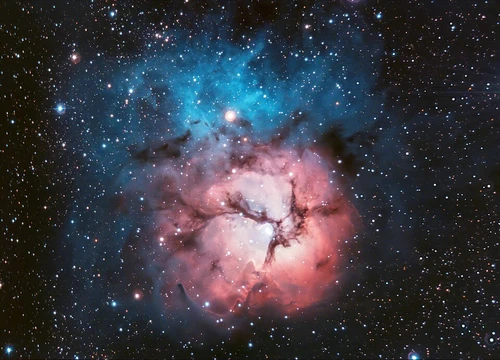
Integrated Flux Nebula
Faint nebulae illuminated by the integrated starlight of the Milky Way.

Integrated Flux Nebulae (IFN) are a relatively recently identified astronomical phenomenon, first formally recognized in 2004. Unlike typical gaseous nebulae within the plane of the Milky Way, IFNs lie at high galactic latitudes but still within the Milky Way's halo, and are illuminated not by a single star but by the integrated flux of all the stars in the Milky Way. They are incredibly faint, requiring hours of exposure to capture, and are composed of dust particles, hydrogen, carbon monoxide, and other elements. These nebulae are an important component of the interstellar medium and are particularly prominent in the direction of both the north and south celestial poles.
- Location
- high galactic latitude, within the Milky Way's halo
Lore & Background
Integrated flux nebulae were initially seen on photographic plates from the Palomar Sky Survey, appearing on 30 of the 600 plates taken. These were catalogued by B.T. Lynds and then described by Allan Sandage. Sandage and others noted the dust characteristics but were unaware of the Extended Red Emission generated by some dust particles. In the 1990s, two far infrared surveys—one from the IRAS satellite and another from the DIRBE instrument on the COBE satellite—produced separate all-sky dust maps that together revealed the full extent of the dust.
Reader's Guide
The significance of Integrated Flux Nebulae lies in their recognition as a distinct class of astronomical objects, expanding understanding of the interstellar medium beyond the galactic plane. While imaging M81 and M82 in December 2004, Steve Mandel spotted a large nebula complex surrounding both galaxies. After consulting with radio and optical astronomers, he confirmed a huge, poorly known dust complex. This led to the creation of a catalogue of integrated flux nebulae in the 'Unexplored Nebula Project,' which so far includes nine total catalogued Mandel-Wilson objects. The term 'Integrated Flux Nebula' was coined by Mandel, who defined them as high galactic latitude nebulae illuminated by the integrated flux of all Milky Way stars. Their legacy includes providing a new framework for studying faint dust structures and their role in the interstellar medium, with the vast nebula MW9 near the south celestial pole known as the South Celestial Serpent.
Did You Know?
- Integrated Flux Nebulae were first formally identified in 2004.
- The term was coined by Steve Mandel during the 'Unexplored Nebula Project.'
- They are illuminated by the integrated flux of all stars in the Milky Way, not by a single star.
- The vast nebula MW9 near the south celestial pole is commonly known as the South Celestial Serpent.
What They Are and Where They Sit
Integrated flux nebulae occupy a region of the sky that most observers associate with the void between stars. Rather than sitting within the dense plane of the Milky Way, these nebulae lie beyond the galaxy's main body, at high galactic latitudes. Their illumination is fundamentally different from that of the familiar gaseous nebulae in the galactic plane: instead of a single bright star casting light onto nearby gas, the glow comes from the combined, or integrated, flux of every star in the Milky Way shining through and off the dust. The result is an extraordinarily faint signal. Capturing even a modest image of one of these clouds demands hours of exposure on a telescope. Compositionally, an IFN is a mixture of dust particles, hydrogen, carbon monoxide, and a handful of other elements, making it a genuine component of the interstellar medium. They stand out most clearly when looking toward the north and south celestial poles. The most famous example, a vast cloud near the south celestial pole, carries the designation MW9 and is popularly called the South Celestial Serpent.
A Long, Partial History on Film and in Space
Long before the name 'integrated flux nebula' existed, traces of these clouds were already sitting in archives. Photographic plates from the Palomar Sky Survey captured nebulae on thirty of the six hundred plates in the survey. B.T. Lynds catalogued those detections, and Allan Sandage went on to describe them. Sandage and his colleagues recognized the dust characteristics of the features, yet the Extended Red Emission produced by certain dust particles escaped their attention entirely. The story picked up in the 1990s when two far-infrared space missions, IRAS and DIRBE, worked together to build a complete all-sky dust map. That map revealed the full spatial extent of the dust that would later be understood as the substrate of integrated flux nebulae. For decades, then, the raw data existed in plate archives and satellite records, waiting for someone to connect the scattered observations into a single, coherent class of object. The phenomenon was not formally identified and named until 2004.
Mandel's December 2004 Breakthrough
The modern story of integrated flux nebulae begins on a December night in 2004. Astronomer Steve Mandel was imaging the well-known galaxy pair M81 and M82 when his attention was drawn to a large nebula complex wrapping around both objects. Rather than dismissing it as a background artifact, Mandel reached out to radio and optical astronomers for a second opinion. Their confirmation was decisive: he had stumbled onto an enormous dust complex that the wider community had not properly characterized. That single observation became the seed of a new catalogue. Mandel launched what he called the Unexplored Nebula Project, a systematic effort to find, document, and classify these faint, high-latitude clouds. He also coined the term 'integrated flux nebula,' defining the class as nebulae lit not by one star but by the summed light of the entire Milky Way. To date, nine objects have been catalogued under the Mandel-Wilson designation, a small but growing roster that marks the first formal inventory of a previously overlooked corner of the sky.
The Faintness Problem and the Road Ahead
Perhaps the single most defining characteristic of an integrated flux nebula is how hard it is to see. Because the illumination is spread across the combined output of every star in the Milky Way rather than concentrated on one source, the surface brightness of these clouds is extraordinarily low. Photographers and researchers must commit hours of telescope time before a recognizable structure emerges from the noise. This faintness is the reason the Palomar plates only revealed thirty of six hundred exposures, and it is the reason the phenomenon went unnamed for decades despite the data sitting in public archives. The challenge also shapes how the objects are studied: infrared satellites such as IRAS and DIRBE proved far more effective than visible-light instruments for mapping the full dust distribution. Today, the small catalogue of nine Mandel-Wilson objects and the ongoing Unexplored Nebula Project represent the first steps toward a deeper understanding of a component of the interstellar medium that had been present in the sky all along, simply too dim for anyone to notice until the right combination of equipment and curiosity aligned.
Frequently Asked Questions
What is an Integrated Flux Nebula?
An Integrated Flux Nebula (IFN) is a type of very faint nebula first formally identified in 2004, set apart from ordinary gaseous nebulae by the fact that it is lit by the combined starlight of the entire Milky Way rather than by any single nearby star.
Where are Integrated Flux Nebulae located?
Unlike the colorful nebulae typically seen along the galactic plane, IFNs sit at high galactic latitudes, floating within the Milky Way's extended halo well above or below the main disk.
What powers the light we see from an IFN?
Rather than reflecting the glow of one bright star, these nebulae scatter the summed light of every star in our galaxy, which is precisely why they appear so extraordinarily dim to the eye.
What are Integrated Flux Nebulae made of?
Their material is a mix of fine dust grains, hydrogen gas, carbon monoxide, and a variety of other trace elements that are part of the broader interstellar medium.
Why do IFNs matter to astronomers?
Because they trace the diffuse material spread through the galactic halo, studying them helps researchers understand how the interstellar medium is distributed far from the Milky Way's dense central disk.
More in Nebulae 1-24
Spotted an error? Know more?
Reader corrections go straight into our review queue. Suggest an edit · How this site is sourced