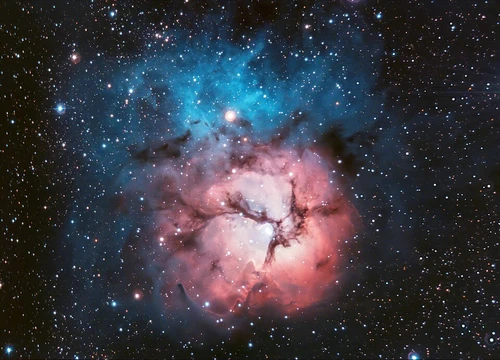
Peripheral nebular regions of the Orion Complex
Outer clouds of Orion shaped by massive stars, hosting star formation.

The peripheral nebular regions of the Orion Complex are small clouds and clumps of interstellar dust located on the outermost edges of the large nebular complex. They are scattered over an area exceeding 600 square degrees, mostly in the western part of the complex spanning Orion and Eridanus. These regions are significant because they exhibit cometary shapes shaped by stellar winds from massive stars, and they host star formation processes, including Herbig-Haro objects and young stellar objects.
- Location
- Western part of the Orion Complex, spanning Orion and Eridanus constellations
- Area
- Over 600 square degrees
- Distance range
- 150–450 parsecs from the Solar System
- Cataloged clouds
- 89 clouds associated with IRAS infrared sources
- Key objects
- LDN 1634, NGC 1788, Witch Head Nebula (IC 2118), LDN 1642
- Associated star types
- T Tauri stars, Herbig Ae/Be stars, protostars
Lore & Background
These peripheral clouds are primarily shaped by ultraviolet radiation from massive blue stars of spectral classes O and B in the Orion OB1 association. This shaping gives them a characteristic cometary appearance, with tails of dissolving gas pointing away from the stars. Similar erosive phenomena are observed in other nebulae, such as the Pillars of Creation in the Eagle Nebula. The clouds are more easily detected in long-exposure infrared images, as many are invisible to the naked eye.
Key examples include LDN 1634, the cloud closest to the Orion A region, which hosts the Herbig-Haro objects HH 240 and HH 241 with prominent bipolar jets. NGC 1788 is a reflection nebula illuminated by the star HD 293815, containing Class 0 protostars and the Herbig Ae/Be star UX Orionis, prototype of UX Orionis variables. The Witch Head Nebula (IC 2118) reflects light from Rigel and contains five T Tauri stars estimated at about 2.5 million years old.
At the outermost edge, LDN 1642 is a cold, tranquil dark nebula at high galactic latitude, one of a small number of such clouds known to host star formation. It contains two pre-main-sequence stars and the Herbig-Haro object HH 123. The distances of these peripheral clouds overlap with those of the central clouds of the complex, so it is not universally true that all peripheral clouds are closer; distances range from 150 to 450 parsecs.
Reader's Guide
The peripheral nebular regions of the Orion Complex are important for understanding how massive stars influence their surrounding environment and trigger star formation. Their cometary shapes, caused by photoevaporation from ultraviolet radiation, provide clear examples of stellar feedback. The presence of Herbig-Haro objects, protostars, and T Tauri stars in these clouds offers laboratories for studying early stellar evolution. The clouds' varying distances—from 150 to 450 parsecs—help map the three-dimensional structure of the Orion Complex. The catalog of 89 IRAS-associated clouds and the identification of young stellar objects like UX Orionis contribute to models of star formation triggered by shock waves. These regions also illustrate the interaction between molecular clouds and the Orion–Eridanus Superbubble, as seen with LDN 1642. Overall, they serve as a nearby analog for processes occurring in more distant star-forming regions.
Did You Know?
- LDN 1634 hosts the Herbig-Haro objects HH 240 and HH 241, with jets spanning 0.8 parsecs.
- The Witch Head Nebula (IC 2118) reflects light from the star Rigel and contains five T Tauri stars.
- LDN 1642 is one of a small number of high-latitude galactic clouds that host star formation processes.
The Nebula's Positional Identity Within the Hunter's Frame
The Orion Nebula holds a singular spot in the winter sky: it occupies the central position of Orion's Sword, a short descending line of three stellar points that hangs below the Belt. This makes it one of the brightest nebulae visible to the naked eye, yet it is embedded within a tightly structured asterism rather than floating in empty space. The broader hourglass pattern that frames it is built from four outer stars—Rigel, Betelgeuse, Bellatrix, and Saiph—forming a roughly rectangular outline, with the three Belt stars (Alnitak, Alnilam, and Mintaka) clustered at the geometric center. The Sword then extends downward from that central cluster, and the nebula replaces what would otherwise be a middle star. An additional eighth star, Meissa, marks the hunter's head above the shoulders. Together these elements create a compact, recognizable silhouette in which the nebula is not an afterthought but a structural joint connecting the Belt to the lower stellar line.
The Stellar Crucible Surrounding the Nebular Region
The stars that cluster around the Orion Nebula belong to a shared stellar family known as the Orion OB1 association, which encompasses both the Belt and the Sword. The dominant members of this group are luminous hot blue supergiants, giving the region a characteristic high-energy environment. Alnilam, the middle and brightest Belt star, is classified as a B-type blue supergiant situated nearly twice as far from the Sun as its Belt neighbors. Mintaka, the westernmost and northernmost Belt star, is actually a multiple system pairing a large B-type blue giant with a more massive O-type main-sequence star, and the pair form an eclipsing binary whose mutual transits produce periodic dips in brightness. Betelgeuse, the conspicuous red supergiant at the hunter's right shoulder, stands apart in color and evolutionary stage, yet it may still be a runaway member of the same OB1 group, hinting at a shared origin despite its current divergence.
Seasonal and Latitudinal Windows for Observation
The nebula and its host constellation are most prominent during the winter months of the Northern Hemisphere, roughly January through April, when they dominate the evening sky. In the tropics, where the observer sits within about eight degrees of the equator, Orion transits directly overhead at the zenith, a position that gives the nebula an unobstructed, near-meridian view. In equatorial nations such as Kenya, Indonesia, Colombia, and Ecuador, the constellation appears overhead around midnight in December and fills the evening sky in February. The situation reverses in the Southern Hemisphere's summer, when the midnight sun south of the Antarctic Circle renders the constellation invisible. Yet during the polar winter, when the Sun stays below the horizon, the brightest stars of Orion—including Rigel at merely eight degrees above the horizon at the South Pole—become visible in the bright twilight band around local noon, a fleeting and unique observing window.
Navigational Anchoring and the Constellation's Geometric Framework
Orion's structural clarity makes it a primary reference point for locating other bright stars across the sky. Extending the Belt line southeastward leads the eye to Sirius, while the same line directed northwestward points to Aldebaran. A line drawn eastward across the two shoulder stars indicates the direction of Procyon, and a line from Rigel through Betelgeuse traces toward the Gemini twins, Castor and Pollux. Rigel also participates in the Winter Circle asterism, linking it to Sirius and Procyon in a broader geometric pattern. The constellation itself spans 594 square degrees, ranking twenty-sixth among the eighty-eight modern constellations, and is bounded by a twenty-six-sided polygon established by Eugène Delporte in 1930. Its neighbors include Taurus, Eridanus, Lepus, Monoceros, and Gemini, and the International Astronomical Union assigned it the three-letter abbreviation Ori in 1922, cementing its identity within the formal sky catalog.
Frequently Asked Questions
What are the peripheral nebular regions of the Orion Complex?
They are scattered clumps and small dust clouds sitting at the outermost edges of the massive Orion nebular structure. Rather than forming one continuous sheet, these wispy regions are spread across more than 600 square degrees of sky, mostly in the western sector that stretches between the constellations Orion and Eridanus.
How far away are the peripheral nebular regions of the Orion Complex?
These outer dust clouds sit roughly 150 to 450 parsecs from our Solar System, placing them at varying depths within the broader Orion molecular cloud system. Their distance range makes them accessible to both amateur and professional telescopes for infrared and optical study.
What well-known objects belong to the peripheral regions of the Orion Complex?
Notable members include the Witch Head Nebula (IC 2118), LDN 1634, NGC 1788, and LDN 1642, among 89 cataloged clouds linked to IRAS infrared sources. Each of these small structures displays the telltale cometary tail shapes carved out by radiation and stellar winds from nearby massive stars.
Why do the peripheral nebular regions of the Orion Complex have cometary shapes?
The tails and pointed forms are sculpted by intense stellar winds and ultraviolet radiation streaming from massive young stars at the complex's core. This one-sided erosion pushes dust and gas outward, creating the familiar comet-like silhouettes visible in both infrared and visible-light imagery.
What types of young stars form in the peripheral nebular regions of the Orion Complex?
These outer clouds serve as active nurseries for protostars, T Tauri stars, and Herbig Ae/Be stars, along with associated Herbig-Haro shock objects. The ongoing gravitational collapse of gas within these small clumps means new stellar systems are still being born in the fringes of the Orion Complex today.
More in Nebulae 1-24
Spotted an error? Know more?
Reader corrections go straight into our review queue. Suggest an edit · How this site is sourced