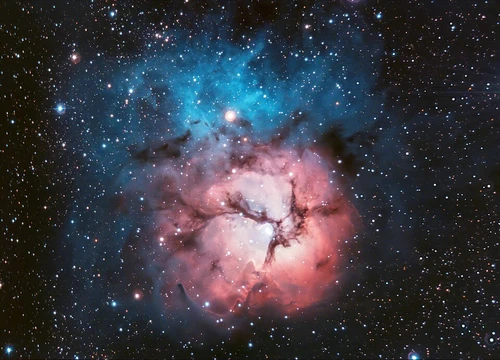
Protoplanetary nebula
Short-lived phase between AGB and planetary nebula stages.

A protoplanetary nebula (PPN) is a short-lived astronomical object that appears during the rapid evolution of an intermediate-mass star between the late asymptotic giant branch (LAGB) phase and the planetary nebula (PN) phase. It emits strongly in infrared radiation and is a type of reflection nebula, representing the second-from-last high-luminosity phase in the life cycle of stars with masses between 1 and 8 solar masses.
- Field
- Astronomy
- Type
- Astronomical object
- Phase
- Stellar evolution (intermediate-mass stars, 1–8 M☉)
- Emission
- Strong infrared radiation
- Classification
- Reflection nebula
- Precedes
- Planetary nebula (PN) phase
- Follows
- Late asymptotic giant branch (LAGB) phase
Lore & Background
The protoplanetary nebula phase begins after the star leaves the late asymptotic giant branch, when the central star's effective temperature rises due to hydrogen shell burning. During this phase, the star is still too cool to ionize the surrounding circumstellar shell ejected during the AGB phase, but it drives high-velocity, collimated winds that shape and shock the shell, producing bipolar, knotty jets and Herbig–Haro-like bow shocks. The morphology of the subsequent planetary nebula can be influenced by the PPN phase, but later stages and binary interactions also play a significant role, so the PPN phase is not considered the sole determinant.
The name 'protoplanetary nebula' is considered unfortunate because it can be confused with protoplanetary disks. To avoid this, Sahai, Sánchez Contreras & Morris (2005) suggested the term 'preplanetary nebula.' These objects are also often called post-AGB stars, though that category includes stars that will never ionize their ejected matter.
The PPN phase ends when the central star reaches about 30,000 K and becomes hot enough to ionize the circumstellar nebula, turning it into a planetary nebula. The timescale for this transition and the density threshold for planetary nebula formation are model-dependent and not part of standard established canon.
Reader's Guide
The protoplanetary nebula is significant as a critical transitional stage in the evolution of intermediate-mass stars, bridging the asymptotic giant branch and the planetary nebula phase. Its study helps astronomers understand how stellar winds shape the circumstellar environment and how planetary nebulae acquire their diverse morphologies. The PPN phase is brief—lasting less than about 10,000 years—making it a rare and valuable observational target. Observations and high-resolution imaging from 1998 to 2001 demonstrated that the rapidly evolving PPN phase ultimately shapes the morphology of the subsequent planetary nebula. The phase also raises questions about the driving mechanisms of fast winds: the 'interacting stellar winds' model of radiatively-driven winds appears insufficient to account for observed momentum and energy, leading theorists to investigate accretion disk scenarios involving binary interactions and magneto-centrifugal launching. These models, if correct, would link PPN outflows to processes seen in active galactic nuclei and young stars, highlighting the broader relevance of magneto-hydrodynamic processes in astrophysical jets.
Did You Know?
- A protoplanetary nebula emits strongly in infrared radiation and is a kind of reflection nebula.
- The name 'protoplanetary nebula' can be confused with protoplanetary disks; the alternative term 'preplanetary nebula' was suggested to avoid this.
- Observations from 1998 to 2001 suggested that the PPN phase influences the morphology of the subsequent planetary nebula, but later stages and binary interactions also play a significant role.
Position in Stellar Evolution
The protoplanetary nebula occupies a singular and transitional position in the life cycle of a star. It is not a nebula in the traditional sense of a vast cloud of gas and dust where new stars are born; rather, it is the very last chapter before the star's material is fully cast into space as a planetary nebula. In this sense, the protoplanetary nebula is a threshold object—a bridge between the dying red giant and the luminous shell that will follow. Astronomers catalog these objects as a distinct class of astronomical bodies, recognizing that they represent a specific, identifiable phase rather than a static structure. The fact that they are listed separately from planetary nebulae underscores how different the two stages appear to observers, even though they are sequential phases of the same underlying process. Understanding where the protoplanetary nebula sits in this sequence is essential for interpreting what we see when we look through a telescope at one of these brief, transitional objects.
The Slow Shedding of Stellar Material
The defining physical event of the protoplanetary nebula phase is the gradual shedding of the red giant star's outermost layers. Unlike a sudden explosion, this is a measured release of material that the star can no longer hold onto with its gravity. The star, already swollen and cooling in its red giant state, begins to push its outer envelope outward into the surrounding space. This expelled material forms the nebular structure we observe. The process is described as slow, suggesting a steady rather than violent ejection, and it involves specifically the outermost layers rather than the star's core. This distinction matters because it tells us that the star's inner structure remains intact during this phase. The material that is cast off will eventually become the visible shell of the planetary nebula, but during the protoplanetary stage, it is still in the process of being released and has not yet fully expanded into the structure that characterizes the later phase.
A Glow Borrowed from the Star
One of the most distinctive observational characteristics of a protoplanetary nebula is the source of its visible light. Unlike many other nebulae that generate their own emission through ionization or thermal processes, the protoplanetary nebula typically does not produce its own glow. Instead, it shines by reflecting the light that comes from its parent star. The expelled material acts as a kind of cosmic mirror, scattering the star's radiation back toward the observer. This means that the brightness and color of the nebula are intimately tied to the luminosity and spectral characteristics of the red giant at its center. If the star dims or changes its output, the nebula's appearance will shift accordingly. This reflective mechanism also implies that the material is not yet hot enough or sufficiently ionized to emit light on its own—a key difference from the later planetary nebula stage, where the exposed hot core ionizes the surrounding gas and produces its own characteristic emission.
A Vanishingly Brief Interlude
Perhaps the most striking fact about the protoplanetary nebula is how fleeting it is. This entire transitional phase typically lasts no more than a few thousand years, a vanishingly short interval by astronomical standards. To put that in perspective, the red giant phase that precedes it and the planetary nebula phase that follows it each span far longer periods. The protoplanetary nebula is, in effect, a brief interlude—a short window during which the star is in the act of shedding its outer layers before the material fully disperses and the next stage begins. This brevity makes these objects inherently rare to observe; at any given moment, only a small fraction of stars in a galaxy will be caught in this particular phase. The short duration also means that the structural changes happening during these few thousand years—material being expelled, the nebula taking shape, the star's surface receding—occur at a pace that is, in a sense, rapid on cosmic timescales. Observers who catch one of these objects are witnessing a process that will be over almost instantly in the grand narrative of stellar evolution.
Frequently Asked Questions
What exactly is a Protoplanetary Nebula?
A Protoplanetary Nebula is a brief transitional object that forms when an intermediate-mass star (roughly 1 to 8 times the Sun's mass) sheds its outer layers after finishing its asymptotic giant branch stage. It essentially marks the final glowing chapter before the star becomes a fully formed planetary nebula.
Where does the Protoplanetary Nebula sit in a star's life story?
It occupies the second-to-last high-luminosity stage in the evolution of intermediate-mass stars, bridging the gap between the late AGB phase and the planetary nebula phase. Think of it as the short bridge between the star's final bloating and its ultimate dispersal.
How long does a Protoplanetary Nebula phase last?
This is one of the most fleeting stages in stellar evolution, lasting only a few thousand years before the object transitions into a full planetary nebula. Its brevity is precisely what makes it so difficult for astronomers to catch in the act.
What does a Protoplanetary Nebula look like and how does it shine?
Rather than producing its own visible light, a PPN is classified as a reflection nebula that scatters and re-emits radiation, with particularly strong output in the infrared spectrum. This makes it best observed with infrared telescopes rather than optical ones.
Why do fans and astronomers care about the Protoplanetary Nebula?
Because it is such a narrow window in a star's lifecycle, catching one in the act gives researchers a rare peek at the mechanics of how intermediate-mass stars die and hand their material back to the interstellar medium. It is essentially the behind-the-scenes moment before the planetary nebula's grand finale.
More in Nebulae 1-24
Spotted an error? Know more?
Reader corrections go straight into our review queue. Suggest an edit · How this site is sourced