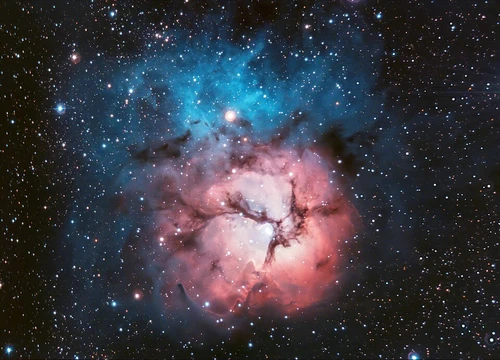
Reflection nebula
Interstellar dust clouds that reflect nearby starlight.

Reflection nebulae are clouds of interstellar dust that reflect the light of nearby stars, making the dust visible through scattering effects. They are distinct from emission nebulae, as the energy from the stars is insufficient to ionize the gas. These nebulae often appear blue due to more efficient scattering of blue light, and they can be sites of star formation.
- Type
- Astronomical object
- Discovery era
- 1912–1922
- Key researchers
- Vesto Slipher, Ejnar Hertzsprung, Edwin Hubble
- Known for
- Reflecting starlight, blue color, polarization, Hubble luminosity law
- Number known
- About 500
Lore & Background
In 1912, Vesto Slipher analyzed the spectrum of the nebula associated with the star Merope in the Pleiades and concluded that the nebula reflects light from that star. Ejnar Hertzsprung's calculations in 1913 supported this hypothesis. Edwin Hubble further distinguished between emission and reflection nebulae in 1922.
Reflection nebulae are usually blue because scattering is more efficient for blue light than red, similar to the process that gives Earth blue skies and red sunsets. They are often seen together with emission nebulae and are sometimes collectively called diffuse nebulae. Some 500 reflection nebulae are known, including a blue one near the Trifid Nebula and a yellow one surrounding the red supergiant star Antares.
In 1922, Edwin Hubble published the Hubble luminosity law for reflection nebulae, which relates the angular size of the nebula to the apparent magnitude of the associated star. The microscopic particles responsible for scattering include carbon compounds (e.g., diamond dust) and compounds of iron and nickel, which can align with the galactic magnetic field and cause slight polarization of the scattered light.
Reader's Guide
Reflection nebulae are significant in astronomy because they reveal the presence and properties of interstellar dust, which plays a key role in star formation and the evolution of galaxies. The discovery by Vesto Slipher and confirmation by Ejnar Hertzsprung established that these nebulae are not self-luminous but reflect starlight, a fundamental insight into the nature of diffuse nebulae. Edwin Hubble's 1922 classification and his luminosity law provided a quantitative tool for studying these objects, linking the apparent brightness of the illuminating star to the nebula's angular size. The blue color of most reflection nebulae, due to preferential scattering of short wavelengths, parallels the physics of Earth's sky and demonstrates universal scattering processes. The presence of carbon compounds and metals like iron and nickel in the dust, along with polarization effects, offers clues about the composition and magnetic environment of the interstellar medium. Reflection nebulae also serve as potential sites of star formation, making them important for understanding stellar birth. Their study continues to inform models of dust dynamics and radiation transfer in space.
Did You Know?
- The supergiant star Antares, which is very red, is surrounded by a large, yellow reflection nebula.
- Microscopic particles in reflection nebulae include carbon compounds such as diamond dust.
The Dominance of Diffuse Nebulae
Most nebulae in the sky belong to a single broad category: the diffuse nebulae. What sets this class apart is a defining structural trait — the absence of well-defined boundaries. Rather than presenting sharp edges or crisp outlines against the surrounding darkness, diffuse nebulae fade gradually into the interstellar medium, their gaseous material spreading without a clear demarcation line. This lack of a fixed perimeter is not a minor detail but the very criterion that places a nebula in the diffuse group. Because the majority of known nebulae share this quality, diffuse nebulae represent the dominant form of these celestial objects. Understanding this foundational characteristic is essential before one can appreciate the subtypes that fall under the diffuse umbrella, since every emission nebula and every reflection nebula inherits this boundary-less, softly graded structure as a shared trait. The diffuseness is, in effect, the common thread that unites an otherwise diverse family of luminous and reflective gas clouds.
A Taxonomy of Subtypes
Within the broad family of diffuse nebulae, astronomers recognize at least two distinct subtypes: emission nebulae and reflection nebulae. This classification acknowledges that while all diffuse nebulae share the trait of lacking well-defined boundaries, they can be further differentiated into named categories. The existence of these subtypes indicates that the diffuse category is not a monolithic group but rather a framework that accommodates different physical behaviors or appearances. Emission nebulae and reflection nebulae are presented as parallel types, each occupying its own place in the taxonomy. The fact that both are listed as types of diffuse nebulae — rather than as standalone categories — underscores that their shared diffuseness is the primary organizing principle, with the emission or reflection characteristic serving as a secondary distinguishing feature. This layered classification system allows observers and researchers to sort the nebulae they encounter into meaningful groups while acknowledging the common structural foundation they all share.
Emission and Reflection: Parallel Designations
The pairing of emission nebulae and reflection nebulae as the two named types of diffuse nebulae highlights a deliberate organizational choice in how these objects are classified. Both categories sit at the same level in the taxonomic hierarchy, each a recognized subtype under the diffuse nebula umbrella. This parallel positioning suggests that, from a structural standpoint, they are treated as equivalents — both diffuse, both lacking well-defined boundaries, both members of the same overarching family. The distinction between them lies in a secondary characteristic that differentiates one from the other, yet the primary identity of each remains that of a diffuse nebula. By grouping them together under a single heading in astronomical references, the classification system emphasizes their shared nature over their differences. This approach reflects a broader principle in astronomical taxonomy: objects are first sorted by their fundamental structural properties, and only then subdivided by more specific attributes. The result is a clean, two-branch structure beneath the diffuse category.
Place in the Broader Astronomical Record
Diffuse nebulae, including their emission and reflection subtypes, occupy a specific niche within the larger landscape of astronomical object cataloging. They are referenced in dedicated lists of nebulae, which serve as organized compilations of these gaseous celestial structures. Beyond that, they are also encompassed within the broader category of lists of astronomical objects, a classification that places nebulae alongside other types of celestial bodies and phenomena. This dual placement — in a specialized nebula list and in a general astronomical object list — reflects the layered way in which the astronomical community organizes its knowledge. A diffuse nebula is simultaneously a member of the nebula family and a data point in the wider inventory of observable objects in the universe. The existence of these cataloging structures, with their cross-references and see-also connections, ensures that researchers and enthusiasts can navigate between specific nebular classifications and the grander taxonomy of the cosmos, maintaining coherence across different levels of astronomical study.
Frequently Asked Questions
What is a reflection nebula?
A reflection nebula is a cloud of interstellar dust that becomes visible because it bounces light from a neighboring star back toward the observer. Unlike emission nebulae, the star's energy isn't strong enough to strip electrons from the gas, so the glow comes purely from scattered starlight.
Why do reflection nebulae appear blue?
The tiny dust particles scatter shorter wavelengths of light more efficiently than longer ones, giving these clouds their characteristic blue tint. This is the same physical principle that makes Earth's sky look blue.
How is a reflection nebula different from an emission nebula?
In an emission nebula, the nearby star is hot enough to ionize the surrounding hydrogen, causing the gas itself to glow. In a reflection nebula, the star lacks that ionizing power, so visibility depends entirely on dust scattering the star's light rather than the gas emitting its own.
When did astronomers first recognize reflection nebulae?
These objects were identified during the 1912–1922 period, with key contributions from researchers like Vesto Slipher, Ejnar Hertzsprung, and Edwin Hubble. Their polarization measurements helped confirm that the light was being scattered by dust rather than emitted by ionized gas.
Why are reflection nebulae important to astronomy?
They serve as natural laboratories for studying how dust scatters and polarizes light, and they can mark regions where new stars are being born. They also provided the observational groundwork for what we now call the Hubble luminosity law.
More in Nebulae 1-24
Spotted an error? Know more?
Reader corrections go straight into our review queue. Suggest an edit · How this site is sourced