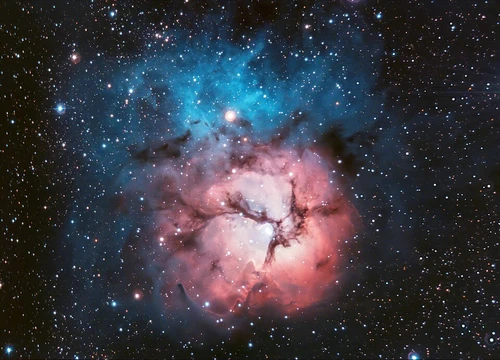
H I region
Neutral hydrogen clouds observed via 21-cm radio emission.

An H I region (pronounced "H one") is a cloud of neutral atomic hydrogen in interstellar space, also containing helium and other elements in their usual cosmic proportions. In astronomy, the Roman numeral "I" denotes neutral atoms, so H I is neutral hydrogen, while H II is ionized hydrogen. These clouds are invisible in ordinary visible light, except for certain spectral lines from elements other than hydrogen. Instead, they are detected via the 21-centimeter (1,420 MHz) radio spectral line, which has a very low transition probability, meaning large amounts of hydrogen gas are needed to observe it. Near ionization fronts, where H I regions meet expanding ionized gas like an H II region, the ionized gas glows more brightly than usual. The ionization level within an H I region is extremely low—about one particle in 10,000 is ionized. At typical interstellar pressures in galaxies like the Milky Way, H I gas is most stable at temperatures below 100 K or above several thousand K; gas between these temperatures quickly heats or cools to one of these stable regimes. Within a stable phase, the gas is usually considered isothermal, except near an expanding H II region, where a dense H I region forms, separated from undisturbed H I by a shock front and from the H II region by an ionization front.
Mapping H I emissions with radio telescopes reveals the structure of spiral galaxies and gravitational disruptions between galaxies. When galaxies collide, material is pulled into strands, showing the direction of motion. H I regions absorb photons energetic enough to ionize hydrogen (13.6 electron volts). They are widespread in the Milky Way, and the Lockman Hole is one of the few clear "windows" for observing distant objects at extreme ultraviolet and soft X-ray wavelengths.
- Field
- Astronomy
- Known for
- Neutral atomic hydrogen clouds in interstellar medium; 21-cm line emission; mapping spiral galaxy structure
- Composition
- Neutral atomic hydrogen (HI), helium, and other elements
- Typical ionization degree
- ~10⁻⁴ (one particle in 10,000)
- Stable temperature regimes
- Below 100 K or above several thousand K
Lore & Background
H I regions are clouds of neutral atomic hydrogen in the interstellar medium, also containing helium and other elements. They are not visible in ordinary light but are detected through the 21-cm spectral line at 1,420 MHz, which has a very low transition probability, requiring large amounts of hydrogen to be observed. At ionization fronts where H I regions collide with expanding ionized gas (such as an H II region), the latter glows brighter than it otherwise would. The degree of ionization in an H I region is very small, around 10⁻⁴.
Reader's Guide
H I regions are fundamental to understanding the structure and dynamics of galaxies. Mapping their 21-cm emissions with radio telescopes allows astronomers to determine the structure of spiral galaxies and to map gravitational disruptions between galaxies. When two galaxies collide, material is pulled out in strands, revealing the galaxies' motions. H I regions also absorb photons energetic enough to ionize hydrogen (13.6 eV), and the Lockman Hole is one of the few 'windows' for clear observations of distant objects at extreme ultraviolet and soft x-ray wavelengths. At typical interstellar pressures, H I regions are most stable at temperatures below 100 K or above several thousand K; gas between these temperatures heats or cools quickly to one of the stable regimes. Near an expanding H II region, a dense H I region forms, separated from undisturbed H I by a shock front and from the H II region by an ionization front.
Did You Know?
- H I regions are observed via the 21-cm (1,420 MHz) spectral line.
- H I regions are ubiquitous in the Milky Way galaxy.
Physical Composition and Thermal Behavior
An HI region is essentially a vast cloud drifting through the interstellar medium, made up primarily of neutral atomic hydrogen along with the helium and trace elements naturally present in space. The notation itself follows a long-standing astronomical convention: the Roman numeral I designates a neutral atom, II a singly-ionized one (what physicists elsewhere would call H+), and III a doubly-ionized species. Despite being called neutral, these clouds are not perfectly so—the degree of ionization hovers around one part in ten thousand, meaning roughly one hydrogen atom out of every ten thousand carries a free electron. Thermally, HI gas in environments like the Milky Way settles into one of two stable regimes: it either cools below roughly 100 kelvin or heats above several thousand kelvin. Gas caught between these two temperature bands is unstable and rapidly migrates toward one extreme or the other. Within either stable phase, the gas behaves as essentially isothermal, unless it sits close to an expanding H II region, which disturbs that equilibrium.
The 21-Centimeter Window
Because HI gas does not produce detectable visible light—apart from narrow spectral lines contributed by elements other than hydrogen—astronomers rely on a single radio-frequency signature to locate and study these clouds. The key is the 21-centimeter line, corresponding to a frequency of 1,420 megahertz, which arises from a hyperfine transition in the hydrogen atom. This transition has an extremely low probability, meaning individual atoms rarely emit at this wavelength. As a result, a radio telescope needs enormous quantities of hydrogen gas before the cumulative signal becomes detectable. This constraint actually works in astronomers' favor in one respect: HI regions are so widespread throughout the Milky Way that they form a near-continuous veil of neutral gas. That same veil, however, absorbs photons energetic enough to ionize hydrogen—photons carrying at least 13.6 electron volts—blocking extreme ultraviolet and soft X-ray light from distant sources. The Lockman Hole, a rare thin patch in this hydrogen blanket, stands out as one of the few clear windows through which astronomers can observe those otherwise obscured wavelengths.
Fronts, Shocks, and Ionized Neighbors
The boundary between a cool, neutral HI cloud and a hot, expanding H II region is one of the most dynamically interesting zones in the interstellar medium. Where the two meet, a dense shell of compressed HI gas forms, sandwiched between two distinct boundaries. On the side facing the ionized nebula, an ionization front marks the surface where energetic photons from the H II region begin stripping electrons from hydrogen atoms. On the opposite side, a shock front separates this compressed layer from the quiescent, undisturbed HI gas that fills the broader interstellar space. The interaction has a visible consequence: the H II region itself glows more brightly than it would in isolation, because the collision with the neutral cloud feeds additional energy into the ionized gas. This layered structure—shock front, dense HI shell, ionization front, then the glowing ionized nebula—provides astronomers with a natural laboratory for studying how neutral and ionized phases of interstellar gas exchange energy and momentum.
Mapping Galaxies and Tracing Collisions
Radio telescopes tuned to the 21-centimeter line have become indispensable tools for charting the architecture of spiral galaxies. By sweeping the sky and recording where and how strongly the HI signal appears, astronomers can reconstruct the distribution of neutral hydrogen across an entire galaxy, revealing spiral arms, disks, and other structural features that optical observations alone cannot fully resolve. The technique extends beyond single galaxies as well. When two galaxies pass close enough to interact gravitationally, their neutral hydrogen is stretched into long, trailing strands. Mapping the shape and orientation of these filaments allows researchers to work backward and determine the direction and nature of the gravitational encounter. In this way, HI mapping serves as both a structural survey tool and a forensic instrument, letting astronomers read the history of galactic interactions written in the distribution of cold atomic gas.
Frequently Asked Questions
What is an H I region?
An H I region is a vast cloud of neutral atomic hydrogen drifting through the interstellar medium, mixed with helium and trace elements in their natural cosmic ratios. The Roman numeral "I" simply marks the hydrogen as un-ionized, setting it apart from fully stripped H II gas.
How do astronomers actually detect H I regions?
These clouds are essentially invisible in ordinary visible light, so observers rely on the 21-centimeter radio emission line at 1,420 MHz to locate them. Because the transition probability is extremely low, enormous quantities of hydrogen must be present before the signal becomes measurable.
What's the difference between H I and H II?
H I is hydrogen that still holds its electron (the neutral state), while H II is hydrogen that has lost that electron and exists as a bare proton. In a typical H I region the ionization fraction is only about one in ten thousand, so the gas is overwhelmingly neutral.
Why are H I regions important for mapping galaxies?
Their 21-cm radio glow lets astronomers trace the distribution of neutral gas across entire spiral galaxies, revealing disk structure and rotational dynamics that visible-light observations miss. They essentially serve as the backbone map of a galaxy's interstellar medium.
What temperature ranges keep H I regions stable?
Neutral atomic hydrogen is stable in two distinct thermal regimes: very cold (below roughly 100 K) or very hot (several thousand kelvin and above). In the intermediate range the gas tends to shift toward ionized H II or molecular H₂ rather than remaining in the neutral atomic state.
More in Nebulae 1-24
Spotted an error? Know more?
Reader corrections go straight into our review queue. Suggest an edit · How this site is sourced