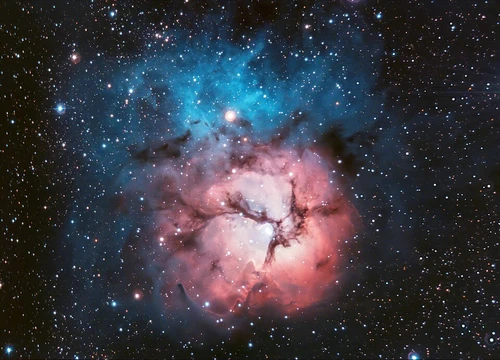
Interstellar cloud
Dense regions of interstellar gas, plasma, and dust.

An interstellar cloud is an accumulation of gas, plasma, and cosmic dust in galaxies, representing a denser-than-average region of the interstellar medium. These clouds are primarily formed from the general interstellar medium, including material from supernovae, stellar winds, and star formation remnants, and can be classified as neutral (H I region), ionized (H II region), or molecular, depending on their density, size, and temperature.
- Formation
- From the general interstellar medium, including supernovae, stellar winds, and star formation remnants
Lore & Background
Interstellar clouds are studied through the electromagnetic radiation they emit, from radio waves to gamma rays. Large radio telescopes scan specific frequencies to identify molecules, and the intensity of these frequencies reveals the chemical composition. Cold clouds emit long-wavelength radiation, while hot clouds contain ions detectable in visible and ultraviolet light. The height of frequency peaks indicates the relative abundance of each molecule or atom.
Reactions in interstellar clouds were once thought to be very slow due to low temperature and density, but organic molecules such as formaldehyde (detected in 1969), methanol (1970), and vinyl alcohol were found, suggesting faster gas-phase reactions unfamiliar to Earth-based organic chemistry, studied in the CRESU experiment. Interstellar clouds also help study metal abundances, which may reveal production methods beyond stellar fusion, such as cosmic ray spallation.
High-velocity clouds have velocities greater than 90 km s⁻¹ relative to the local standard rest, detected primarily in the 21 cm line of neutral hydrogen. They typically have lower heavy element content than normal interstellar clouds. Theories for their origin include leftover material from galaxy formation or tidally-displaced matter from other galaxies, such as the Magellanic Stream. Better distance and metallicity data are needed to determine their origins.
Reader's Guide
Interstellar clouds are significant as laboratories for studying the chemical and physical processes of the interstellar medium. Their unexpected organic molecules challenge prior assumptions about reaction rates in cold, low-density environments, suggesting that gas-phase reactions unfamiliar to Earth-based chemistry occur. This has implications for understanding the formation of complex molecules in space. High-velocity clouds offer clues to galactic evolution and interactions, potentially revealing leftover material from galaxy formation or tidal interactions with other galaxies. The study of metal abundances in these clouds also informs theories of element production beyond stellar fusion, such as cosmic ray spallation. Overall, interstellar clouds provide a window into the composition, dynamics, and history of galaxies.
Did You Know?
- Formaldehyde and methanol were detected in interstellar clouds in 1969 and 1970, respectively, well before 2001.
- The chemical composition of interstellar clouds is determined by studying electromagnetic radiation from radio waves to gamma rays.
The Architecture of Darkness
Dark nebulae owe their signature silhouette to an extraordinarily fine particulate structure. The primary agents of light extinction are dust grains measuring less than a micrometre across, each coated in a frost of frozen carbon monoxide and nitrogen. These tiny particles reside within the coldest, densest pockets of molecular clouds and are efficient at blocking photons at visible wavelengths, rendering whatever lies behind them—background stars, emission nebulae, reflection nebulae—invisible to optical observation. Yet the same clouds harbour a rich molecular inventory: molecular hydrogen, atomic helium, carbon monoxide bearing the oxygen-18 isotope, carbon monosulfide, ammonia, formaldehyde, cyclopropenylidene, and the diazenylium ion. These species remain comparatively transparent to visible light. It is the dust, not the gas, that carves the dark shapes we observe. Because the molecular and ionic components do not contribute significantly to the obscuration, the gas phase retains a chemically complex character even in regions where no starlight penetrates.
Classification, Scale, and Irregular Form
Within the taxonomy of interstellar clouds, dark nebulae—also called absorption nebulae—occupy a distinct niche defined by their extreme density. They are a particular subtype of molecular cloud, and their organization spans a wide range of scales. At the small end, isolated compact objects are classified as Bok globules, while at the large end, clusters and vast complexes of dark nebulae are associated with Giant Molecular Clouds. Together with the surrounding molecular gas, dark nebulae form the structural backbone of molecular cloud complexes. Morphologically, these objects resist tidy geometric description. They possess no clearly defined outer boundary, and their silhouettes sometimes assume convoluted, serpentine configurations. This irregularity makes each individual nebula a unique and unrepeatable pattern against the stellar backdrop, distinguishing them from the more symmetric shapes one might expect of a simple gaseous body suspended in space.
Seeing Through the Dark: Observation and Naked-Eye Visibility
The very property that makes dark nebulae striking—their capacity to extinguish background starlight—also makes them among the most challenging objects in the optical spectrum. The dust grains responsible for the extinction are effectively opaque at visible wavelengths, so the stars, emission nebulae, and reflection nebulae hidden behind them are invisible to conventional telescopes. Astronomers must therefore turn to radio and infrared techniques to peer through the obscuring material and map the structures concealed within. Despite this optical opacity, the closest and largest dark nebulae are visible to the unaided eye. Because they sit relatively near Earth, intervening stars contribute less additional dimming, and their large angular size gives them a prominent silhouette. Against the luminous band of the Milky Way, they appear as dark patches—familiar examples include the Coalsack Nebula and the Great Rift. Collectively, such naked-eye objects are sometimes termed dark cloud constellations and have accumulated a variety of names.
Stellar Nurseries: Activity in the Dense Core
Beyond their role as cosmic silhouettes, the densest interior regions of dark nebulae and their parent molecular clouds serve as the primary sites where new stars are born. The extreme cold and density that make these clouds opaque to visible light are precisely the conditions under which star formation proceeds. In these central zones, maser emission also takes place, providing astronomers with a powerful diagnostic tool for probing the physical conditions within otherwise invisible regions. The coexistence of star-formation activity and maser emission in the same dense cores underscores that dark nebulae are not inert curtains of dust but active, evolving structures. Their lifecycle, from the diffuse molecular cloud complex through the dense globule stage, represents a fundamental chapter in the ongoing cycle of galactic matter, linking the quiet, cold chemistry of the interstellar medium to the birth of new stellar objects.
Frequently Asked Questions
Who is Interstellar cloud?
An interstellar cloud is a concentrated pocket of gas, plasma, and cosmic dust that sits within a galaxy's interstellar medium. It represents a region where matter is packed more tightly than the surrounding space, making it a key structural element of galactic environments.
What are Interstellar cloud's powers/role?
These clouds serve as the raw material from which new stars and planetary systems are born, as gravity can pull their dense contents together over time. They also come in several types—neutral, ionized, or molecular—each with distinct temperatures and densities that affect how they interact with light and radiation.
Why is Interstellar cloud important?
Without these denser-than-average regions, star formation would be far less efficient, since gravity needs a concentrated mass to overcome the pressure of surrounding space. They are essentially the nurseries and building blocks of entire stellar populations within a galaxy.
How was Interstellar cloud created?
Interstellar clouds form from the general interstellar medium, gathering material shed by dying stars in supernovae, expelled through stellar winds, and left behind as remnants of earlier star-formation events. As this material accumulates and cools, it becomes dense enough to distinguish itself from the tenuous gas around it.
More in Nebulae 1-24
Spotted an error? Know more?
Reader corrections go straight into our review queue. Suggest an edit · How this site is sourced