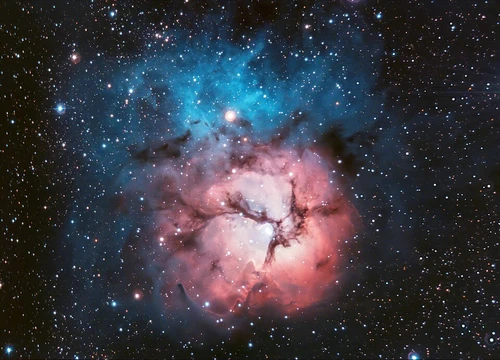
Emission nebula
Ionized gas clouds emitting light from nearby hot stars.

An emission nebula is a cloud of ionized gas that shines at different wavelengths. The energy to ionize the gas usually comes from high-energy ultraviolet light given off by a nearby hot star. There are several kinds of emission nebulae. H II regions, for example, are areas where new stars are forming, and the young, massive stars there provide the ionizing photons. Planetary nebulae are another type: in these, a dying star sheds its outer layers, and the exposed, hot core then ionizes that material.
- Type
- Astronomical object
- Composition
- About 90% hydrogen, with helium, oxygen, nitrogen, and other elements
- Primary cause
- Ionization by high-energy ultraviolet photons from hot stars
- Common color
- Red (due to Balmer series emissions)
- Notable examples
- North America Nebula, Veil Nebula, Lagoon Nebula, Orion Nebula, Carina Nebula
Lore & Background
Emission nebulae form when ionized gases emit light, typically ionized by high-energy ultraviolet photons from a nearby hot star. Young, massive stars often ionize part of the same cloud from which they were born, and entire clusters of young stars can contribute energy. Stars hotter than 25,000 K emit enough ionizing ultraviolet radiation (wavelength shorter than 91.2 nm) to make emission nebulae brighter than reflection nebulae, while cooler stars generally cannot ionize hydrogen effectively.
Reader's Guide
Emission nebulae are significant because they reveal regions of active star formation and the final stages of stellar evolution. H II regions mark areas where young, massive stars are born and ionize surrounding gas, while planetary nebulae represent dying stars that have shed their outer layers, with the hot core ionizing the expelled material. The color of an emission nebula depends on its chemical composition and degree of ionization; hydrogen's prevalence and low ionization energy cause many to appear red due to Balmer series emissions. When more energy is available, other elements ionize, producing green and blue nebulae. Astronomers study their spectra to infer chemical content. Prominent examples visible from the northern celestial hemisphere include the North America Nebula and Veil Nebula, while the southern hemisphere features the Lagoon Nebula, Orion Nebula, and Carina Nebula. Dark areas within emission nebulae result from dust clouds blocking light. Some nebulae, like the Trifid Nebula, contain both emission and reflection components.
Did You Know?
- The most common source of ionization in emission nebulae is high-energy ultraviolet photons from a nearby hot star.
- Most emission nebulae are about 90% hydrogen, with the remainder helium, oxygen, nitrogen, and other elements.
- Emission nebulae often have dark areas caused by clouds of dust that block light.
The Birth of Light: How Emission Nebulae Form
An emission nebula is, at its core, a cloud of gas that has been stripped of electrons and now glows across a range of wavelengths. The engine behind this glow is almost always a nearby star hot enough to hurl ultraviolet photons energetic enough to knock electrons free from atoms. Two dramatic life stages of stars produce these luminous clouds. In H II regions, a young, massive star—sometimes an entire cluster of them—sits embedded in the very gas cloud from which it was born and floods its surroundings with ionizing radiation. At the opposite end of stellar life, a dying star sheds its outer envelope, leaving behind a scorching core that ionizes the expelled material, creating what we call a planetary nebula. In both cases, only stars exceeding roughly 25,000 kelvin generate enough short-wavelength ultraviolet light, below 91.2 nanometers, to ionize hydrogen on a large scale. Cooler stars simply lack the energy, and their surrounding gas instead scatters starlight, producing the dimmer reflection nebulae.
Why They Glow Red — and Sometimes Green or Blue
The hue of an emission nebula is a direct fingerprint of what it is made of and how deeply its atoms have been energized. Because hydrogen dominates interstellar gas and requires relatively little energy to ionize, the most common visual signature is a deep red glow produced by the Balmer series of hydrogen emission lines. When the ionizing source is powerful enough to strip electrons from heavier elements as well, the palette expands: green and blue hues emerge as oxygen, nitrogen, and other species contribute their own spectral lines. Astronomers exploit this by capturing the full spectrum of a nebula and reading off its chemical inventory. The typical recipe is strikingly simple—roughly ninety percent hydrogen, with the remainder split among helium, oxygen, nitrogen, and trace heavier elements. The degree of ionization shifts with the energy available, meaning a nebula bathed in radiation from a hotter, more massive star will display a richer set of emission lines than one lit by a marginally cooler source.
Sky-Worthy Showcases: The Great Emission Nebulae
A handful of emission nebulae have become landmarks of the night sky, distributed across both celestial hemispheres. In the northern sky, the North America Nebula (NGC 7000) and the Veil Nebula (NGC 6960/6992), nestled in the constellation Cygnus, are among the most prominent targets for observers. Looking south, the Lagoon Nebula (M8 / NGC 6523) in Sagittarius and the famous Orion Nebula (M42) stand out as brilliant winter and summer spectacles. Even farther south, the Carina Nebula (NGC 3372) blazes as one of the brightest large nebulae visible from that hemisphere. What unites these showpieces is the presence of hot, young stars whose ultraviolet output keeps the surrounding gas perpetually ionized and luminous. Some of these objects, such as the Trifid Nebula, are not purely emission features; they blend reflection and emission components into a single visual structure, offering observers a layered portrait of how starlight interacts with gas and dust in the same region of space.
Shadows, Dust, and the Interplay of Light
No emission nebula is a uniform sheet of glowing gas. Dark patches and lanes thread through many of them, created by dense clouds of interstellar dust that absorb and block the light streaming from the ionized gas behind them. These silhouettes give nebulae their sculpted, three-dimensional appearance and remind us that the same cloud that glows also contains opaque material. The boundary between emission and reflection is not always sharp either. In many well-known objects, both processes operate side by side: gas close to the hot star is ionized and emits its own light, while dust grains farther out scatter the star's visible photons, producing a bluish reflection halo. The Trifid Nebula is a classic example where both components are visible in a single field of view. This coexistence means that what an observer sees is a composite image—emission lines from ionized hydrogen and other elements layered over scattered starlight—making each nebula a small laboratory of radiative physics written across the sky.
Frequently Asked Questions
What is an emission nebula?
An emission nebula is a cloud of ionized gas that generates its own visible light rather than merely reflecting starlight. It glows across multiple wavelengths because the gas atoms have been energized and are releasing photons as they return to lower energy states.
What actually makes emission nebulae glow?
High-energy ultraviolet photons from a nearby hot star strip electrons from the gas atoms, ionizing them. When those free electrons recombine with the nuclei, the gas emits visible light at specific wavelengths, producing the characteristic glow.
Why do emission nebulae usually look red?
Hydrogen makes up roughly 90% of the nebular gas, and its Balmer-series emissions—especially the H-alpha line—fall squarely in the red part of the spectrum. That overwhelming hydrogen signal drowns out the fainter contributions from helium, oxygen, and nitrogen.
Which emission nebulae are the most famous?
The Orion Nebula, Carina Nebula, Lagoon Nebula, Veil Nebula, and North America Nebula are all well-known examples. They span a range of scales and contexts, from active star-birthing regions to the luminous shells shed by dying stars.
How do H II regions differ from planetary nebulae?
H II regions are zones where young, massive stars are still forming and their ultraviolet output ionizes the surrounding gas. Planetary nebulae, by contrast, form when a dying star ejects its outer layers and the newly exposed hot core ionizes that expelled material—so they represent opposite ends of stellar evolution.
More in Nebulae 1-24
Spotted an error? Know more?
Reader corrections go straight into our review queue. Suggest an edit · How this site is sourced