Independence National Historical Park
Preserves Philadelphia sites central to American founding.
Last updated
Where it is
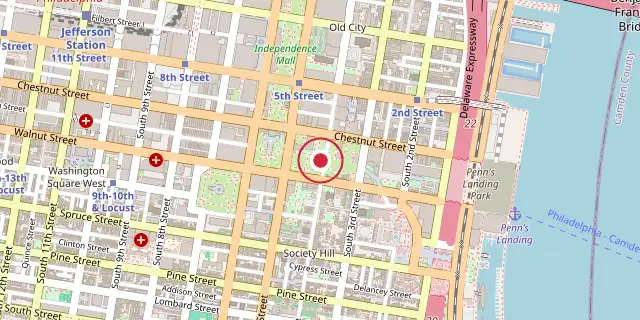
Coordinates: 39°56′53″N 75°08′53″W (39.9480, -75.1480) · Open in OpenStreetMap
Coordinates and connected clubs: the infobox of Wikipedia: Independence National Historical Park (CC BY-SA 4.0). Map: drawn by Codexery from OpenStreetMap tiles.
Independence National Historical Park is a federally protected historic district in Philadelphia, Pennsylvania, administered by the National Park Service. The 55-acre park preserves sites associated with the American Revolution and the nation's founding, including Independence Hall, where the Declaration of Independence and the U.S. Constitution were debated and adopted. It has been called "America's most historic square mile" due to its concentration of landmarks.
History
The First Continental Congress met at Carpenters' Hall in Philadelphia from September 5 to October 26, 1774, in response to the Intolerable Acts. The congress organized a boycott of British goods through the Continental Association and arranged for a Second Continental Congress. After the Battles of Lexington and Concord, the Second Continental Congress assembled at the Pennsylvania State House on May 10, 1775. It adopted the Olive Branch Petition in July 1775, affirming loyalty to Britain, but King George III rejected it and issued the Proclamation of Rebellion.
In February 1776, news arrived that Parliament had passed the Prohibitory Act, blockading American ports. On June 11, the Second Continental Congress appointed the Committee of Five—John Adams, Benjamin Franklin, Thomas Jefferson, Robert R. Livingston, and Roger Sherman—to draft a declaration of independence. Congress unanimously adopted the final version on July 4, marking the formation of the United States. The Old State House Bell, now known as the Liberty Bell, is believed to have been rung on July 8 for the Declaration's reading.
After 1781, the government operated under the Articles of Confederation, which gave the federal government little power. The Annapolis Convention of September 1786 called for a broader meeting in Philadelphia, leading to the Philadelphia Convention from May 14 to September 17, 1787, at the Pennsylvania State House.
Park history
The area’s importance faded after City Hall moved west, but it stayed a busy commercial hub. In 1915, architects Albert Kelsey and D. Knickerbacker Boyd suggested clearing the half-block in front of Independence Hall to improve its appearance, lower fire risks, and ease traffic. Support for a park grew during the 1920s and 1930s, boosted by patriotic feelings around the 1926 Sesqui-Centennial. World War II then increased urgency to safeguard national landmarks.
Congress authorized the park through Public Law 795 on June 28, 1948, and it officially opened on July 4, 1956. The Old Philadelphia Customs House, also called the Second Bank of the United States, was added on March 16, 1959; it had been a national historic site since May 26, 1939. The park entered the National Register of Historic Places on October 15, 1966. In 1973, Pennsylvania’s legislature gave the three blocks of Independence Mall to the federal government.
Independence Hall became a UNESCO World Heritage Site on October 24, 1979. The U.S. Custom House houses the Federal Bureau of Prisons Northeast Region Office.
Management
The National Park Service, a federal agency within the Department of the Interior, maintains and preserves the park. In fiscal year 2003, the NPS spent about $30.7 million on the park, with personnel and benefit costs representing about 41 percent of expenditures and non-recurring construction and investment projects about 25 percent. The Independence Visitor Center is operated jointly by the park and the Independence Visitor Center Corporation, a nonprofit.
The NPS employs 247 permanent and seven seasonal employees. The park's cultural resource management program protects historic buildings, archaeological sites, cultural landscapes, and approximately 1.5 million artifacts. Major projects in 2003 focused on repair and rehabilitation of buildings and grounds.
Independence Mall
Independence Mall is the central three-block stretch of Independence National Historical Park, sitting just north of Independence Hall and framed by Chestnut, Race, 5th, and 6th Streets. On the northernmost block stands the National Constitution Center. The middle block houses the Independence Visitor Center and the Free Quaker Meetinghouse. The southern block contains the President's House Memorial and the Liberty Bell Center.
Beneath much of the middle block lies a multi-level underground parking garage, and a small open-air café opened on its east side in 2008. The southern block also has public restrooms and Peoples' Plaza, a designated First Amendment Area. A sculpture of Benjamin Franklin's Join, or Die cartoon marks the spot where the official United States Semiquincentennial time capsule was buried in 2026, set to be opened in 2276. Surrounding the mall are Congress Hall, Independence Hall, and Old City Hall to the south; the Philadelphia Bourse, the National Museum of American Jewish History, Christ Church Burial Ground, and the Philadelphia Mint to the east; the approach to the Benjamin Franklin Bridge to the north; and WHYY-TV, the Federal Reserve Bank of Philadelphia, the James A. Byrne Federal Courthouse, and the Rohm & Haas Building to the west.
Conception
The idea for a park around Independence Hall took root with the Historic Sites Act of 1935. Architect Roy F. Larson first proposed the concept for Independence Mall in 1937, envisioning a five-block corridor from Chestnut to Callowhill Streets. The Independence Hall Association and its president, Judge Edwin O. Lewis, strongly supported the plan. In 1947, Lewis pushed for the federal government to buy the three blocks north of Independence Hall, but the National Park Service only wanted the first block.
So Lewis took the three-block mall idea to the Pennsylvania General Assembly, which built it as a state park and a memorial to Pennsylvanians who died in World War II—though that memorial concept was never fully carried out.
Frequently Asked Questions
Where is Independence National Historical Park?
Independence National Historical Park is located in 143 S. 3rd Street, Philadelphia, Pennsylvania, U.S.
Who designed Independence National Historical Park?
Independence National Historical Park was designed by William Strickland and et al.
More in National Historical Parks of the United States
Sources
Compiled from Wikipedia and the sources listed below. Text from Wikipedia is available under CC BY-SA 4.0; this entry is adapted from it.
- Wikipedia: Independence National Historical Park (CC BY-SA 4.0).
Spotted an error? Know more?
Reader corrections go straight into our review queue. Suggest an edit · How this site is sourced