Lowell National Historical Park
Preserves the planned industrial city of the Industrial Revolution.
Last updated
Where it is
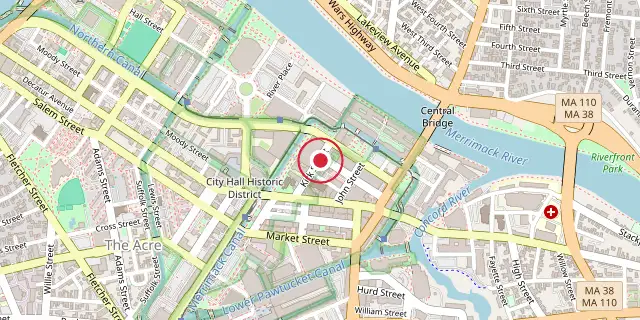
Coordinates: 42°38′49″N 71°18′36″W (42.6470, -71.3100) · Open in OpenStreetMap
Coordinates and connected clubs: the infobox of Wikipedia: Lowell National Historical Park (CC BY-SA 4.0). Map: drawn by Codexery from OpenStreetMap tiles.
This U.S. National Historical Park in Lowell, Massachusetts, was created in 1978 and is managed by the National Park Service. It features several sites tied to the city’s textile manufacturing history during the Industrial Revolution. In 2019, the park was chosen to represent Massachusetts on the America the Beautiful Quarters series.
History
First settled by Europeans in the 17th century, East Chelmsford (later renamed Lowell in honor of the founders' deceased business partner) became an important manufacturing center along the Merrimack River in the early 1820s. The Middlesex Canal, completed in 1803, linked the Merrimack to the Charles River, and the powerful 32-foot Pawtucket Falls provided water power. The existing Pawtucket Canal, built for transportation around the falls, became the feeder canal for a 5.6-mile system of power canals.
Unlike many mill towns, Lowell's manufacturing facilities were built on a planned community design, a reaction to cramped British mill communities. This was called the "Lowell Experiment," aiming to combine production efficiency with democratic morals and social structure. Factories initially had ample green space and clean dormitories, anticipating later architectural trends like the City Beautiful movement. Lowell attracted immigrants and migrants, including many young women known as Lowell mill girls.
Legislative history of Lowell
Lowell National Historical Park was established by the Lowell Establishment Act in 1978 due to the significance of its cultural and historical sites and structures, which symbolized aspects of the Industrial Revolution. Lowell is represented as the most significant planned industrialized city in the United States. The immigration of different ethnic groups during the late nineteenth and early twentieth century was represented in Lowell's neighborhoods, and preserving the area would maintain those representations.
Although the city had a large budget for cultural and historical preservation, federal assistance was needed to ensure all necessary early buildings and structures were preserved. The extra protection and funding by the federal government would allow preservation of these lands and sharing of the history with present and future generations. In 2012, the Lowell National Historical Park Land Exchange Act of 2012 was added to allow land within park boundaries to be exchanged with land owned by the Commonwealth of Massachusetts, the city of Lowell, or the University of Massachusetts building authority. The park is an originally established park and did not replace a previously established site.
Park information
Notable features include the Boott Cotton Mill and Museum, the Francis Gate, Pawtucket Dam and Gatehouse, Suffolk Mill Turbine and Powerhouse, Kirk Street Agents House, Mill Girls and Immigrants Boardinghouse, the Lowell Canal System, Swamp Locks, Lower Locks, Guard Locks, Merrimack River and Northern Canal Walkway, the Worthen House, the National Streetcar Museum with associated trolley service, and Boarding House Park hosting the Lowell Folk Festival and Lowell Summer Music Series.
The park has a visitor center with a free self-guided tour, including display exhibits such as the patent model of a loom by local inventor S. Thomas. A footpath along the Merrimack Canal is lined with plaques describing the importance of various sites. The Boott Mills, on the Eastern Canal, is the most fully restored manufacturing site, offering a walk-through museum with living recreations of 19th-century textile manufacturing. The walking tour includes a detour to a memorial to local author Jack Kerouac.
A walkway along the river leads to unrestored mill sites and canal raceways. The park also includes the Patrick J Mogan Cultural Center focusing on immigrants' lives, a working streetcar line, canal boat tours exploring gatehouses and locks, and the River Transformed / Suffolk Mill Turbine Exhibit showing how water power and the Francis Turbine ran the factories.
More in National Historical Parks of the United States
Sources
Compiled from Wikipedia and the sources listed below. Text from Wikipedia is available under CC BY-SA 4.0; this entry is adapted from it.
- Wikipedia: Lowell National Historical Park (CC BY-SA 4.0).
Spotted an error? Know more?
Reader corrections go straight into our review queue. Suggest an edit · How this site is sourced