Kalaupapa National Historical Park
Preserving the historic Hansen's disease settlements on Molokai.
Last updated
Where it is
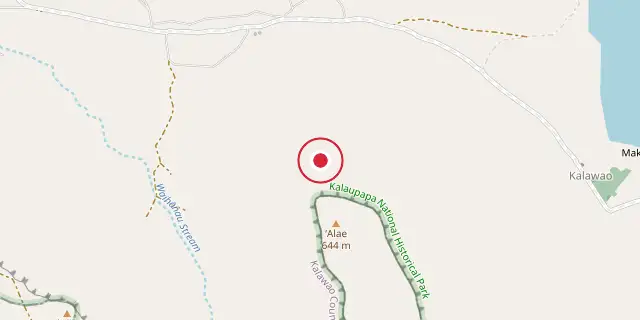
Coordinates: 21°10′41″N 156°57′36″W (21.1780, -156.9600) · Open in OpenStreetMap
Coordinates and connected clubs: the infobox of Wikipedia: Kalaupapa National Historical Park (CC BY-SA 4.0). Map: drawn by Codexery from OpenStreetMap tiles.
Kalaupapa National Historical Park is a United States National Historical Park on the island of Molokai, Hawaii, nearly coterminous with Kalawao County. The park is administered by the National Park Service and is accessible to the general public only through guided tours, which resumed in September 2025 after a pandemic suspension.
History of Kalaupapa peninsula
Archaeological evidence indicates indigenous peoples inhabited the peninsula for more than 900 years before European contact, leaving house sites, cultivated taro fields, irrigation systems, stone walls, and temples (heiau). Historical accounts from the early to mid-1800s describe populations of 1,000 to 2,700 people living on the peninsula, in the valleys, and in villages, but by 1853 only about 140 remained after epidemics of Eurasian diseases.
In 1865 the Kingdom legislature passed a law to prevent transmission of leprosy, now known as Hansen's disease, which had been introduced to the islands around 1830 by foreign workers and was then incurable. Sugar planters pressured the government due to concerns about the labor supply. The government removed Native Hawaiian inhabitants from Kalaupapa to develop it as an isolation settlement for persons with severe leprosy, cutting off centuries-old cultural ties and associations with the āina (land).
Patients were brought first to Kalawao and then to Kalaupapa, causing broader dislocations across Hawaiian society; many families were affected and sometimes divided when a member contracted leprosy. The governments of the Kingdom, Territory, and State of Hawaii tried to control the disease by relocating patients with severe symptoms to the isolated peninsula, while others were treated in quarantine on the main islands. The settlements were administered by the Board of Health, with local financial control held by Rudolph Meyer, a German immigrant who worked for the Molokaʻi Ranch.
Local supervision for decades was by superintendents of Hawaiian and part-Hawaiian ancestry, some appointed from among the patients or family members of persons with leprosy.
Representation in popular culture
Belgian missionary-priest Father Damien, after receiving a high award from the Kingdom of Hawaii, drew considerable publicity to the leper colony in the late 19th century, and his story was recounted in popular culture and literature. Robert Louis Stevenson, suffering from tuberculosis, visited the Molokai leper colony after Father Damien's death in 1889 and described the settlement as a "prison fortified by nature," cut off by 2,000-foot-high mountains.
He published a 6,000-word open letter praising Damien's work and was inspired by Mother Marianne and the girls of the Bishop Home, teaching them croquet, sending a piano, and writing a poem. Jack London visited in 1908 and wrote the short stories "Lepers of Molokai" and "Koolau the Leper," as well as describing his visit in his sailing memoir The Cruise of the Snark (1911). Cecil B. DeMille's 1923 version of The Ten Commandments features a woman who escapes from a Molokai leprosy colony.
James Michener's 1959 novel Hawaii describes life in the colony in the difficult early times. The 1999 movie Molokai, with Peter O'Toole and Kris Kristofferson, features the life of Father Damien. Alan Brennert's 2003 novel Molokaʻi recounts history through the eyes of fictional character Rachel Kalama. The colony was used as a location for a Hawaii Five-0 episode.
Park description
Kalaupapa National Historical Park was created in 1980 to protect the sites of the former Hansen's disease settlements at Kalawao and Kalaupapa. A small number of elderly former patients, some of whom were disfigured before being cured, still live in the Kalaupapa community and have recounted their life and hardships there. On the windward side of the peninsula, Kalawao retains the Protestant Siloama church, founded in 1866, and Saint Philomena Catholic Church, linked to Saint Father Damien.
More in National Historical Parks of the United States
Sources
Compiled from Wikipedia and the sources listed below. Text from Wikipedia is available under CC BY-SA 4.0; this entry is adapted from it.
- Wikipedia: Kalaupapa National Historical Park (CC BY-SA 4.0).
Spotted an error? Know more?
Reader corrections go straight into our review queue. Suggest an edit · How this site is sourced